
Searching for Earthlike Worlds
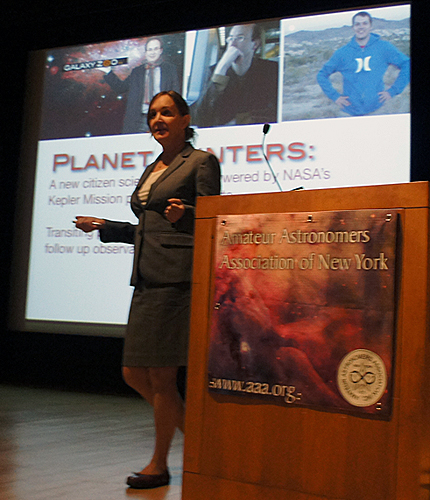
Today’s post is a guest post by Tony Hoffman. He’s a fellow Planet Hunter and is also one of our Planet Hunters Talk moderators. Today he’s writing about the public talk Planet Hunters PI Debra Fischer gave at the Amateur Astronomers Association of New York.
On March 30, Planet Hunters’ own Debra Fischer, professor of astronomy at Yale University, gave a talk on “Searching for Earthlike Worlds” for my astronomy club, the Amateur Astronomers Association of New York, at the American Museum of Natural History’s Kaufmann Theater. The talk was both informative and inspirational, expanded my perspective on the science of exoplanetology, and left my head spinning with the discovery possibilities that the next decades may have in store.
Dr. Fischer covered 6 broad topic areas in her talk: our place in space in time; exoplanet discovery techniques; the importance of finding many Earthlike worlds; how do we know if a planet is “habitable” enough; how our solar system compares with others we’ve found; and astronomy as a vision plan for life on Earth.
Our Place in Space and Time
Debra started with our own solar system, describing the (now) 8 planets and other bodies, and how Earth is the only habitable world among them, and then quickly zoomed out, with the Sun as one of billions of stars in our galaxy, and the Milky Way one of billions of galaxies. “We’re such a tiny speck in a vast universe,” she said.
As to our place in time, she evoked Carl Sagan’s cosmic calendar, a measuring stick in which the age of the universe is compressed into a single year, to try to put the time scale of the universe in human terms. In it, the Big Bang occurred as the New Year began, and we’re waiting just as the clock is about to tick over into a new year. In this scenario the Milky Way formed in May, the Sun and its planets in August. The dinosaurs arose on December 25 and went extinct on December 30. All of human history would have taken place in the last hour or so. Fischer marveled at the human ability to study and comprehend the universe around us, and wondered what humanity might be able to accomplish if we were to have the same species longevity as the dinosaurs.
She then related a brief history of exoplanetology, describing how before the discovery of 51 Pegasi in 1995, some early planet hunters despaired of finding planets and wondered if we were alone. When 51 Peg was discovered, using the radial velocity or wobble technique (which Fischer uses in her own research), many scientists were incredulous that there could be a Jupiter-sized world orbiting its star in only 4 days—how did it survive, and how was it formed? (We now know that it formed much farther out and migrated there.)
The Birth of Planet Hunters
Debra then discussed the transit method and the Kepler project, singling out Kepler-11—the 6-planet system whose small worlds were confirmed by transit timing variations: some of the transits appeared earlier or later than expected, enabling the Kepler team to calculate the mass of the planets based on their effect on each other. She also discussed “Tatooine,” the Saturn-sized world orbiting a double star.
She related how Planet Hunters began. “We were very excited about the Kepler mission at Yale,” she said. “Kevin Schwainski, an Einstein fellow at Yale, would stand in the hallway, and every morning when I’d walk in he’d say, ‘So Debra, what can we do for planet hunters? There has to be something we can do with exoplanets. People love exoplanets.’”
“I’d sort of look at him and say “Nothing I can think of.” Then in the summer of 2010, I sent my grad students and postdocs to a Sagan summer school where they looked at the Kepler data. The way that they were studying the data was inspiring. They’d take one light curve and puzzle over it. I realized that the computer algorithms to solve these systems weren’t terribly robust, and maybe we could start a new citizen science project where we’d serve up the Kepler light curves.”
She, Meg Schwamb, and others at Yale got in touch with Chris Lintott and the Oxford team running the Zooniverse, and the result is the Planet Hunters site, with which she notes the public has found exoplanets that “…fell through the cracks in the Kepler data.” Our work here has also helped the Kepler project fine-tune its search algorithms.
Another exoplanet discovery technique she mentioned is direct imaging. So far, mostly using the Keck telescope, astronomers have imaged a couple of dozen gas giants at relatively large separations from their stars. Fischer thinks that’s just the beginning, though. “We want to be at the point some day when we can take a photograph of a star, null out the light from the star, and see those pale blue dots, orbiting.”
Hundreds of Earth
Projects like Kepler and HARPS have been detecting smaller, rocky worlds, some in or near their star’s habitable zone. In order to eventually find life-bearing worlds, it’s important that we find a large sample of potentially habitable worlds. “We want to find hundreds of Earths,” she said.
Suppose we find a super-Earth that’s 10 Earth masses. How would we know if it might be habitable? “It’s tricky because the composition of a planet can vary wildly,” says Fischer.”You really want to have the mass of the planet as well as its size, so you can start to figure out whether it’s a planet like the Earth, which has a layer of molten iron, which convects turbulently and spawns a magnetic field that protects us from the solar wind, or is it something like a super-Earth that has a heavy iron and rock mantle, that may be convecting very actively, or is it in fact a water world?”
Water is one of the most common elements in the universe, and if you have a planet in the habitable zone, it’s going to have liquid water. But water doesn’t guarantee habitability. “A lot of astronomers right now are a little bit worried,” she continued. “If you don’t have an active world with plate tectonics that shoves the land up into mountains, and has the water pooling at lower levels, you’ll just end up with a planet that’s covered with a whole skin of water. Will we be able to find life on those kinds of worlds? I think the answer is yes, but it’s probably not going to be a SETI kind of life. Electronics and water usually don’t mix very well.”
She has been very involved in increasing the sensitivity of spectrographs in the Yale Doppler Diagnostic Facility, an instrumentation lab where she works with 3 post-docs, to be able to detect smaller rocky worlds. “We don’t want to build spectrographs the way they’ve always been built. We’re trying to think outside the box. How low can we go? As we increase the resolution of the spectrograph and control all of our systematic errors, we think we can get down to something like 2, 5, 10 cm/second (instead of meters per second).”
Debra is in charge of a project that uses CHIRON, a spectrometer her team developed, to search for low-mass, rocky planets around Alpha Centauri A and B, the nearest star system to Earth. If planets are found there, she thinks that eventually humans will send space probes there—not spaceships filled with humans, but nanotechnology-inspired micro-ships more like cell phones, which can take pictures and “phone home”.
In the next decade, Fischer expects spectroscopy to be a powerful tool in helping to determine the potential habitability of the worlds we find, as astronomers look for the chemical signatures they associate with life. “What you’re going to see in the next decade is transmission spectra from transiting planets,” said Fischer. “The planet’s light also disappears when it passes behind the star. By dividing out the starlight, you can see the spectrum of the planet.”
Fischer also noted that the science is changing, borrowing and learning from other disciplines.”Exoplanet discoveries used to happen in isolation,” she said,” but now we’re partnering with biologists working to understand origins of life on our planet, and geologists, who are helping us to understand the geological processes that spawn magnetic fields, that store water, sequester water, on planets.”
How Our Solar System Stacks Up
We’ve found hundreds of planets, thousands of candidates. Most of the planets are multiple-planet systems. How many of the systems look like ours?
Statistical analysis of Kepler data indicates that there are ~1.6 planets per star (a lower limit). Around 1% of stars will have hot Jupiters, and that occurrence rate goes up if the star has more heavy elements and if the star is bigger. For Earths and super-Earths, occurrence rate is greater than 30 percent, probably 45 or 50 percent. Also, planets are prone to migrate away from the location they formed, just as 51 Peg B migrated in to a 4-day orbit. Theoreticians are convinced that planets move around all the time. In fact, there’s evidence that asteroids and comets scattered in a configuration that only makes sense if Uranus and Neptune were once between Jupiter and Saturn, and then went spiraling outward into wider orbits.
Astronomy as a Vision Plan for Earth
Fischer ended the talk by revisiting the dinosaurs, and what we as a species might be able to accomplish if we’re able to survive. “The dinosaurs were munching along as the asteroids were flying over their heads,” she said. “They had no idea. Of all the species that have existed, we are, I think, magnificent, because we are willing to look out and try to understand our place, our origin, our history, our fate. We’re the first species to be able to consider engineering solutions to some of the big threats. A lot of people say, this doesn’t seem important to me, let’s take all of that huge NASA budget—which is something like a half penny on the dollar—and use it to feed people. If you’re a business manager, you have to think about the day-to-day running of your business, but to be really successful—to be a Steve Jobs, a Bill Gates—you also need to have vision. That’s where I think astronomy plays a key role. We have vision—we’re looking out, and looking back, and understanding ourselves better for that.”
Dwarf Novae
We have a guest post from Martin Still. Martin is Deputy Science Team Lead and Guest Observer Office Director for Kepler. He’s writing today to tell you about an interesting class of objects you might encounter when classifying Kepler light curves


Kepler Gets an Extended Mission
The NASA Senior Review panel decisions are in. The panel assessed Kepler and several other astrophysics missions including Hubble Space Telescope, Chandra X-ray Observatory, Spitzer Space Telescope, XMM-Newton, Swift, Planck, Fermi Gamma Ray Telescope,and Suzaku. This is to evaluate the missions and decide if they should be renewed or approved for an extended mission. For Kepler, having launched in March 2009, the spacecraft is over 3 years old. The primary mission was to last 3.5 years with the goal to find and constrain the frequency of rocky planets and in particular Earth-sized planets in the habitable zone (the region around the star where liquid water could exist on a planet with an atmosphere similar to the Earth’s) of solar-type stars.
Kepler has been a spectacular success finding a treasure trove of over 2000 planet candidates in the first 16 months of data (Quarters 1-6), and revolutionized our understanding of planetary systems. But the Earth-sized planets are proving tricky because stars are much more variable than the Sun. This was unexpected,so instead of taking 3 years to confidently identify Earth-sized and smaller planets it will take 3 more years beyond the nominal mission. For NASA missions, you’re given the time you request when the mission gets selected to do your primary science goals and then can ask for additional funding for an extended mission. The Kepler spacecraft is in excellent health, with the only major failure being the loss of once of their science modules in Quarter 4. There is plenty of fuel to keep Kepler alive and pointed well beyond 2016, so Kepler team applied as did the other missions for funding to extend the mission another four years.
A NASA panel reviewed the mission, and the excellent news is that Kepler was approved for a 4 year extension! They also recommended to extend all of the missions it assessed which is excellent for the astronomy community. You can read the entire report here. Congratulations to the Kepler team for the success of their program and thanks for the excellent data that we’ve been finding planets and other interesting things in with Planet Hunters. This is great news! So this means Kepler will be running an additional 4 years – so a total of ~7 years of data. This means we can probe planets out at even further distances. This will be particularly interesting because we have been finding these very compact multiplanet systems (some having more several planets on orbits smaller than Mercury’s), so I’m curious to see how many multiplanet systems that have planets at distances beyond an 1 AU exist.
So what does this mean for Planet Hunters? First off it’s mean we’ll have plenty of light curves to look at for a long while with the potential to find even more interesting things and planets awaiting discovery. But what’s going to change come November, is the there is no proprietary data anymore. Currently the Kepler scientists have a first crack at the data before it is released to the rest of the scientific community and the public. Kepler is currently observing Quarter 13 but we have only up to Quarter 6 data. In Novemeber this all changes – they’ll be another big data release in July 28 (Quarters 7,8, and 9 will be released) and the next on October 28 (Quarters 10, 11, 12, and 13 will be released) . After that once the data comes off the Kepler spacecraft and is processed by the data processing algorithms the data will be released to the public and the Kepler team at the same time and we’ll be showing the light curves as fast as we can get them on the site.
This is a new era for the exoplanet community. I can’t wait for November, it’s going to be a great couple of years for Kepler and Planet Hunters if the past year has been any indication of the interesting science we’ll be able to do. In the meantime, there’s still lots of light curves to search through before the next data release and we’re starting to look for new planet candidates in those classifications from Quarters 3, 4, and 5 as well as take follow-up observations of our highest priority candidates (more on that in next the few blog posts). So keep those clicks coming.
 Planet Hunters