
Planet Hunters TESS Mobile: swipe right for planets
It has been an extremely exciting year for Planter Hunters TESS and we have identified multiple potential new planetary systems. Due to the success of the project, we have decided to expand by bringing PHT to your mobile device!

To date, all of the data that we have looked at have been from the targeted bright, nearby stars that TESS observes every 2-minutes. However, in addition to these targeted stars TESS monitors the brightness of millions of other stars, both bright and faint, recording their brightness every 30-minutes. These stars are found in what are known as TESS’s Full Frame Images (or FFIs), and the time has come for us to start looking for planets there.
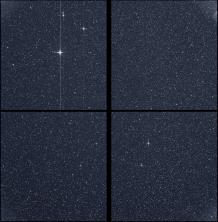
Example TESS Full Frame Images. Photo credit NASA/MIT
Due to the huge number of stars contained within these Full Frame Images, we decided to first analyse the data using a computer algorithm. This code, which was developed by Chelsea Huang at MIT pre-selects the best lightcurves for us to look at in more detail.
The automated search has two parts. First, it runs searched for periodic signals using an algorithm called Box Least Squares (BLS). This algorithm ‘folds’ the lightcurve at various trial orbital periods. If a trial period corresponds to the orbital period of an existing planet in the system the dips cause by a transiting object will overlap, suggesting the existence of a possible planet. The second part of the search uses machine learning, to look at the lightcurves that pass the BLS search, in order to assess whether the periodic signal could be the result of a transiting planet.
For many lightcurves the code is extremely good at identifying the good planet candidates without any human vetting. However, there are also a huge number of marginal cases where the machines are unsure as to whether there is a planetary signal present or not, and it is these cases that we need your help on.

Examples of GOOD planet candidate as seen in on the app
The images that we show on the site have been folded at the orbital periods determined by the BLS search so that multiple dips should overlap with one another. We are showing the odd and the even (alternating) dips in red and white. This is because any difference in odd and even transit depth and shape is a tell-tale sign of the dips being the result of two stars of different sizes orbiting around one another in an eclipsing binary. Please discard these lightcurves on the app by swiping left or pressing the ‘discard’ button on your screen.
In this project we are also want to pay close attention to the shape of the dips. Transits due to eclipsing binaries tend to be very V-shaped, whereas transits due to planets are more U-shaped or have a flat bottom so look out for these!

Examples of BAD candidates. Many of these are Eclipsing Binaries or dips caused by systematics
See what you can find by downloading the Zooniverse app onto your mobile and looking for the Planet Hunters TESS project.
We hope you enjoy this new version of Planet Hunters TESS and can’t wait to see what kind of systems we can find!
Happy Birthday PHT!
It has been exactly a year since the first public TESS data release and the launch of Planet Hunters TESS! Thank you to everyone who has taken part and helped us classify all of the data so far. It has been a truly exciting year!

- A sparkly PHT cake!
Since 6 December 2018, PHT has had over 14 thousand registered (and many more thousand unregistered) participants, and together you have completed almost 11 million classifications! Together, you have helped us find some exciting new planetary systems.
For example, your participation and dedication to the project over the past year have led to the detection and validation of the first PHT planet, TOI-813. TOI-813 is not only the longest period planet found in the TESS data to date, it is also in orbit around a subgiant star. Subgiant stars are stars in the later stages of their lives, meaning that studying these planets will help us understand the synergies between planetary and stellar evolution in the later stages of the stars life, in other words, it may help us understand what will happen to the Earth in the far far future.
But TOI-813 isn’t the only planet that PHT has found so far. You have brought many interesting targets to our attention and we are working hard to test whether these promising signals are indeed caused by planetary bodies. The targets that pass all of our initial vetting tests are being followed up using ground-based telescopes and we hope to validate them in the near future. This will allow us to contribute to the ever-growing population of known planets and bring us one step closer to findings a planet like Earth.
Here are some of the ones that we’re particularly excited about:


These are only some of the candidates that are currently being actively followed up using telescopes found across the globe, including Chile, France, Australia and the USA. We will be sharing the results of our findings soon!
In addition to the exciting planets that are being found by the project, we have also come across lightcurves of some puzzling stars. These are often brought to our attention via the talk discussion boards and I would like to thank you everyone for using this tool to post and highlight interesting signals and patterns in lightcurves there. Here are some of the ones that we haven’t been able to explain.
There appear to be more dips here than we would expect for a simple eclipsing binary?

This one appears to be two binaries, but could they be locked together making this a quadruple?

This is a beautifully long eclipsing binary!

Thank you so much for your participation over the past year! Here at Zooniverse we are celebrating Planet Hunter TESS’s first birthday with a sparkly cake!

Some of the Planet Hunters TESS team!
 Planet Hunters