
W-shaped dips in M-dwarf lightcurves
Planet Hunters TESS users have identified two very interesting lightcurves of M-dwarf stars that show repeating patterns that are difficult to explain with well-known astrophysical phenomena such as star spots, eclipsing binaries or stellar pulsations.

Phase folded lightcurves of two M-dwarf stars as observed by TESS.
Both of these lightcurves exhibit two dips, a shallow one and a deeper one, which could be explained as the primary and secondary eclipses of an eclipsing binary. However, in addition to these ‘eclipses’, we can also see a w-shaped dip after or after the deeper eclipse. Both lightcurves repeat with a period of less than 1 day and the patterns remain stable over the course of the available TESS observations, as shown in the phase folded figure below. The target stars are both M-dwarfs, with temperatures of around 3000 K and radii of around 0.3 Solar radii.
Similar lightcurves had previously been seen in the Kepler data, see Stauffer et al. 2017 (https://iopscience.iop.org/article/10.3847/1538-3881/aa5eb9/pdf) for more detail. This paper suggests that the pattern could be caused by clouds of dust orbiting around one of the stars. Could that also explain the w-shaped dips in the TESS data, or are we seeing an entirely different phenomenon here?
In order to study these systems in more detail we want to see if we can identify more of them in the TESS data.
If you see any of these please tag a member of the researcher team or use the hashtag #wstars to help us find and study these elusive systems.
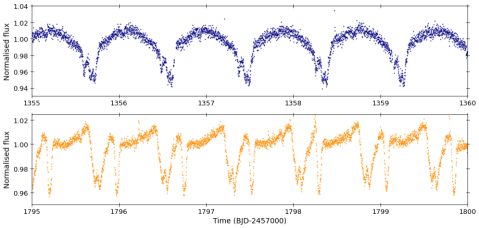
Sections of the full TESS lightcurves of the M-dwarf stars.
A circumbinary Planet from TESS, with the help of Planet Hunters TESS
A new paper released this week and accepted by the Astronomical Journal (https://arxiv.org/abs/2004.07783) announced the discovery of TOI-1338, a planet in an eclipsing binary system. An eclipsing binary consists of two stars in orbit around each other, and this new planet orbits both stars. The paper was led by Veselin Kostov and his team at NASA’s Goddard Space Flight Center and elsewhere, but they were first tipped off to the presence of this interesting system by reading comments on Planet Hunters Talk. Several citizen scientists appear as authors on the paper – congratulations to everyone involved!
This isn’t the first time Planet Hunters have found a circumbinary system – PH1b, discovered way back in 2014, was found in Kepler data by volunteers, and is still the only planet known in a four-star system.

Light curve of the week: EB
Many stars are not alone, but instead form part of a multi-stellar system of two or more stars that are gravitationally bound together. Even though the prime science goal of TESS is to find exoplanets, it also observes a plethora of eclipsing binaries that allow us to study these systems in more detail.
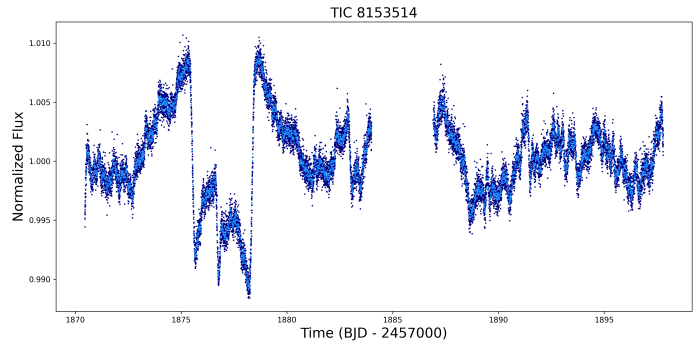
The light curve of TIC 8153514, observed in Sector 21, shows a sharp eclipse superimposed on top of the signal of a variable star.
If you see eclipsing binaries on PHT you can tag it with #EB or #eclipsingbinary to let others known what you have found!
 Planet Hunters