
A week in the life of an observer
Last month I had the privilege of observing at the Telescopio Nazionale Galileo (TNG) at the Roque de los Muchachos Observatory on La Palma. It’s convenient that often the conditions required for excellent observations are the same as what you’d look for in a warm holiday destination, although when you’re working night shifts there isn’t much time for sunbathing. Located at an altitude of 2,370 metres on the edge of La Caldera de Taburiente, the TNG is home to five instruments: SiFAP2, Nics, Dolores, GIANO-B and HARPS-N. We primarily used the HARPS-N instrument, or to give it its full name: the High Accuracy Radial velocity Planet Searcher for the North hemisphere, because astronomers love an acronym. This instrument is designed to measure the radial velocity signal of stars. This is a technique that essentially detects how much a star is “wobbling,” from which we can determine the minimum mass of any orbiting body (if it’s low enough, then we have a planet!).
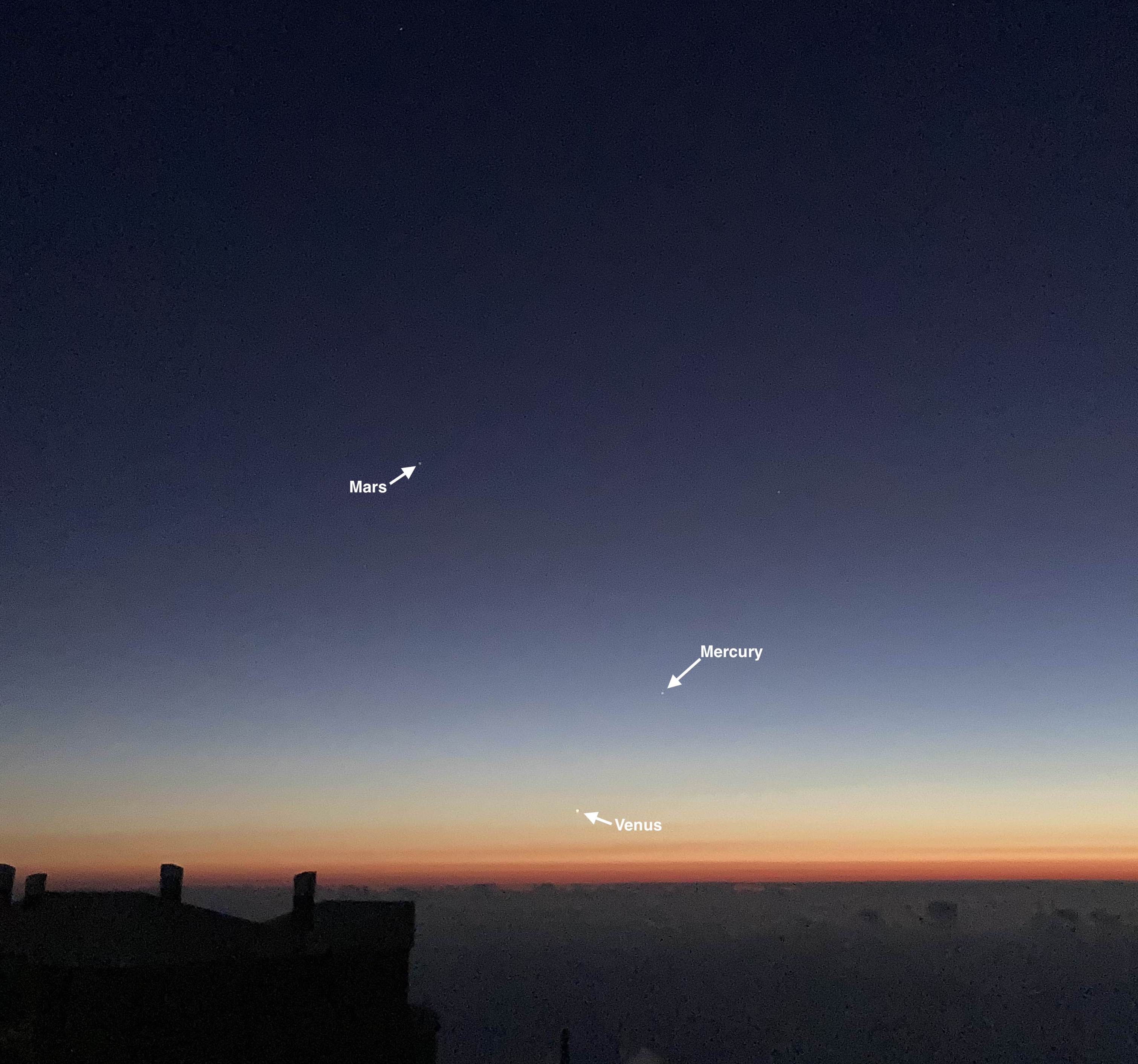
With no direct flights between Belfast and La Palma, we had to make a brief stopover in Tenerife before arriving in La Palma the following morning. A quick taxi ride up the mountain road and we reached the Residencia which would be our home for the next 9 days. Our observing run didn’t start until the next night which meant we had plenty of time to watch the sunset. The images below show the three other terrestrial planets in our Solar System with Venus shining bright near the horizon, Mercury (a rare sighting!) a short distance up and right of Venus, and Mars a bit further away up and to the left. Since my phone camera isn’t quite as good as a 3.58-metre, world-class telescope, I’ve annotated the image so you can be sure that those aren’t just smudges on your screen.
The typical “day” when on an observing run (in Summer, when the nights are short!) is as follows: Wake up around 3:30pm, grab a quick breakfast and head up to the telescope at 5pm to start calibrations and schedule the target list. Depending how quick we get calibrations done, we have some time to kill before eating dinner as late as possible then heading back up to the telescope for sunset (which for us is around 9pm). After watching the Sun dip below the horizon, we head into the telescope control room to review the schedule for the night, check the weather forecast to make sure there aren’t any pesky clouds inbound and, if needed, look for backup targets that can be observed in poor weather. We start scientific observations at the end of nautical twilight, which is when the horizon is no longer visible (so-called as this is the period when sailors could navigate using bright guide stars while still having sight of the horizon). Assuming the weather is clear and the telescope doesn’t have any technical faults, observing a set list of targets is quite straightforward and we continue to observe until the end of nautical night which is around 6:30am. After filling out the night report detailing what we observed and any issues that may have occurred, we head back down to the Residencia and get to bed around 7am to get as much sleep as possible before starting the same routine all over again.
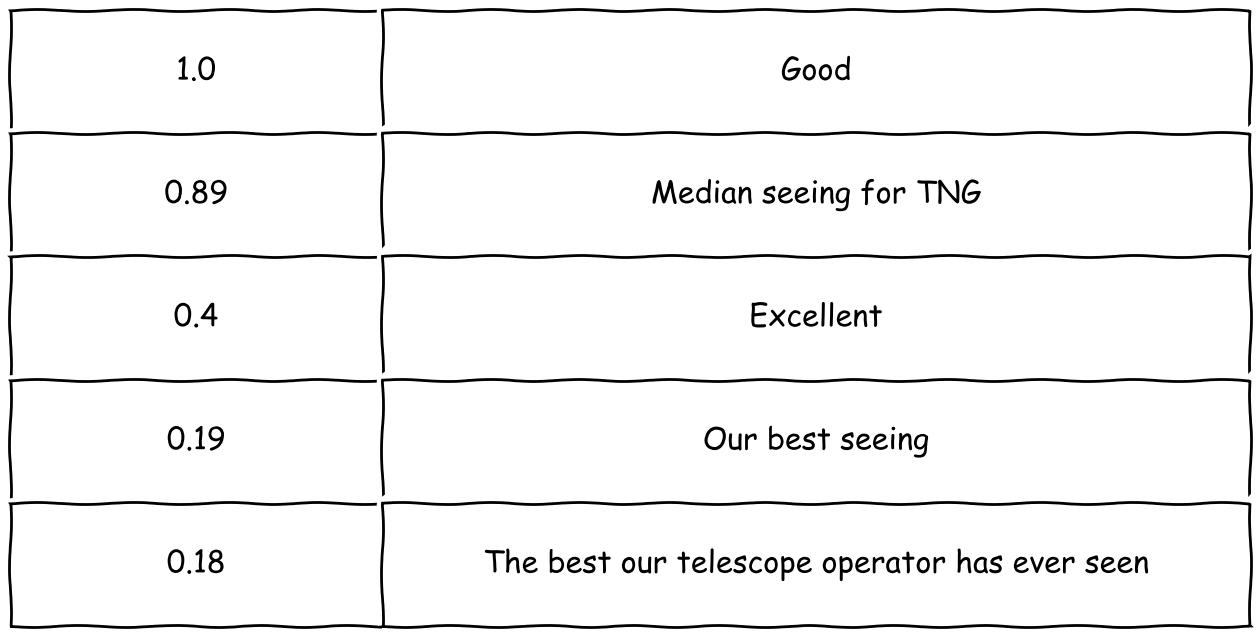
Our first three nights of observing went pretty smoothly, with remarkably good conditions on night two. The seeing (a measure of how good your image quality is due to turbulence in the atmosphere) reached 0.19 arcseconds! I’ve provided a cartoon below to put into context how good the conditions were:
We passed some of the time getting other work done (as best we could when adjusting to a night shift) but mostly we played card games while checking that the observations were still on track. During our free time in the day, we took the opportunity to go up to the summit of the Roque de los Muchachos, which provides stunning views into the caldera (the remnants of a huge volcano crater) and across the island of La Palma. In the distance we could see the site of the 2021 Cumbre Vieja volcanic eruption which is still smoking to this day.

The fourth night of our observing run marked the midway point, and the weather had taken a comparative turn for the worse with high-level cloud rolling in throughout the night, disrupting our observations and leaving us to chase targets that were in any gaps we could spot. These conditions are more typical of an observing run, with variable conditions and time lost waiting for clouds to pass, so it was a useful experience to learn how to react when the weather won’t play nice.
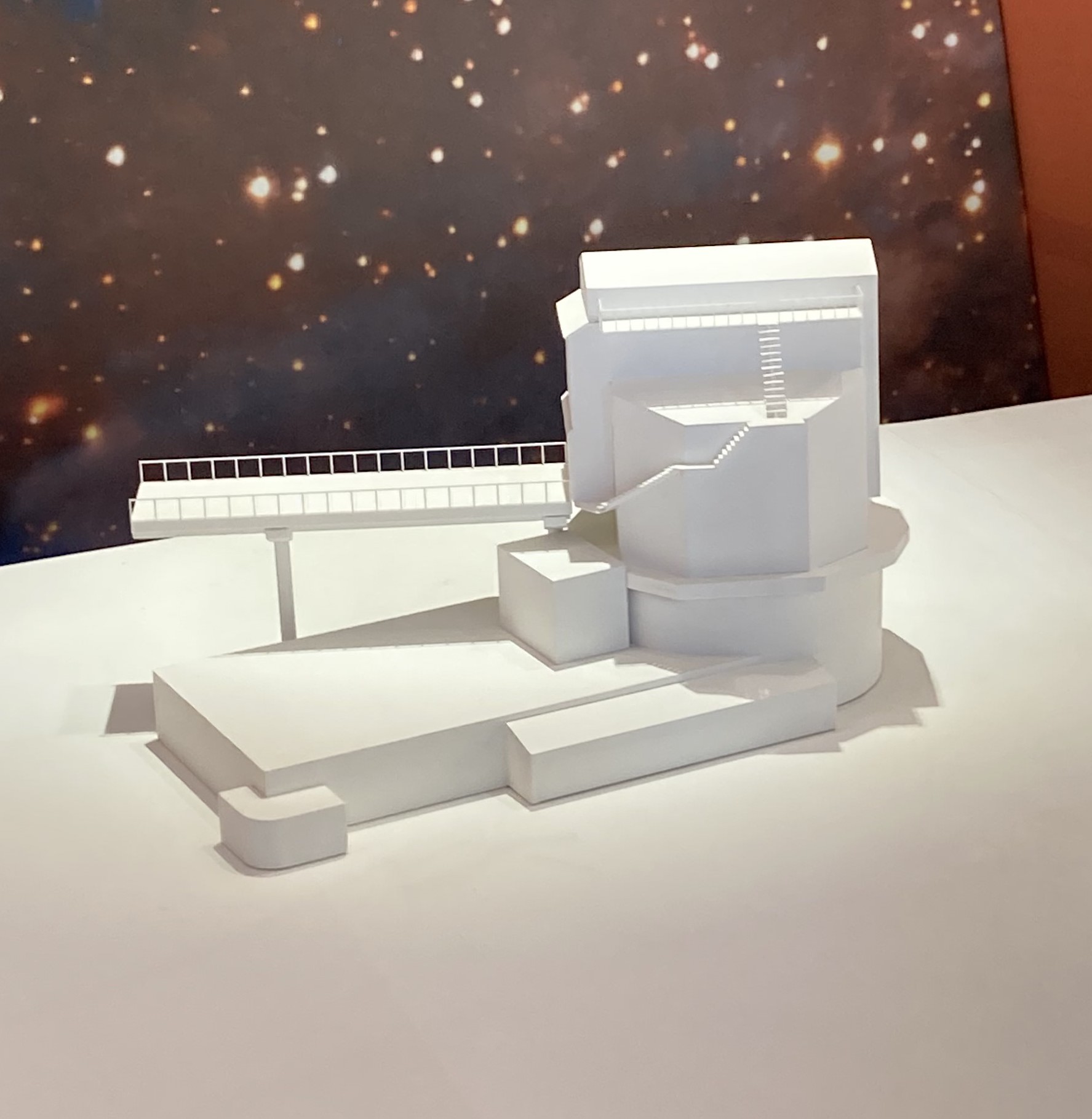

The forecast for night 5 looked as though it could go the same way as the previous night, but luckily the clouds kept dissipating before they reached us. The final two nights of the observing run also went smoothly which gives me the opportunity to talk a bit about the interesting history of the TNG’s design. The TNG’s design is derived from that of the New Technology Telescope (NTT) which is located at La Silla Observatory in Chile. As the name suggests, the NTT pioneered many of the technologies which are widespread on many of the best telescopes today. It implemented active optics, where the mirrors are adjusted during observations in order to correct for atmospheric effects and preserve the image quality. Most large telescopes have historically been built with spherical domes whereas the NTT and TNG use an octagonal enclosure which is designed to reduce turbulence due to air passing over/through the telescope structure which again results in a better image quality. These technological advancements have been applied to, most notably, the Very Large Telescope (VLT) at Paranal Observatory in Chile (just a few kilometres away from NGTS!).
Finally, I’d like to thank the Royal Astronomical Society who kindly provided financial support to help me go on this trip. I had an amazing time and learned a lot about how astronomical observations are actually done, which will no doubt be a useful skill in my future career as an astronomer.


 Planet Hunters