
Status of the PH1 Paper
We had submitted the PH1 paper to the Astrophysical Journal about a month ago and released the submitted draft on the public arXiv.org archive. What happened at that point is the paper was assigned an editor from the Journal. The editor selects a referee, a scientist in the field and one of our scientific peers, to read and critique the paper. We call this the peer review process. It may not be perfect, but the process is supposed to help ensure the quality of the science published. The referee has a different perspective than the authors and collaborators of the paper, and that new perspective can in many cases help improve a paper. In most cases, the referee has about a month to read the paper and write up a report assessing whether the paper is worthy of publication with comments and critiques on points and issues the referee believes should be addressed or included in the paper.
Last night, I received the email from the Journal with the referee’s report for the PH1 paper. The referee thinks the work does merit publication but has raised some good points and has questions that he or she would like to be addressed. Now our task is to respond to the referee’s feedback, concerns, and suggestions. We’ll make some revisions to the paper based on the input from the referee’s report, and resubmit to the Journal the paper and a formal response highlighting the changes we made and addressing specifically each point raised by the referee. This will take probably a few weeks for us to complete. Once resubmitted, the referee will receive our response and revised draft and have another chance to comment and critique. We’ll find out in another several weeks what the referee thinks of the revised draft. We’ll keep you updated on our progress.
The Kepler Extended Mission

Image Credit: NASA/Kepler Team
Today marks the successful end of Kepler‘s primary mission. Kepler has revolutionized the field of exoplanets. Kepler has facilitated the discovery of over 2,000 planet candidates, nearly quadrupling the inventory of known exoplanets. Kepler has transformed our understanding of planetary systems by finding the first Earth-sized planets. the first habitable zone planet, the first confirmed circumbinary planet (planet orbiting both stars in a stellar binary), and a wealth of multiple planet systems.
NASA has granted another four years of science operations for Kepler up to 2016 (and hopefully longer with an extended-extended mission depending on spacecraft health,funding, etc). Today marks the transition to the extended mission. The Planet Hunters science team is very excited that the exquisite Kepler data will continue to come for several more years. The lightcurves are such a rich dataset with many buried gems (like PH1) awaiting discovery. With so many eyeballs staring at the data we’re bound to find more in the extended mission.
The extended mission also marks a change in the data policy. Before there was a proprietary period where the scientists who helped bring Kepler to fruition had exclusive access to the data for many months to allow them first access to the science and then after that time the data is released to the community for use by anyone. Now in the extended mission there will be no proprietary period. All the data will be made public by the Kepler team and shared once the observations are downloaded from the spacecraft and processed through the data reduction pipelines to make the Kepler light curves. Another change in the extended mission will be how candidate transit events are released by the Kepler team. All events detected by the automated routines utilized by the Kepler team will be announced online as they are detected at the NExScI Exoplanet Archive. Their status will be vetted in close to live time and shared with the community to encourage and foster follow-up and further analysis.
In the coming year, you’ll see changes to the site as we adapt and change in the extended mission. We’re looking forward to what the Kepler extended mission brings. All of the hard work and time that you all put into Planet Hunters has made it a success in the primary mission. We can’t wait to see what is waiting in the light curves for the Planet Hunters community to find in this next phase.
Growing Planets Around Binary Stars
Today we have a guest post from Stefano Meschiari. Stefano is a postdoctoral researcher at the University of Texas at Austin. He works on planet formation in binary environments and planet detection through radial velocities and transits. He developed the Systemic software as a tool for scientists and citizens to analyze radial velocity data. His hobbies include cooking, clumsy puppeteering and all things pop culture. You can read more about his research here
The discovery of PH1, together with all the other circumbinary planets identified by Kepler, provides theorists with an incredibly important clue on how planets form in binary environments. The clue is that these planets, rather than being mere sci-fi tropes, are actually detected in Nature! Their existance is all the more remarkable when we consider that all the planets detected so far (including PH1) orbit rather close to the central binary; so close, in fact, that they almost straddle the region of dynamical instability (inside which a planet would eventually be either ejected or collide with one of the stars). The fact that these planets successfully formed and survived to be observed by us indicates that the process of planet formation must either be very robust to the dynamical perturbations from the central binary (if the planet formed near its current location), or have happened in a less disturbed region (with subsequent migration to the current location).

Planet formation in tight binaries has long been the subject of a number of studies in the scientific literature; indeed, both our closest neighbor, Alpha Centauri, and the system hosting one of the first detected planets (with a tentative detection dating back to 1988!), Gamma Cephei, are examples of tight binaries where planet formation is significantly hindered. The discovery of the first circumbinary planet, Kepler-16, reignited interest in the topic, and I (together with a number of other teams) have been performing numerical simulations that model planet formation, in an attempt to better understand the physical processes at play.
Binary systems represent a stringent test for planet formation theories, since the environment can be highly disturbed by the presence of multiple stellar components. Computer simulations show that the planetesimal stage is the most vulnerable to disruption, becoming a “bottleneck”. This bottleneck is primarily caused by the interplay between the gravitational perturbations of the binary (which raise the eccentricities of planetesimals) and the aerodynamic drag from a protoplanetary gas disk (which acts to misalign the planetesimal orbits). The latter misalignment raises the velocities at which planetesimals collide, such that instead of growing into larger objects, they get destroyed. The reason why the alignment of the orbits is crucial is easy to understand: imagine the collision between two cars on two contiguous lanes, versus that of two cars colliding at an angle. The latter collision will be much more violent, as there will be an additional velocity component perpendicular to the motion of either cars. The end result is that, in the simplest models, planet formation can only proceed far enough from the central binary (in the case of Kepler-16, outside 4 AUs).
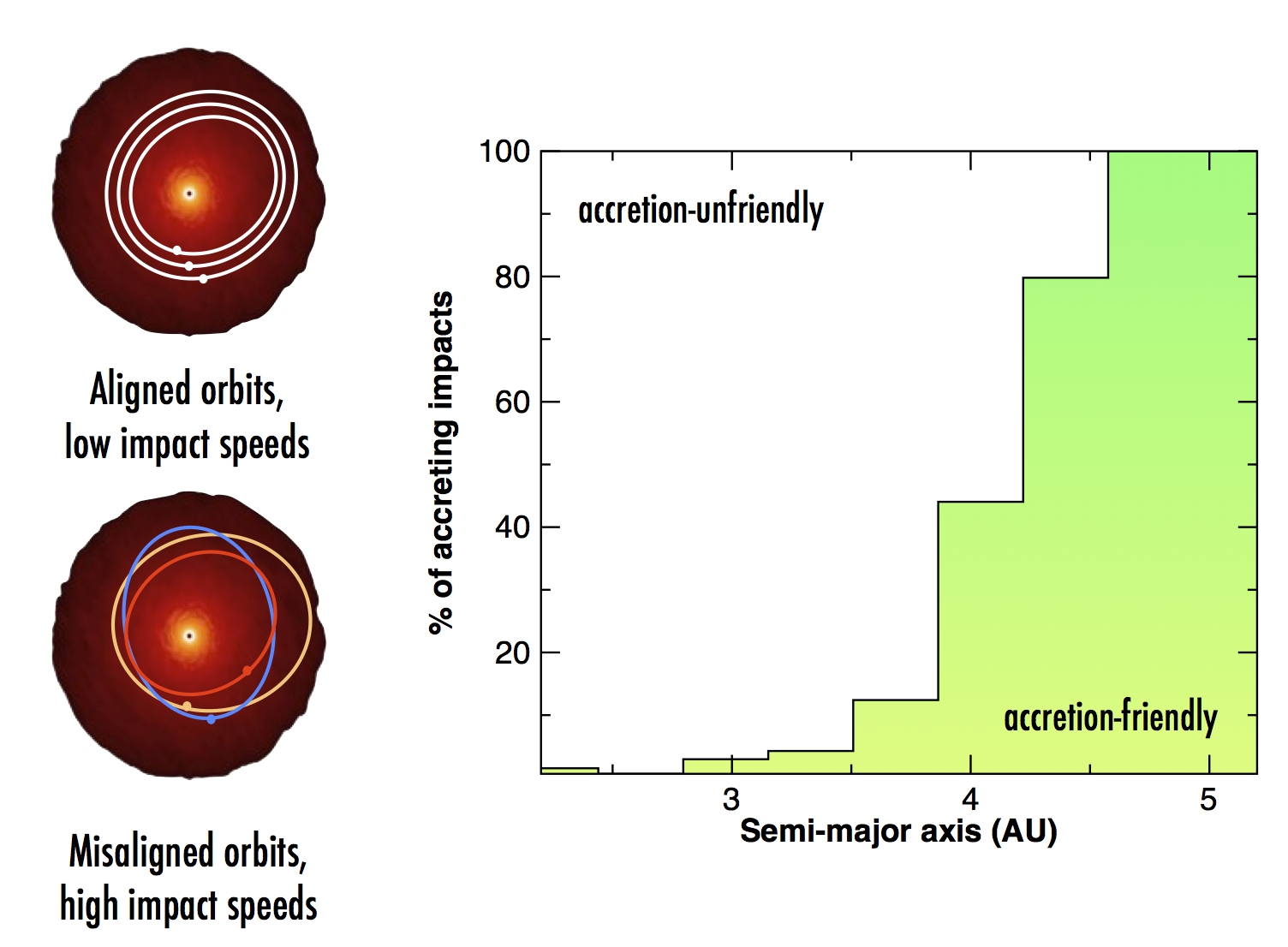
The implication is that circumbinary planets might only be able to form far enough from the central binary (how “far” depends on the properties of the central binary), and subsequently migrate to their current observed location. This picture, while attractive, might be too simplistic to capture the full complexity of planet formation in this environment. More realistic models will need to include a number of physical ingredients (such as the dynamical evolution of the gas disk), which are usually neglected for the sake of computational expediency but could potentially play a big role in determining how and where circumbinary planets were formed. For instance, my models indicate that even small perturbations from turbulence in the disk can make the disk hostile to planet formation by perturbing planetesimal alignment. Comprehensive (and computationally expensive!) simulations of planet formation in the binary environment are still ongoing: they might reveal further roadblocks, or uncover “sweet spots” in the range of physical parameters where planet formation can proceed. As the census of circumbinary planets continues to grow thanks to the efforts of scientists and volunteers, it will provide a larger sample of planets to inform and constrain our models.
Flatter than a Pancake
Today we have a guest post from Julia Fang. Julia is an astronomer and grad student at UCLA working with Jean-Luc Margot. She works on the dynamics of multi-body systems, ranging from multi-satellite asteroids in the Solar System to extrasolar multi-planet systems. Recently she’s been using Kepler data to constrain the architecture of planetary systems. In her free time, she enjoys watching hockey, doing public outreach, and posting about planetary news on Twitter
By figuring out the architecture of planetary systems, such as the alignment or misalignment of planetary orbits, we can provide important constraints on planet formation and evolution models. For example, well-aligned planetary systems (like the Solar System) are consistent with a standard formation model of planets forming in a protoplanetary disk. Planetary systems with misaligned or inclined orbits can be indicative of past events that increased their inclinations. As a result, information on the alignment or misalignment of planetary systems can reveal clues to important planet formation and evolution processes.

Recently, Jean-Luc Margot and I used the latest planet candidate catalog released by the Kepler team to perform a statistical analysis of the inclinations of planetary systems. To do so, we created artificial planetary systems, simulated observations of them by the Kepler spacecraft, and compared their properties with the actual Kepler planet detections. Our best-fitting models showed that most inclinations of planets are less than 3 degrees — implying a high degree of coplanarity! Such alignment is also consistent with planetary orbits in the Solar System, with the exception of Mercury.

To put these inclinations into perspective, Jean-Luc made a batch of pancakes and (ignoring the first and last pancakes as outliers) measured an average thickness and an average radius of the pancakes. This corresponded to inclinations of six degrees. Crepes, on the other hand, were too thin. Consequently, the best mental image for the geometry of planetary systems (with inclinations less than 3 degrees) is somewhere between that of a crepe and that of a pancake.

The Road to Characterizing PH1: Stellar Evolution Models
Today we have a guest post from Willie Torres. Willie is an astronomer the Harvard-Smithsonian Center for Astrophysics (Cambridge, MA), and member of the Kepler team. His work for Kepler includes the statistical “validation” of transiting planet candidates that cannot be confirmed in the usual way, that is, by measuring their mass and showing that it is small enough to be a planet. He also works on determining fundamental parameters of stars in eclipsing or astrometric binaries, for testing models of stellar evolution.
Transiting circumbinary planets are interesting because they show us that planets can form in environments that are very different from our Solar System. Instead of being a single star, the central object is actually a pair of stars orbiting each other, and in these systems the planet can occasionally pass in front of one or even both stars, producing transit signals. For circumbinary planets such as those the Kepler Mission has announced (Kepler-16, Kepler-34, Kepler-35, Kepler-38, and most recently Kepler-47), the orbit of the two stars is such that they eclipse each other periodically, and these typically deep eclipses are what calls attention to them in the first place, in the light curves produced by Kepler. The neat thing about these transiting circumbinary systems is that they can also provide a wealth of information about the stars that is normally not available in regular transiting planet systems with a single host star. Two important stellar properties one can often measure are the masses and radii, from knowledge of the orbit of the stars around each other.
Masses and radii can of course also be determined in favorable eclipsing systems that don’t have planets, but when there is a transiting circumbinary planet, it’s even better. This is not hard to understand: as the planet passes in front of one or both stars, it is actually chasing a moving target because the two stars are revolving around each other. Each time the planet transits, the stars are in a different place in their orbit. This means that by measuring the precise times of these transits, we are actually mapping the orbit of the binary in a different way than would normally be done for a regular eclipsing binary. This provides extra information about the motion of the stars, and in particular it constrains the ratio of the masses between the two stars very well. It also helps to determine their sizes. Combining this with additional observations such as radial velocities measured from spectra of one or both stars, their masses and radii can be measured to high precision.
Astronomers care about the masses and radii of stars because these measurements allow them to test their models of how stars form and evolve. Theorists have come up with a fairly detailed prescription for how a star of a given mass and chemical composition changes its properties (radius, temperature, luminosity, etc.) as time goes by. But without real observations against which to check those predictions, we can’t be sure they’re right. This is important because astronomers often use those same models to infer properties of single stars that are much more difficult to measure directly. Or they may be interested in knowing the age of a star, which also relies on theoretical models. As it turns out, observations have shown that models for low mass stars (such as the cool M dwarfs) are not quite right: real stars tend to be a little bit larger and cooler than the models predict.
Circumbinary planets in which the eclipsing binary at the center contains an M dwarf are particularly interesting, because they allow us to test theory in this problematic low-mass regime. That happens to be the case for the recent exciting Planet Hunters discovery of KIC 4862625. The primary component in the eclipsing binary is an F star of about 1.3 solar masses, and the secondary is an mid M dwarf a little under 0.4 solar masses. They orbit each other every 20 days. The circumbinary planet goes around every 138 days. With other colleagues I’ve been working on determining the stellar properties of both stars as accurately as possible, and comparing them with several sets of stellar evolution models (since models are not all created equal). For getting the stellar properties we use not only high-quality spectra taken with the 10-meter Keck telescope in Hawaii, but also results from a very sophisticated modeling of the Kepler light curve that can reproduce all the binary eclipses as well as the transits of the circumbinary planet nearly perfectly. This tells us that we at least understand the dynamics of the system pretty well (i.e., how all the objects move).
But there are always complications. In this case, we took a high-resolution image of the system and discovered that there’s another star right next to eclipsing binary that (we realize now) is introducing contamination in the Kepler light curve. It’s only about 0.7 arcsec away from the eclipsing binary, and we believe it is physically associated. But wait, there’s more! The images show that this companion is actually a close binary itself! At the time of this writing we are still trying to figure out exactly how much extra light these new objects are contributing to the Kepler photometry, so that we can take that into account in order not to bias the measured properties of the eclipsing binary stars, or of the circumbinary planet.
The Road to Characterizing PH1: Transits and Initial Modeling
Today we have a blog post from Dirk Terrell. Dirk is an astrophysicist and the manager of the Astronomy and Computer Systems section at the Southwest Research Institute in Boulder, CO. His hobbies include coaching football, racing motorcycles and space art. He is a Fellow and former President of the International Association of Astronomical Artists.
The discovery of PH1, a planet orbiting an eclipsing binary with another pair of stars about 1000 AU away, was exciting for everyone involved. As someone who has worked with amateur astronomers for over twenty years, I was particularly happy to see that the initial discovery of the transits was made by two amateur scientists, Kian Jek and Robert Gagliano. My involvement came shortly thereafter when Meg Schwamb was visiting my institution , Southwest Research Institute in Boulder, Colorado, last spring to give a talk on another topic. She was meeting with Hal Levision, a dynamicist here at SwRI, and was describing the rather complicated Kepler data on the system. That’s when Hal gave me a call.
I get calls from Hal all the time, almost always on some computer-related topic. But this time he said “Do you have time to talk science?” My area of expertise is eclipsing binary stars, and here at SwRI I am surrounded mostly by scientists who do research on topics in planetary science, so I don’t often get phone calls from people here to talk about science. Curious, I walked down the hall to Hal’s office.
When I walked in, he introduced me to Meg and she began to describe this eclipsing binary system that had been observed by the Kepler satellite. She pulled up the light curve on the Planet Hunters web site. Having been doing the analysis of eclipsing binary light curves for nearly a quarter century, I immediately began to develop an idea of what the system looked like. It had an eccentric orbit and the stars were reasonably small compared to their separation, so they would not be very distorted by each other’s gravity. It was also clear that there were regular variations in the light curve outside the eclipses of the stars, probably pulsations or spots on one of the stars. It was a very busy looking light curve! Then she showed me the dips that Kian and Robert had noticed. With all of the activity in the light curve, it wasn’t quite as obvious as it is in simpler systems that we had transits by a planet. She asked me if I could help clear things up enough to warrant turning very expensive big telescopes like Keck on the system to get complementary data. I told her I’d be happy to look at it.
When working with data, I like to start as closely as possible to what the instruments produce and then do what’s needed to get the data into the form needed for an analysis. That way I know exactly what’s been done. Kepler data, like those from any instrument, have various effects that have nothing to do with the object you are observing. For example, the spacecraft has to make periodic maneuvers to keep its solar panels properly aligned. These rolls show up clearly in the data because the stars being observed are in different places on the imaging detectors before and after the rolls. Kepler, as you probably know, measures the brightness of stars very, very precisely with CCD arrays, the same device inside your digital camera. The pixels that make up the CCDs are not all uniformly sensitive, so when a star is moved from one set of pixels to another, the response to the same brightness level from the star will be a little different. But even a relatively small 1% difference in sensitivity will show up as a big jump with detectors as precise as those on Kepler. To give you an idea of what these raw data look like, here is a plot of the raw Kepler data for PH1 from quarter four:

You can see five deep eclipses of the hotter star, the higher frequency pulsations or spot modulation, as well as large instrumental effects and gaps. And, as we later showed, there is indeed a transit by the planet in there too, but it certainly doesn’t jump out at you because of everything else that is going on. So, my job was to clean up the light curve so that we could isolate the potential transit signatures. While we will later be very much interested in the stellar eclipses and the spots/pulsations, at this stage of the game we just needed to get rid of them. My approach was pretty simple: break the light curve up into parts to which I could fit a combination of linear and periodic terms, and then subtract those fits to get the residuals (i.e. what was left). Since spot/pulsation modulations happened at a much higher frequency (period of about 2.6 days respectively) than the suspected transits (period of about 138 days), removing the high frequency terms would leave the transits and the stellar eclipses (20 day period) intact and the linear term would remove most of the instrumental effects. Then I could fit the stellar eclipses with the Wilson-Devinney light curve program and remove the eclipse signatures leaving only the transits. This approach worked well enough to answer our big question at the time: are there transits? Lurking in the residuals were things like this:
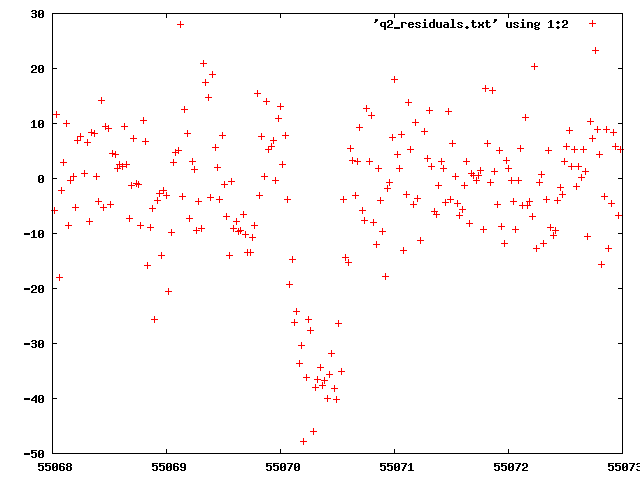
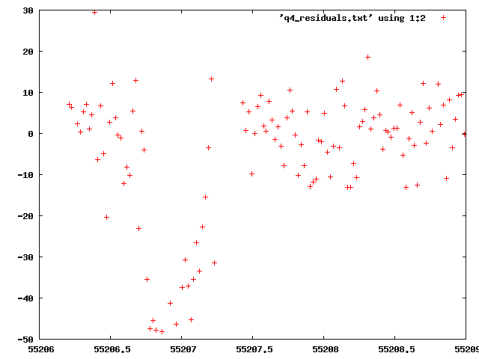
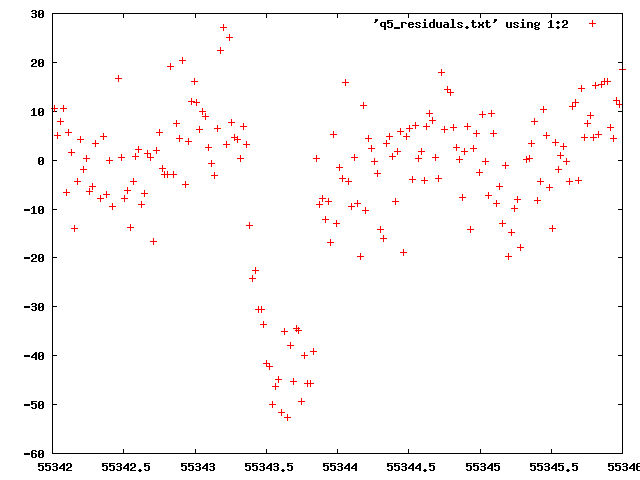
and plotting them all together:

Yes, we had discovered transits and at that point decided it was worth turning Keck towards this system to further characterize it.
More PH1 Artwork
Today we have a blog post from Dirk Terrell. Dirk is an astrophysicist and the manager of the Astronomy and Computer Systems section at the Southwest Research Institute in Boulder, CO. His hobbies include coaching football, racing motorcycles and space art. He is a Fellow and former President of the International Association of Astronomical Artists.
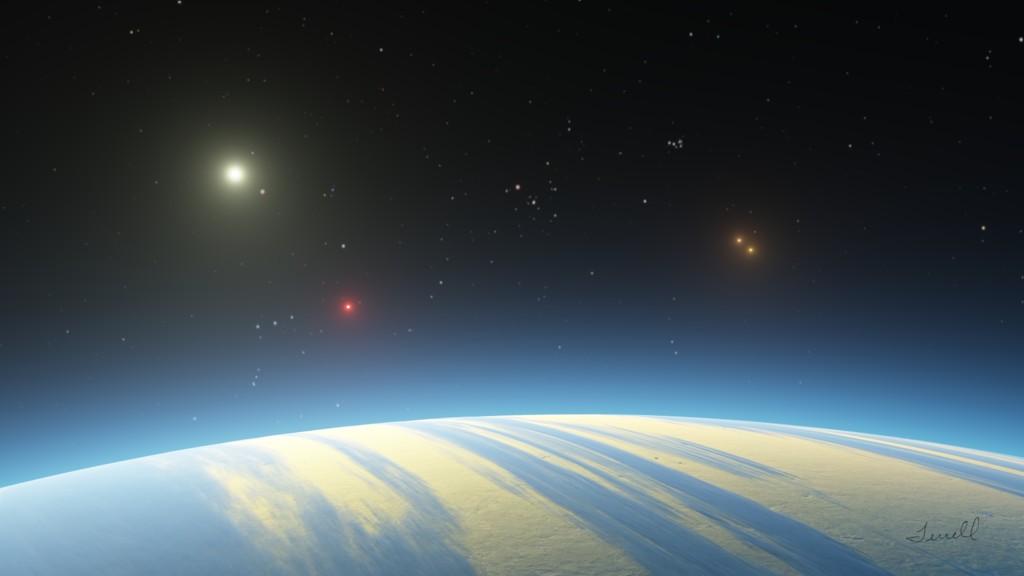
Dirk is also a coauthor on the PH1 paper, and you’ll hear more about how he helped confirm and validate PH1 in the next blog post. Inspired by the discovery Dirk made paintings depicting PH1, and we wanted to share with all of you. These images and more can be found on his website. Dirk is kindly letting us share his artwork. Please contact him for all usage, private or commercial, at terrell at boulder.swri.edu.

View of PH1 from just above the clouds of the gas giant planet. Image credit: Dirk Terrell
A view of PH1, the first discovery of a circumbinary planet in a quadruple star system. Image credit: Dirk Terrell
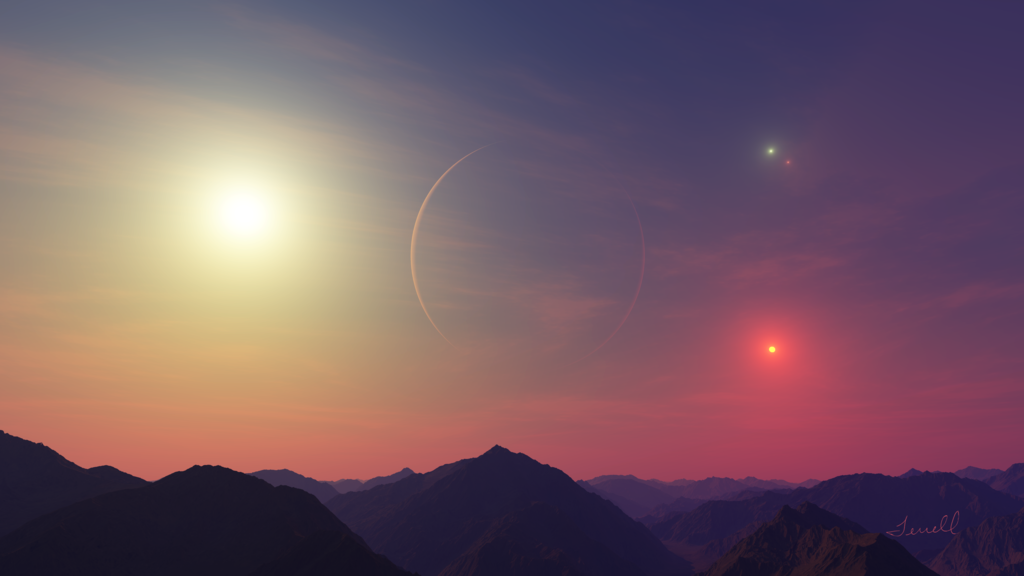
Sunset on a Four-star World- Image Credit – Dirk Terrell
Planet Hunters PH1 Live Chat
This week we announced the discovery of our first confirmed planet, PH1.
On Monday, we’ll be having a live chat with the discoverers as well as some of the astronomers who have helped along the way to take us from planet candidate to confirmed planet.
We’ll be talking to Josh Carter (Harvard Center for Astronomy and Astrophysics), Robert Gagliano (Planet Hunters), Kian Jek (Planet Hunters), Chris Lintott (University of Oxford/Zooniverse/Planet Hunters), Jerry Orosz (San Diego State University) and Meg Schwamb (Yale University/Planet Hunters). We’ll be giving you the inside story on how we characterized and confirmed the PH1 system, as well as answering some of your questions,.
Join us here on Monday October 22nd at 11:30am PDT (2:30pm EDT or 7:30pm BST or 18:30 UTC)
The Road to Characterizing PH1: The Overview
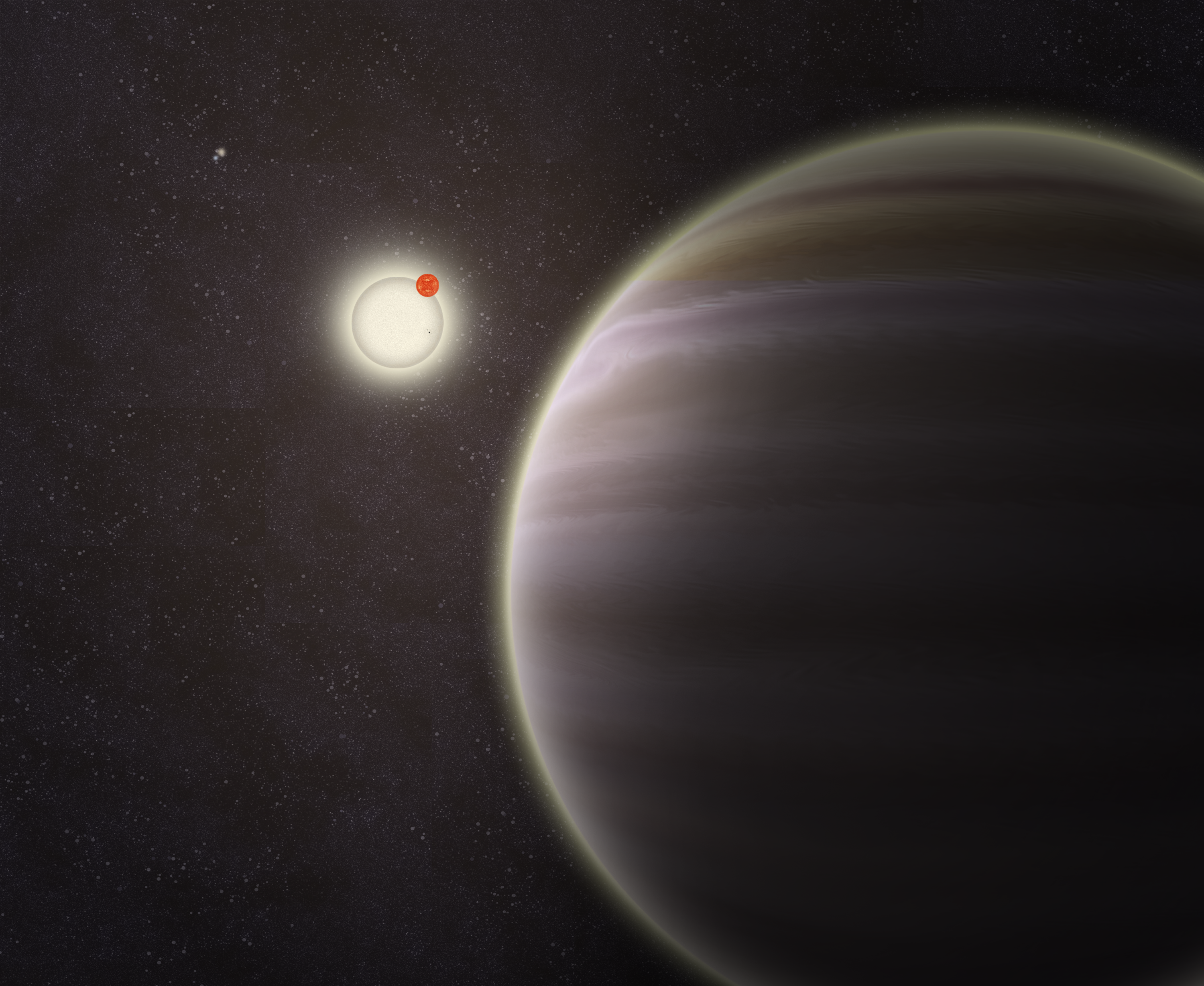
Haven Giguere/Yale
It’s been an exciting week for exoplanets with the discovery of PH1 and the discovery of an Earth-mass planet around the closest star to Earth (Alpa Centauri B). In the coming days and weeks, you’ll hear more about the specifics of how we came out confirming and validating the discovery of PH1 and solidifying that it was a planet orbiting the two central stars in a four star system, but I wanted to give a brief summary of the data and results.
This effort has taken months and months from obtaining the telescope observations, to modeling the light curves, combining Kepler data with radial velocity observations, and applying stellar evolution models. Robert Gagliano and Kian Jek get enormous credit for the discovery and starting this process off and recognizing and spotting the planet transits.
Many collaborators have worked hard to confirm PH1 and study its properties, especially: Jerry Orosz, Josh Carter, Willie Torres, and Debra Fischer who have put tremendous effort (particularly in the past few weeks) to get us from so we found some transits to bona fide planet.
Everyone in this collaboration involved in the paper (including Kian and Robert who were coauthors on the discovery paper) are listed below:
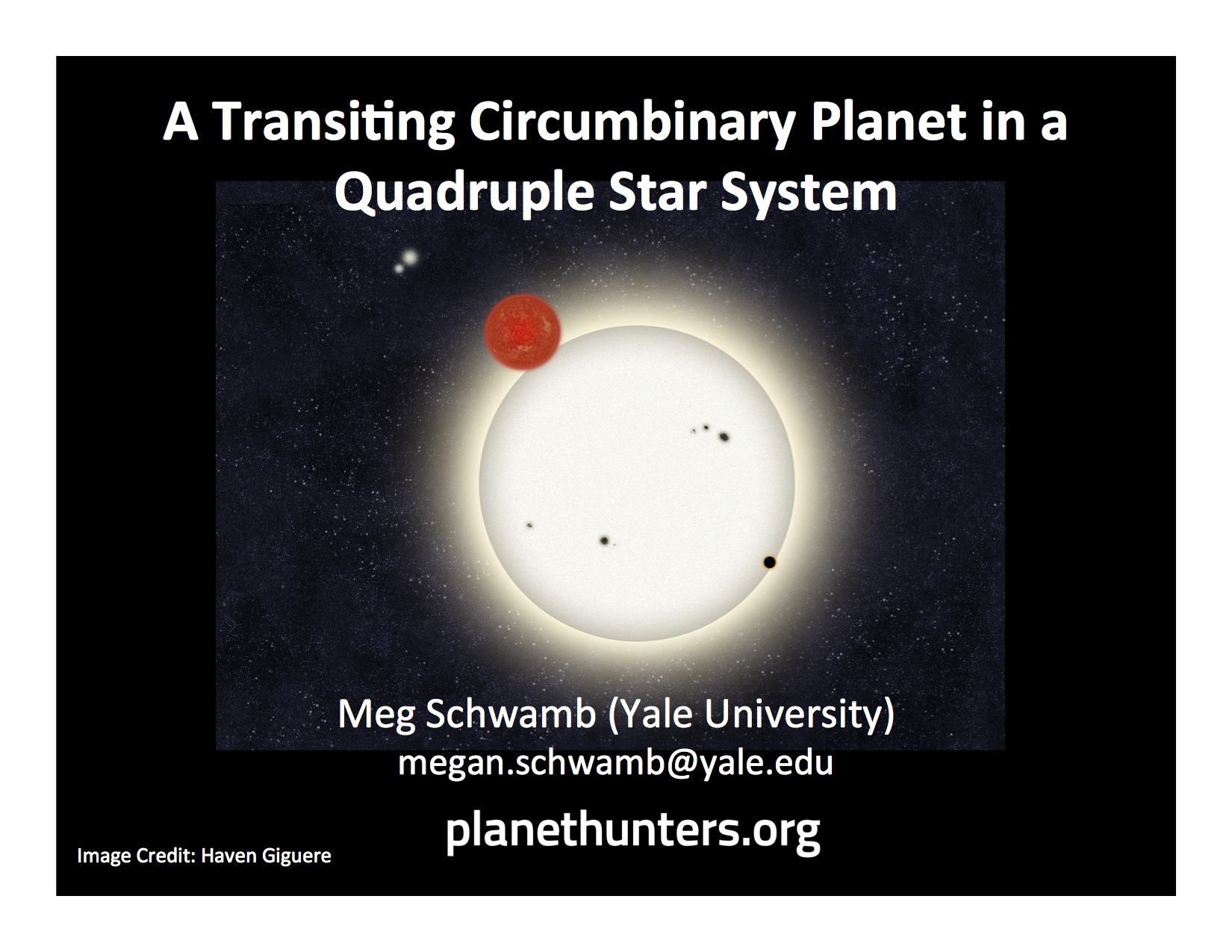
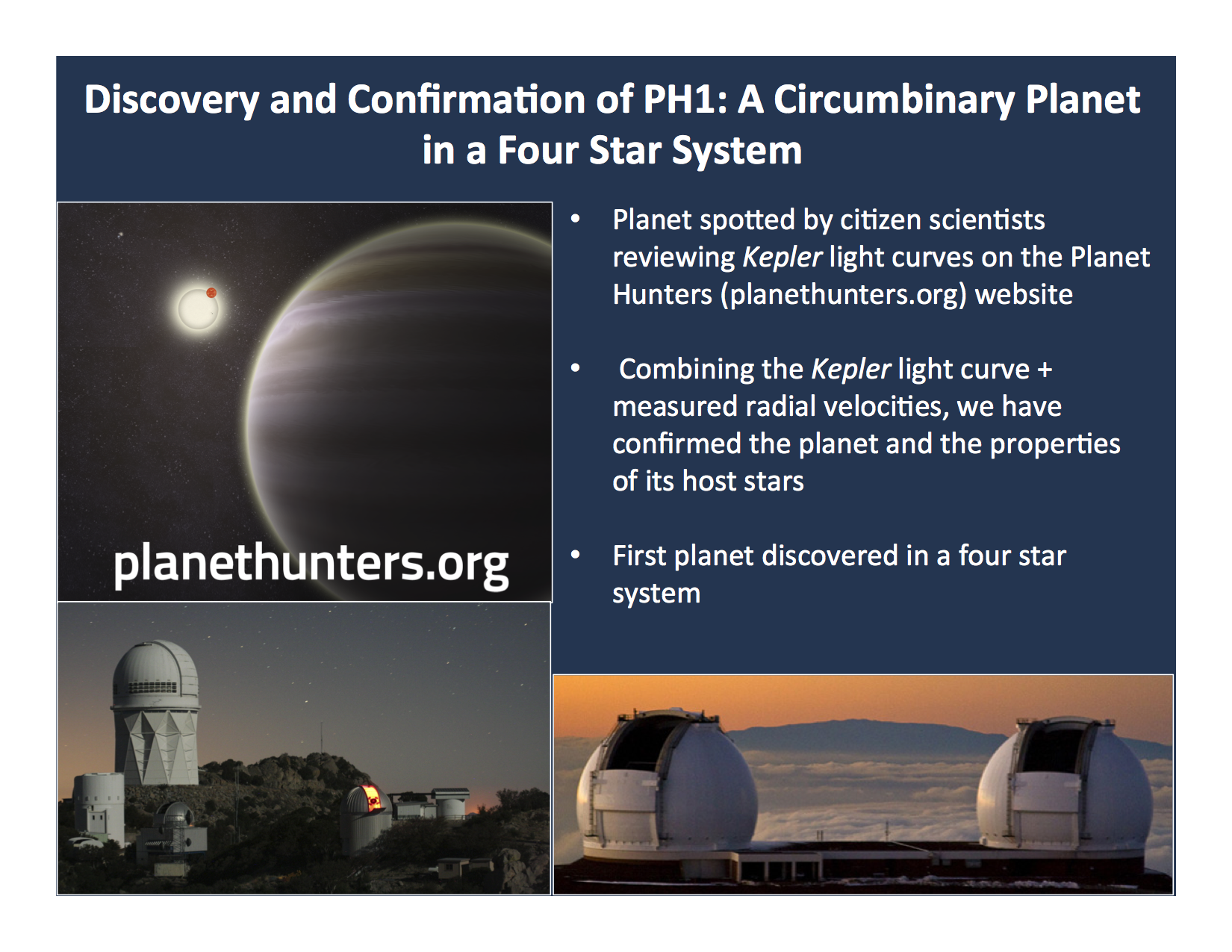
To summarize PH1’s confirmation story, I thought I’d share my press talk slides:
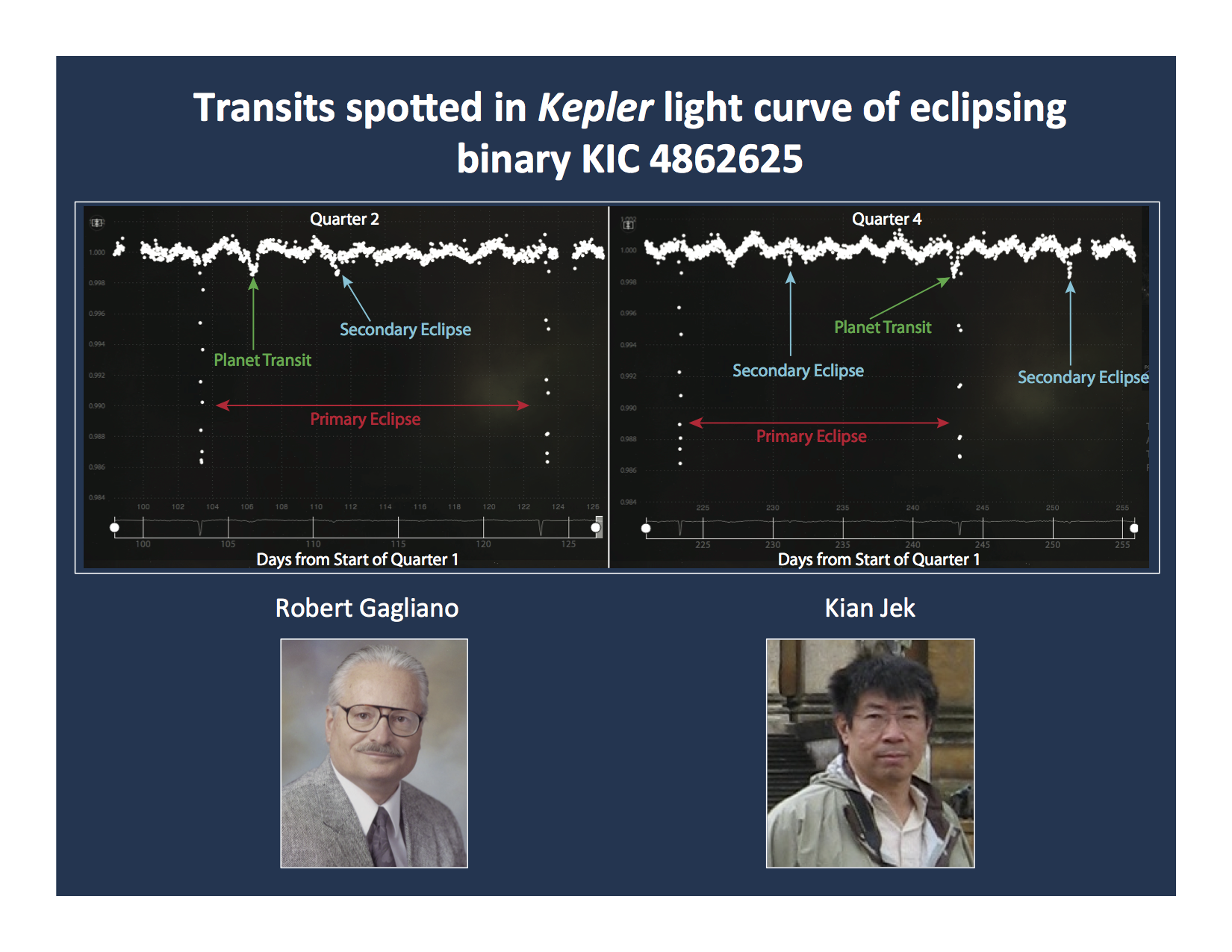
Robert and Kian identified three transits in the light curve of an eclipsing binary . In the binary, there are two stars, one larger and hotter and one smaller and cooler. When the smaller cooler star crosses the face of the larger hotter star, you get some of the larger star’s blocked out and we call that a primary eclipse. When the smaller cooler star crosses behind the larger hotter star, we get a secondary eclipse where the light from the smaller cooler star is blocked out. So we see this big dip+ small dip pattern. Robert and Kian noticed three transits separated by ~137 days in Quarters 1-5 data superimposed on the light curve indicating a third small body in the system, and notified the science team of a possible circumbinary planet.
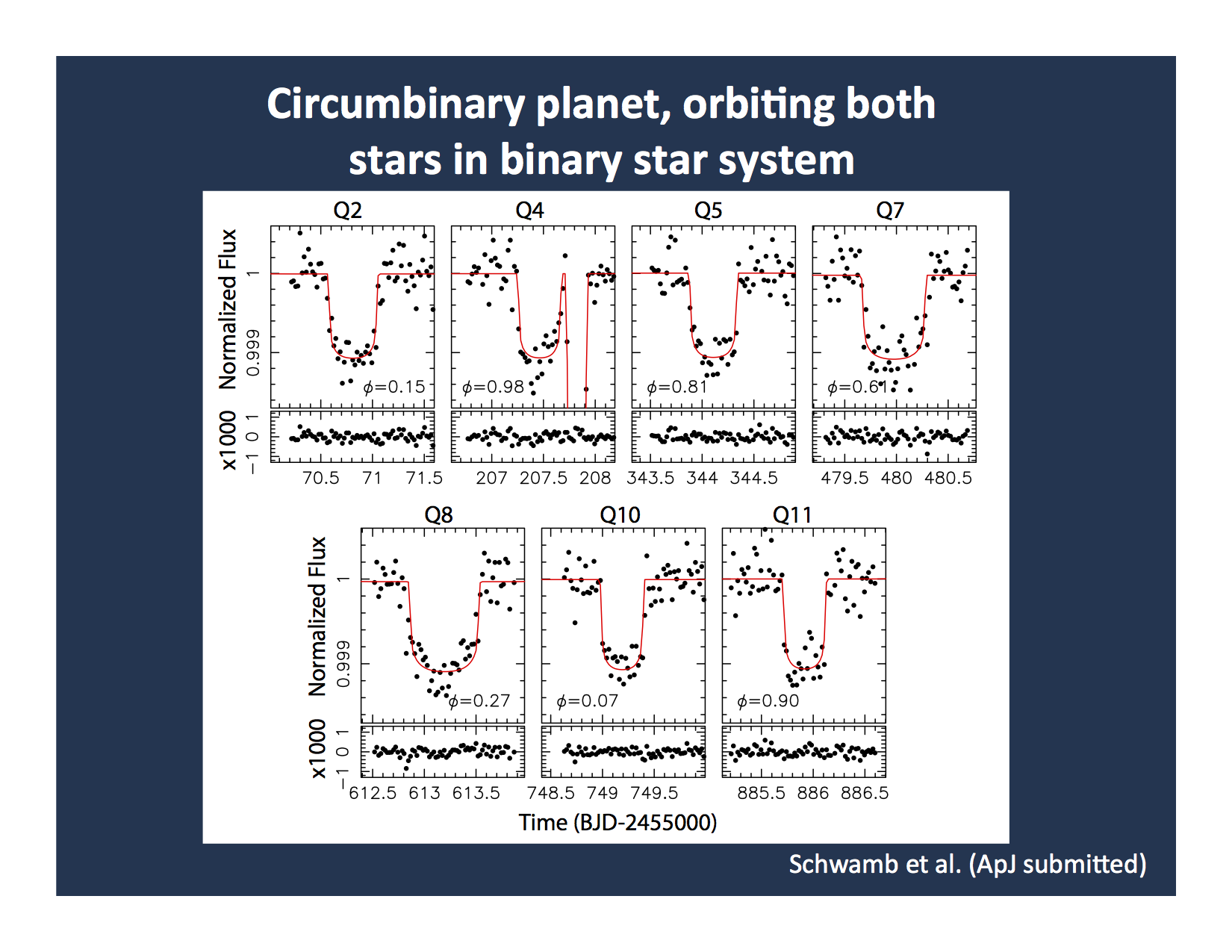
There’s a small chance that we’re seeing a false positive, where on the sky our Kepler eclipsing binary is aligned with a faint background eclipsing binary giving rise to the transit-like signal. If the transiting body is truly orbiting both stars, we have a way of checking. A body in a circumbinary orbit (orbiting around both stars in a stellar binary), is orbiting a moving target, so the positions and velocities of the two stars are different each transit. So this means that at each transit, there are slightly different gravitational tugs on the planet causing the timing and the duration of the transit to change. We see these changes and this gives us high confidence the planet is really orbiting the Kepler eclipsing binary and not some background source. If you look below at the 7 planet transits across the larger bigger star in the binary, you can convince yourself that the widths of the transits are changing. So bingo, planet!
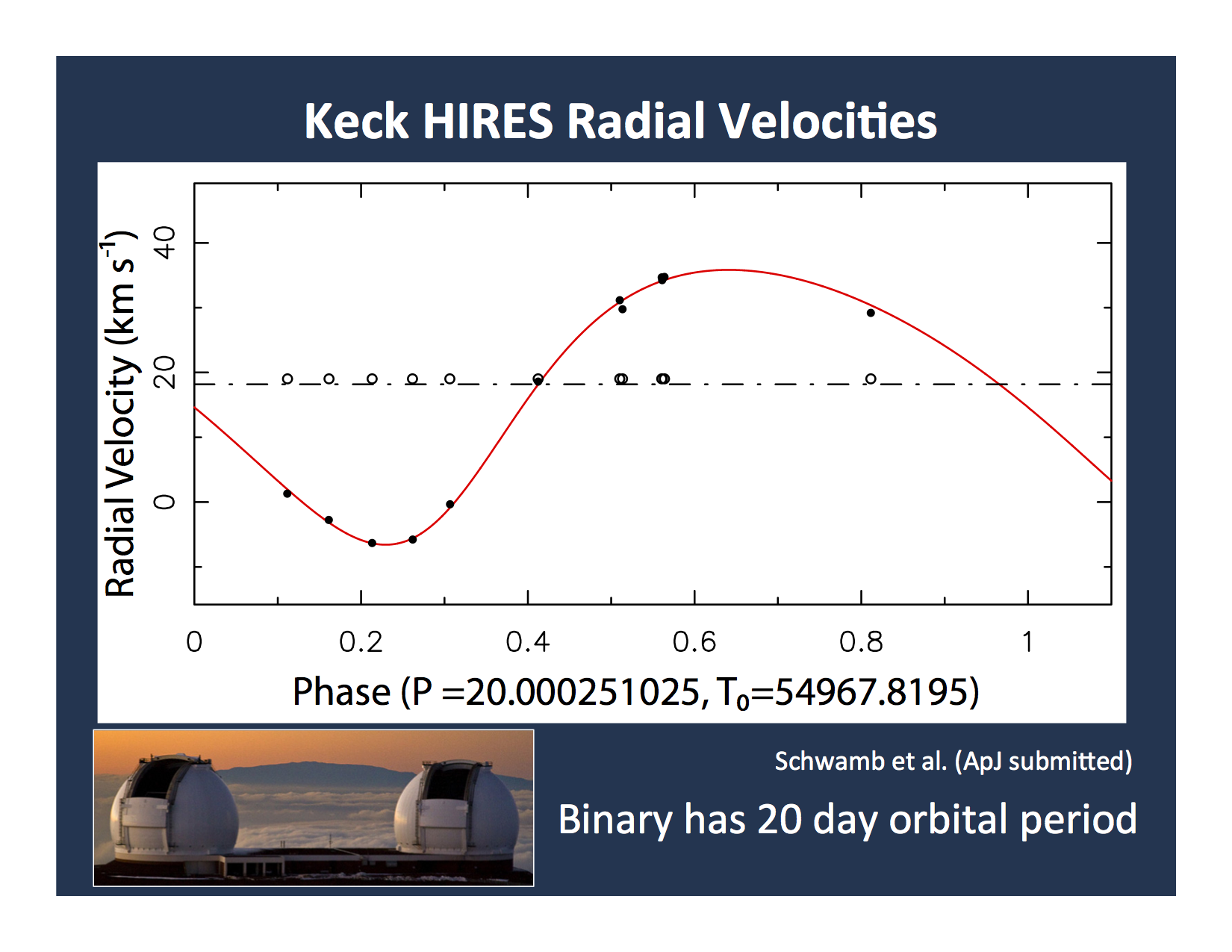
We got radial velocity observations from the Keck telescopes on Mauna Kea. The radial velocity observations measure the wobble of the larger star in the binary that the planet orbits. With the precision of the observations and time duration we have on the observations, we cannot measure the wobble caused by the gravitational pull of the planet. What we are measuring is the wobble due to the gravitational tug of the smaller star as it orbits the larger star in the binary.
To our surprise we found two velocity contributions in the radial velocity observations. One is from the larger star in the eclipsing binary (solid points) with the model fit for the velocity observations shown in red. The 2nd component is stationary over the roughly 5 months we were taking radial velocity observations. This 2nd component is coming from a source that is providing some light in the spectra slit we place across the Kepler target when observing on Keck. It has the same value as the average or systemic velocity of the binary. So if you take the average value of the black points that’s the velocity of the eclipsing binary (and planet host stars) moving towards or away form us. This second component has the same velocity and random field stars have velocities in the galaxy ranging from ~20-60 km/s so to have a source that has to be very close to the eclipsing binary on the sky that we see it in the Keck observations and have the same average velocity as the eclipsing binary tells us that this source is bound to the eclipsing binary.
We used adaptive optics observations from the Keck II telescope to zoom in and look around our eclipsing binary for other stars that would be contamination the Kepler photometric aperture. We also used deep optical imaging to look for slightly further contamination stars as Bill Keel described in his blog post. As Bill discussed in his post, if there are stars providing extra light to the aperture that is summed up to make the Kepler light curve, it will give us the wrong planet radius. This is because the extra light will decrease the observed transit dips causing us to underestimate the size of the planet. We go these adaptive optics observations while we getting the radial velocity observations.
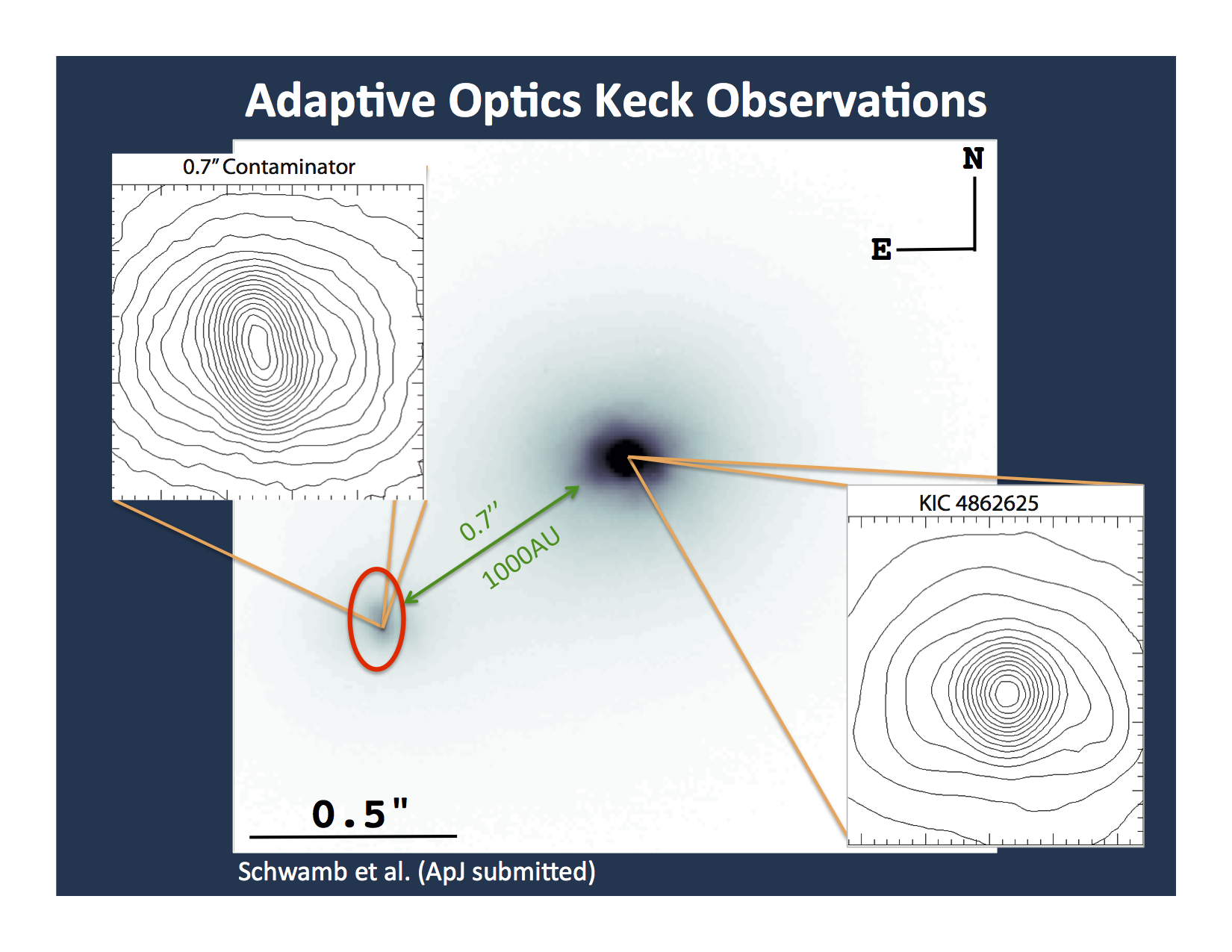
In the adaptive optics observations there is a source 0.7” away (or about 1000 AU) from the eclipsing binary, and we knew about its existence when we were analyzing the Keck radial velocity observations. There is was the ah-ha moment, where we went oh, this source in the adaptive optics observations must be that second velocity source we see in the radial velocity observations, that we think is gravitationally bound to the eclipsing binary orbiting well outside the planet’s orbit. To our surprise the adaptive optics observations revealed that this source is elongated in one direction (which you can see in the slide below). What we think this means is that we’re just barely resolving the source as a visual binary (2 stars!). So that we have a pair of stars, getting 2 for the price of 1 – (getting us to four stars in the system!) orbiting the eclipsing binary. Our best guess from the Keck observations is that the 2 stars in the distant binary are separated by no more than 40-50 AU.
Combining all of these observations, we went after obtaining the properties of the planet and the stars in the PH1 system. Here below are the properties that come out of the combined photometric-dynamical model that uses the radial velocity observations and Kepler light curve for both PH1 and the stars,. The age we estimate for the entire system from spectral modeling. We estimate the mass of the planet by the fact that it not massive enough to pull on its parents stars sufficiently for us to see slight changes in the timings of when the stars eclipse each other (so when the smaller cooler star crosses the face of the larger hotter star and when the smaller cooler star crosses behind the larger hotter star).
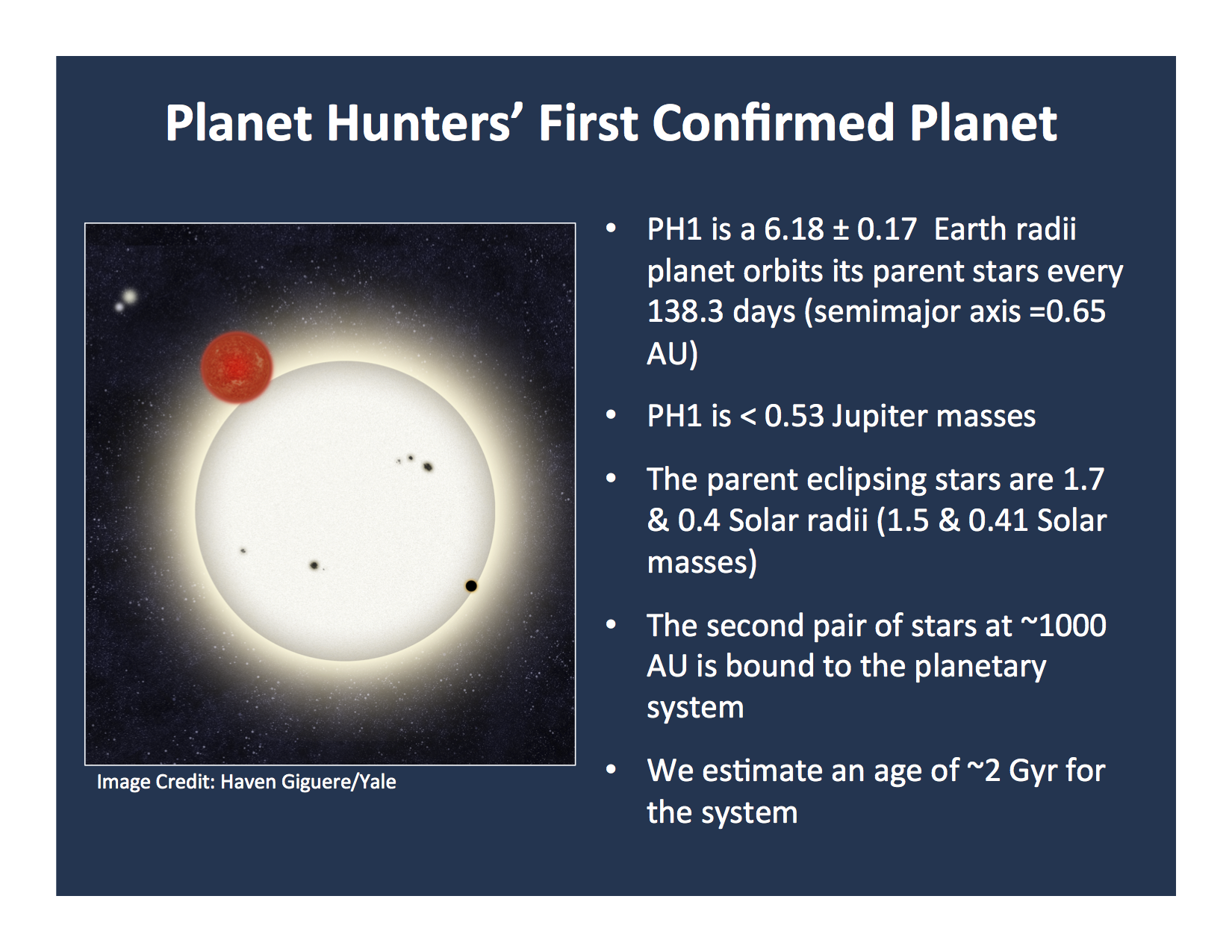
We confirmed with modeling the eclipsing binary properties with just the Kepler light curve, and we’re confident in our estimation for the planet and host star properties. The planet is a gas giant, a bit bigger than Neptune and slightly smaller than Saturn. PH1 orbits its parent stars at a distance between Mercury and Venus in our own Solar System. The planetary system is stable. The planet happily orbits the eclipsing binary every ~138 days not really noticing there’s a second pair of stars out at 1000 AU .
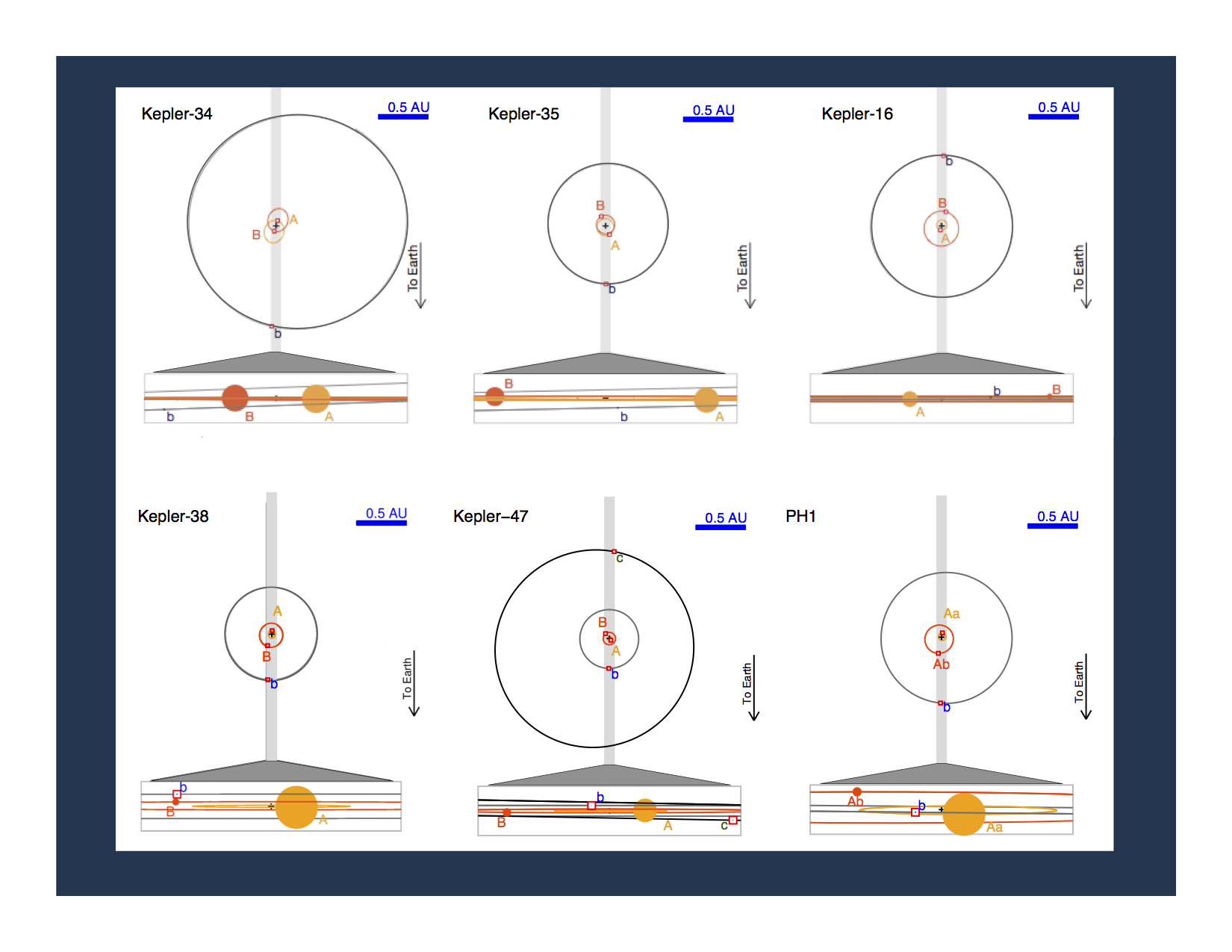
PH1 is the 7th circumbinary planet, and the 6th circumbinary system. Below are the orbits of all the circumbianry Kepler planets and PH1 (not depicting the second distant pair of stars).So why do we care? Well, circumbinary planets are the extremes of planet formation, and we need to understand how they form if we are really understand how we form planets in our own solar system. Planet formation models need to be able to explain both environments, and each of the systems detected gives us another puzzle piece to this picture.
The Road to Characterizing PH1: Visual-band Imaging
Today we have a guest post from Bill Keel. Bill is a member of the science team for Galaxy Zoo, and is more accustomed to dealing with stars by the billion than one at a time. He is a University of Alabama astronomer, weekend trombonist, and occasional photographer, being gradually trained by two cats with names out of Tolkien. Both his Twitter stream and his posts on the Galaxy Zoo forum can be found under the name NGC3314, and his other professional exploits may be found at http://astronomy.ua.edu/keel.

SARA telescope at Kitt Peak
Kepler is sometimes most effective when properly backed up by other instruments, since its design was tightly optimized for precision in measuring bright stars at the expense of other things (such as angular resolution). Here’s a case showing how interpretation of Kepler results on planetary transits can be assisted by fairly routine ground-based measurements.In late June, I got an email request from Meg Schwamb:
“We’ve found a planet with ~130 days orbit going around a eclipsing binary. The eclipsing binary has a 20 day orbit so the planet is circumbinary and there’s a third star in the binary+planet system orbiting out at ~1000 AU with a period of 10E4-10E5 years. We’ve been following up the system with Keck observations.” [We didn’t yet know at the time that this third star would itself turn out to be a binary star].
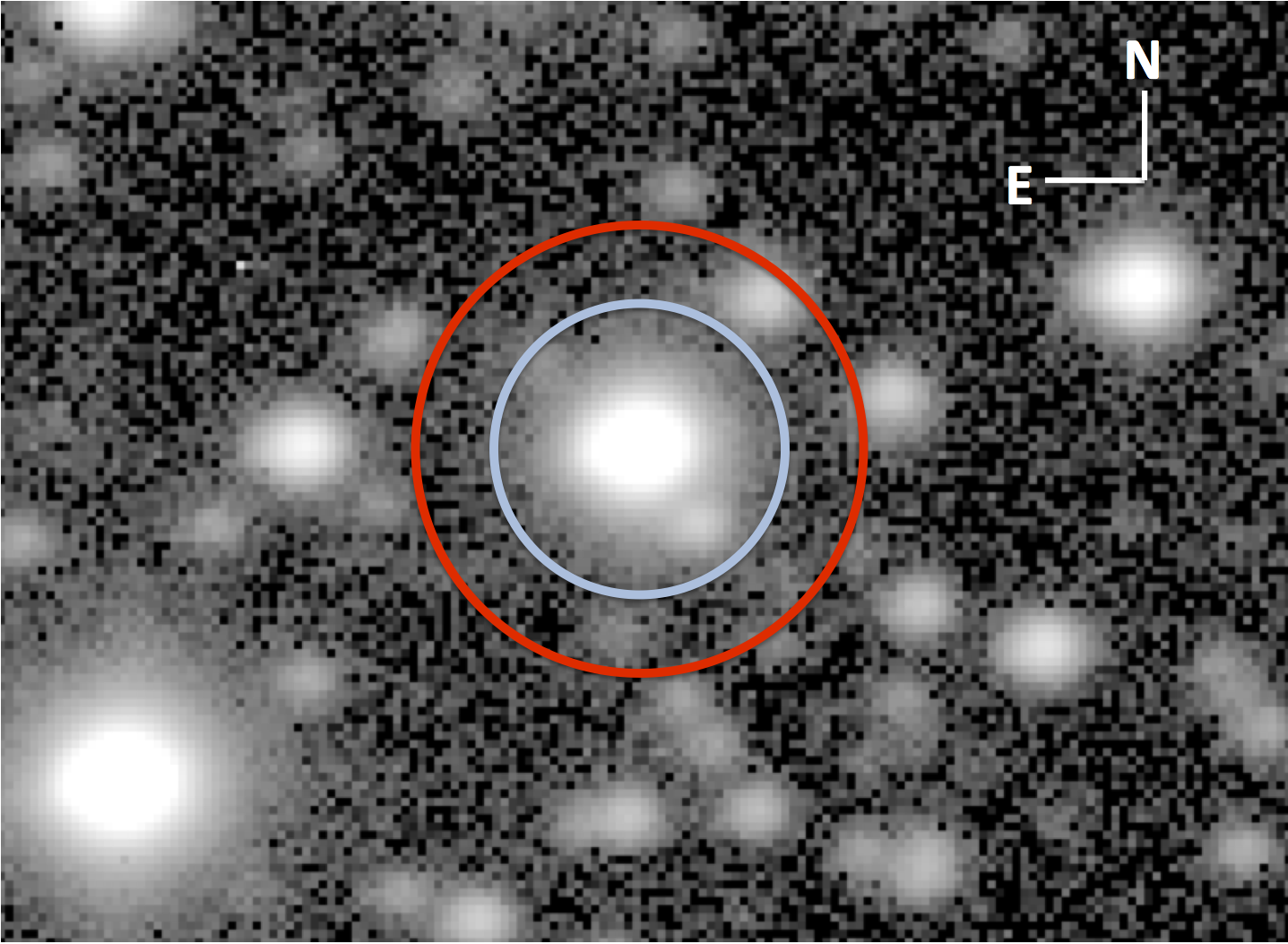
The region around this star from our perspective is very busy (like the whole Kepler field), and the Kepler measurement includes light from additional faint stars. One, in particular, appears about 3 arcseconds away from the star of interest, well within the 6-acsecond radius of a Kepler measurement. Knowing its brightness would help narrow down the planet’s properties, making sure we have the right starting points in brightness for the Kepler target star my itself.
My institution is a partner in the SARA consortium, which operates telescopes in Arizona and Chile remotely. As a result, I have fairly regular nights scheduled, and indeed there were a couple of nights I could use at our northern telescope, a 0.9m instrument on Kitt Peak, Arizona, in July (just before shutdown for the monsoon season). After a couple of tries when the weather didn’t quite cooperate, including one night that was clear but the air to turbulent for this project, I got an hour’s worth of images on the evening of July 17. The image quality (seeing, in astronomical jargon) was 1.5-1.8 arcseconds, meaning that these values give the diameter across which a stars image drops to half its peak intensity due to atmospheric turbulence. That makes separating stars 3 arcseconds apart tractable. The timing worked out well during the night – the field was within 15 degrees of the zenith, minimizing atmospheric and tracking problems.
Trying to get precision measurements of bright and faint stars simultaneously takes some care – good data on the faint star isn’t much help if the bright star is hopelessly saturated in the data. So instead of one long exposure, I took 60 1-minute observations, using a red filter to roughly match the midpoint of the very broad spectral band used by Kepler. For further analysis, that gave both the grand average of all 60, and I also used averages of subsets of 10 to help estimate certain sources of error in the processing.

Crowded Kepler field with the host stars for PH1
Even though the fainter interfering star was clearly separated from the bright one in these images, there was enough spillover to need correction.I tried several procedures or this – the most successful took as a reference point a similarly bright star with no companion in that direction, subtracting variously scaled versions of its image to eliminate as much of the bright star’s light as possible (the subtracted images looked a little odd in the middle – much later I realized that might come from the very close companion star seen in other data).
To make sure we understood how our brightness measurements relate to the Kepler data, I checked published magnitudes for Kepler stars in this neighborhood. This gave me some bad moments until I realized that the published values were often based on short exposures with a telescope no bigger than I was using – bright stars are OK, faint stars become quickly much less accurate. Phew. Now I know this, so that if it comes up again, I’m ready.
The result? That fainter star has magnitude R=18.73, making it only 1.02% as bright as the Kepler target with planet. Other contaminating stars are still fainter, down to 0.03% of the target star’s red-light intensity.
 Planet Hunters