
Exciting New Planet Candidates
PHT may well have found its first planets! They are not yet confirmed, but we have taken the big step of uploading the candidates to ExoFOP, the website used by the worldwide exoplanet community to contribute to the follow-up TESS planet candidates. If all goes well, the additional ground-based observations that are needed to confirm whether our candidates are really planets will be made soon.
It all started when a very exciting planet was brought up and discussed on Talk by Dolorous Edd, mhuten, davidbundy77, zbish and Vidar. This is the first of three candidates we uploaded so far, and is currently my favourite. TIC 55525572.01 is a long period planet candidate that appears in multiple observational sectors. The fact that the dips don’t repeat in any one sector is likely to be the reason why the official TESS pipeline didn’t find it (yet!). The widely separated transits suggest that the planet candidate completes an orbit every 83.4 days, making this the longest period planet found in the TESS data so far (as far as we know)!
From Talk to Telescope

Phase folded lightcurve.
It was exactly three weeks ago today when I first saw the lightcurve of TIC 55525572, a subgiant star which is potentially hosting a beautiful, distant world. Prepped with strong coffee, awesome data and many pages of code we spent the afternoon pulling together figures, parameters, models and plots in order to find out everything we could about the transit events. If this candidate was going to pass the scrutiny of the planet-jury we would need a whole file of evidence. The initial checks included looking at the plots of the background flux and stability of TESS at the time of the transits; checking whether the lightcurve extraction aperture size had an effect on the size and shape of the dips; and making sure that the brightest points in the aperture didn’t move during the transit. All these tests were passed with flying colours, which urged us to move on to modelling the transit event, to see what kind of a planet it would be, if it really is a planet. Amongst other things the models showed that all three of the observed transits have the same depth and width; and revealed that, if the planet is real, it has a radius that is approximately 7 times greater than that of the Earth. At this point we were happy to call it bona fide planet candidate and upload it to ExoFOP as a “community TESS Object of Interest”, or cTOI. The candidate is now known as cTOI 55525572.01.

Model of cTOI 55525572.01.
Next, we wanted to gain a better understanding of the entire system, and thus we needed to obtain a spectrum of the host star in order to accurately determine properties such as its mass, radius and temperature. Due to the very Southern location of this object, we turned to our Australian friends over at Australian National University who kindly observed the star for us. We are still in the process of analysing this spectrum.
As one of the final steps in the verification process we will need to obtain images of the system that are sharper than those TESS gathered, to see if the star being obscured is really TIC 55525572 and not some fainter, neighbouring star. In an ideal world we would make these observations around a transit. In fact, there was one just this past weekend, but sadly it was only observable from Antarctica… We don’t want to wait 3 months until the next transit, so for now we will settle for just having a good, sharp image the target area. Once we have all that information in hand we should be in a position to validate the candidate statistically, and if all goes well that’s when we will be able to give it its proper, planet name: will cTOI 55525572.0 one day become PHT-1b???
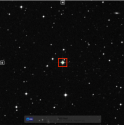
2MASS image of the vicinity of TIC 55525572.
This candidate got the ball rolling, and within a matter of days we found two more excellent candidates that surface on Talk. All three are now on ExoFOP and awaiting follow-up. More planet candidates can be expected to appear on there soon once they pass all our initial vetting tests!
We will soon know more about these exciting candidates and I can’t wait to share that information with you. None of this would be possible without your incredible help and dedication in finding these distant, alien worlds within our galaxy!
An earlier version of this post was briefly live at the weekend; I’m so sorry for the confusion.
The Exoplanet Hunt: the radial velocity method
By Oscar Barragán
The night has finally arrived at the Roque de Los Muchachos Observatory. The blue sky has turned into a deep ocean full of stars which eclipses the beautiful horizon that is scattered with pink clouds. The telescopes are ready to hunt for starlight. At first sight, all the stars seem static in the night sky which is victim to the Earth’s rotation. However, this is a misconception, as all the stars that shine at night are moving within our galaxy, the Milky Way. Our mission for the night is is to detect their subtle movement which may tell us about the existence of faraway worlds.

Sunrise at the TNG in La Palma. Photo credit: Oscar Baragán.
The motion of the stars manifests itself in two ways. The first one is their movement in the plane of the sky – also known as their proper motion- which slowly re-shapes the constellations. The second one, and the one that we are searching for, is the movement of the stars with respect to us. This receding and approaching velocity of the stars is known as their radial velocity. This stellar motions, however, is so small that is is imperceptible to our naked eyes, meaning that we need to use big telescopes and state-of-the-art instruments in order to detect it.

The Doppler Effect. Photo credit: Alysa Obertas
You may be familiar with the acoustic version of the Doppler effect: the change in sound as a car first moves towards and then away from you. This change in sound is caused by the compression and elongation of the car’s sound waves caused by the motion of the car. In the same vein, light travels as a wave, and the Doppler effect results in an apparent change in color. If a light-emitting astronomical object moves towards us the waves are compressed and appear redder. Conversely, if the object moves away from us the waves are elongated and appear bluer. This effect is extremely small, and thus we have to use specifically designed instruments, known as spectrographs, to measure it. These devices work by dividing starlight into all the colors of the rainbow. The resultant colourful decomposition of light -called a spectrum– is imprinted with strange dark lines which, combined, make up a signature conveying information about the building blocks of the star. This is because the dark lines are a result of the emitted light travelling through the atmosphere of the star which absorbs specific colours depending on its composition. Astronomers have been using this technique to learn about stars for centuries. Additionally, we can look at these dark spectral features to study how the star dances across the sky. The position of the lines, with respect to where we expect them to be if the star were not moving, allows us to measure the Doppler effect and therefore the radial velocity of the star. It is this effect that hints at the presence of exoplanets around stars.
Let’s picture a planet orbiting a star as a gravitational tango where one of the dancers, the planet, isinvisible. By analysing the movements of the visible dancer, we can reconstruct the choreography, the song and even the nature of the hidden companion. We, the planet hunters, search for the periodic changes in the stellar pulsations, fluctuating between red and blue, which can last anywhere from hours to years. These changes indicate perturbations in the stellar velocity, suggesting that there is a planet affecting the galactic dance of one of the stars which illuminates our night sky.
Gazing at the Stars.
Changes in stellar radial velocity are not only useful to learn about the existence of exoplanets, but can also be used to determine the minimum mass of the planets. This is because the effect of the ‘wobble’ of the star is larger when the difference in mass of the star and the planet is higher. We can, therefore, use the the spectra of a star to understand if a planet is massive like Jupiter, or relatively light like the Earth. The problem with this method is that these changes in velocity are very small. Jupiter, for example, causes the Sun to wobble with a mere velocity of 13 m/s every 10 years, while the Earth does it with an almost insignificant 9 cm/s each year. Hence, we need instruments with extremely high levels of precision and stability if we want to be able detect the effect that exoplanets have on their stars.
We are now in the Telescopio Nazionale Galileo, which hosts one of the best exoplanet hunter instrument in the northern hemisphere: HARPS-N. This spectrograph is a copy of the original HARPS (High Accuracy Radial Velocity Planet Searcher) which is located in the Southern hemisphere, in Chile. Both of these instruments allow us to measure the stellar velocity with a mean precision of 1 m/s, which is approximately equivalent to the speed of a crawling baby. Our mission here is to follow-up exoplanets discovered by the Kepler space telescope, TESS’ predecessor. If we combine our radial velocity measurements with the transits observed by Kepler we are able to obtain the real planet mass (and not just a lower limit). This gives us a first approximation of what the planet is made of, and paves the the first step along the way of testing for habitability. Perhaps the next time we are here we will be measuring the mass of an exoplanet discovered by you via Planet Hunters…
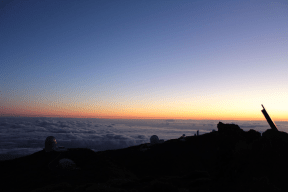
Sunrise.
As a matter of symmetry, the end of the night is announced on the horizon with the same colors that we saw at the beginning of the night, 9 hours ago. The vibrant colors mark the time to close to telescope before the Sun is back as a protagonist in the bright blue sky. We leave the telescope in the early hours of the day after having successfully measured the radial velocity of tens of potential planet-hosting stars. Each datum taken this night will help us to decode, step by step, a gravitational choreography, which will tell us about the existence of faraway worlds.
The Hill of the Telescopes
An Observer’s start to the Day

Panoramic shot showing the two MAGIC telescopes (left and centre) and CTA (right); the William Herschel Telescope laser; the NGT in the distance (middle); and the GTC (middle right). All photos by Oscar Barragán.
Our ‘day’ here in La Palma starts around 4 pm. After a quick breakfast and a much needed coffee we head up to the mountain to the telescope where the telescope operator has already started setting up the equipment for the night. The Sun is still high in the sky so the telescope dome stays closed while we carry out the calibrations of the instrument that we plan to user throughout the night.
Once all the calibrations are done we have to wait for the sunset, giving us time to have dinner, visit other telescopes, or have a quick snooze in preparation for the long night ahead. The telescopes around here are incredible, and we have bee lucky enough to get a tour of three of the most impressive ones.
MAGIC and CTA

Sunrise reflected in the mirrors of the CTA.
MAGIC (Major Atmospheric Gamma Imaging Cherenkov Telescopes) and CTA (Cherenkov Telescope Array) are the first telescopes that you see when you drive up the mountain from sea-level and their impressive mirrored structures make you feel like you have entered into another world. MAGIC is a system of two Cherenkov telescoped which detect particle showers in the atmosphere released by gamma rays. The twin-telescopes each consist of a 17-m diameter dish that is covered with smaller mirrors that reflect the light into a highly sensitive camera. Next to MAGIC lies the newly built CTA which has a similar design and beautifully reflects the stars at night the sunrise at the start of the day. All three of these telescopes are sensitive to galactic and extragalactic gamma-rays, allowing us to study high energy events in the Universe such as active galactic nuclei, gamma-ray bursts, pulsars and supernova remnants. Without any domes, these telescopes proudly dominate the hillside, making the scenery look slightly surreal (or MAGICal).
Isaac Newton Telescope

Inside the dome of the INT.
The next telescope that we visited was the 2.54-m optical Isaac Newton Telescope (INT). It was initially built in 1967 at Herstmonceux Castle in Sussex, England (the initial site of the Royal Greenwhich Observatory) but was moved to La Palma in 1984, due to light pollution and the less-than-ideal British weather. The INT is the oldest telescope on the mountain, and walking into the impressive building gave me the slight feeling of going back in time. The control room is filled with computers from the 70s with a control deck that exhibits analog dials and manual knobs that control various aspects of the telescope.
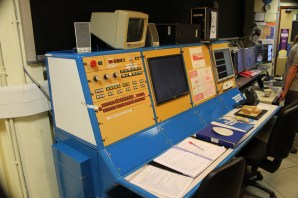
INT’s 70s control deck.
The telescope is located on the third floor and sits on a warm wooden floor along with tanks of liquid nitrogen that are used to manually cool the electronics. But it’s not just the telescope that’s impressive at this observatory. Leaving the dome of the telescope we set off on a tour to explore the rest of the building, which felt like a beautiful combination of a museum and a 70s royal bunker. It is fully equipped with office spaces, sleeping rooms, rooms and cupboards filled with various electrical equipment and spare telescope parts, and an incredible library that hosts books and journals that date back to the eighteen hundreds.
We also headed to the roof of the INT, which presented us with a good view of the 4.2-m William Herschel Telescope (WHT) that is currently shining an extremely powerful orange laser into the atmosphere (see top image). Simultaneous observations of this laser and the targets throughout the night allows us to correct for the effects of turbulence in the atmosphere, transforming fuzzy observations into sharp images.
Gran Telescopio Canaria
Our final telescope tour was of the Gran Telescopio Canaria (GTC), the largest optical and infrared telescope in the world. As we walked into the silver dome we were overarched by the huge structure of the telescope – with a height of over 25 m from top to bottom it truly is gigantic! The primary mirror is made up 36 individual hexagonal segments that perfectly piece together to act as a single 10.4 m mirror. The segments, which are made of a ceramic material similar to that used for modern kitchen hobs, are polished to perfection, conforming to a 15 nanometer (millionths of a millimetre) margin of error. But not only does each mirror have to be perfectly uniform, the individual segments must also fit together smoothly with no more than 90 nanometers difference between each. To put this into perspective, if the primary mirror were scaled up to the size of Texas, the ‘unevenness’ would have to be kept to less one millimetre. Automatic sensors are used in order to ensure this degree of accuracy throughout the observations.

The gigantic structure of the GTC with Oscar for scale.
Its immense scale combined with the perfect location makes the GTC the ideal telescope to study the nature of black holes, the formation and evolution of stars and galaxies in the early universe, the nature of exoplanets and the mysteries of dark matter and dark energy that fills our Universe. The 400 tonne instrument was truly amazing to see.
Back to our own Telescope

Getting ready for a fun night of observing with a sunset-espresso.
At sunset we drive back up to our own telescope, slightly overwhelmed by the beauty of the sunset that is reflected off the sea of clouds that lies beneath us. So far we have been lucky and have always remained above the clouds, leaving us with beautifully clear skies that allow us to obtain spectra of Kepler and K2 targets. But what are Spectra and what can they tell us? Stay tuned for the types of observations that we are obtaining during our time here.
The best sky in Europe: La Palma

Sunset view of the 3.6-m Telescopio Nazionale Galileo (left) and 10.4-m Gran Telescopio Canarias (right).
Oscar and I have just arrived in La Palma, one of the Spanish Canary Islands, where we will be spending the next few days taking radial velocity follow-up observations of Kepler and K2 exoplanet candidates. As this tiny island is situated north of the equator, we are not able to observe any TESS targets from here (yet!), as TESS is currently observing stars in the southern hemisphere. Even though these are not TESS targets, this is great training for when our targets are observable from here.
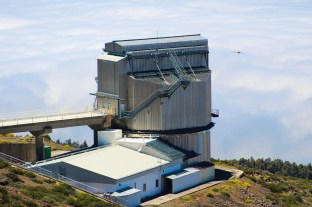
The TNG. This 21 year old telescope primarily contributes to the study of exoplanets, the most distant galaxies in the Universe and nearby comets and asteroids within our own Solar System.
We will be using the Italian owned 3.58-metre Telescopio Nazionale Galileo (TNG) with the HARPS-N instrument, located at the Roque de los Muchachos Observatory. At it’s highest point of 2,400 m above sea level, the observatory lies above a beautiful ‘sea of clouds below which we find ourselves surrounded by the vast extent of the Atlantic ocean. It is this body of water that ensures that the air at the observatory is very stable, providing us with the perfect conditions to look at stars, galaxies, and our own solar system. There’s good reason as to why they call this one of the best places on Earth to observe the night sky.
We will start to use the telescope tonight, at which point I’ll be able to tell you much more about how this exciting instrument works and about the thrilling process of discovering distant worlds.
 Planet Hunters