
Welcome to the Era of K2
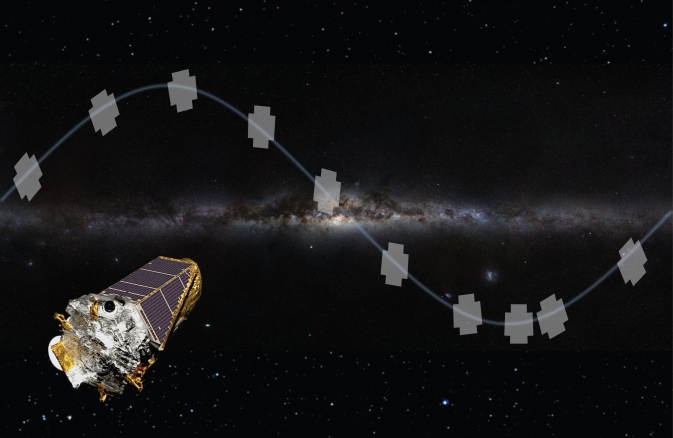
Image Credit: NASA Ames/ W Stenzel
Last August, I wrote about the end of Kepler’s original mission as it had been operating for the past 4 years. Kepler was launched in 2009 with a goal for providing a census for planets around Sun-like stars and helping us understand the frequencies of rocky planets. Kepler stared at the same field monitoring 160,000 stars nearly continuously for those 4 years. To achieve the precision pointing to obtain precise enough measurements to detect rocky terrestrial planets, Kepler had to point with extreme precision with the stars moving very little on the camera. To do this Kepler had three reaction wheels (and one spare) that would help nudge the spacecraft slightly one way or another. Last year, Kepler suffered a second reaction wheel failure that prevents it from continuing with its mission of monitoring the Kepler field. Pointing at the Kepler field, the spacecraft moves too much, and this effectively ended the Kepler mission as is. Kepler had taken its last observations of the Kepler field.
The Kepler team devised a new way of observing with Kepler using solar irradiation to help stabilize the spacecraft and act as the third reaction wheel. They set out to test it and prove this was a viable mission (which they dubbed ‘K2‘) that would return interesting science and discoveries worthy of NASA funding. Back in December, NASA gave the go ahead for K2 to compete with other viable missions in the Senior Review. Well, what is this Senior Review? Space missions cost money. You have to pay for the engineers that keep the spacecraft happy and running, pay the project managers and support staff and scientists, have funds if there are guest observer programs, as well as it costs money to use time on the Deep Space Network to send commands to and receive the data from your favorite telescope. The NASA Senior Review is NASA’s way of prioritizing and deciding which already existing missions will continue on and receive funding from the limited amount of funds available to spend while building and launching new spacecraft. Ben Montet from Astrobites has a nice summary description of the competing missions from this year’s Senior Review. Funding is tight and although these missions and spacecraft have all produced interesting science and capable of continuing to do that, not every mission that was on the chopping block is guaranteed to get money to pay for its operating costs. There simply isn’t enough to go around.
Officially today, NASA has announced the results from the Senior Review. You can read the full report from the panel here and the response from NASA. The verdict from the panel for Kepler/K2: “This is an outstanding mission and we look forward to the results from the program. K2 uniquely addresses a range of observational goals and is expected to engage a broad community of scientists.” K2 has been recommended by the review to continue with the extended K2 mission, and NASA has agreed to provide funding. The Kepler team didn’t get all the money they asked for, but 90% of the requested budget more than enough for the K2 mission to officially start science operations in June. K2 is a go! There will be new light curves from never before seen stars coming from Kepler over the next 2 years!
Congratulations to everyone involved in the Kepler project who made this happen. They put in lots of tireless effort to find a way to use Kepler in a novel observing scheme and prove that it could deliver interesting science worthy of continuing on. The Senior Review specifically about the science goals and case for K2: “K2 will allow exoplanet surveys of all stellar classes,O-M, giants-dwarfs, and white dwarfs as well as the asteroseismology of late stars, studies of nearby open clusters for the fundamental properties of pre-main sequence (PMS) and zero age main sequence (ZAMS) stars, and explore supernovae and accretion physics in AGNs. These are but a small sample of what can be achieved with the study of precise photometric long term continuous data“ .
This is exciting times for the study of extrasolar planets, as Kepler is now primed to deliver a whole new crop of planets and other astrophysical discoveries and results. The Planet Hunters science team and the Zooniverse are working on preparing the site to be able to ingest and serve the K2 data to you all in a fast and efficient way. Stay tuned to this space as we get closer to August when the first science grade K2 data is released.
You can learn more about the K2 mission at http://keplerscience.arc.nasa.gov/K2/
The Role of Planetary Migration in the Evolution of the Solar System
In the past two decades, exoplanet hunters have discovered almost 1800 planets beyond the Solar System, and there is more than twice that number of potential candidates still awaiting further confirmation. Of the known alien systems, astronomers have found a substantial number of planets travel around their parent stars in truly unusual orbits, unexplainable by any planetary formation mechanism.
The list of peculiar cases includes bodies that travel along completely different orbital planes to one another, worlds that take millennia to complete an orbit, and those that possess extreme comet-like eccentricities. Even more extreme are the rogue planets out there that orbit no star, presumably having been ejected from their solar systems altogether. However, the most inexplicable bodies are hot Jupiters, which orbit their parent stars in a matter of hours to days at a fraction of the distance that Mercury lies from the Sun. At such close proximity to the star, temperatures would simply be too high for a massive planet to retain its gaseous envelope during formation.
If these bodies cannot have formed at their current locations this may mean that planetary orbits are subject to dramatic change throughout the evolution of a system; meaning that where we observe a body now may not be where it formed, or where it will eventually end up. This reordering is referred to by scientists as planetary migration.

Artist impression of an accretion disk. Image credit: NASA/JPL-Caltech
There are three ways in which planetary migration is understood to occur: the first describes a gas driven process in which the planetary disk effectively pushes or pulls the planet to a new position; the second arises as a result of gravitational interactions between neighbouring bodies, where a large object can scatter a smaller one and thereby create an equal and opposite resulting force back onto itself; and the third is due to another gravitational effect, tidal forces, which mainly occur between the star and the planet and tend to result in more circular orbits.
Surprising as it may seem to some, it is widely accepted that planetary migration has shaped and influenced the architecture of the Solar System quite dramatically. In fact, its dynamic past actually explains the existence and properties of several Solar System entities, and shows that our planetary system might not be as unique as once thought. So how have the planets moved since their birth?
It all began with the inward migration of the largest planet in the Solar System, Jupiter. The gas giant, weighing more than all the other planets combined, is believed to have travelled right up to the orbit of Mars, 1.5 AU from the Sun, before travelling back out to its present location almost four times as far. Luckily for Mars this occurred some 600 million years into the birth of the Solar System (around 4 billion years ago) before any of the terrestrial planets had formed and only four gas giants ruled the skies. At this time, Jupiter, Saturn, Uranus and Neptune possessed much more compact orbits and were surrounded by a dense disk of small icy objects.

Artist impression of planetary system. Image credit: Dana Berry, Harold Levison, Dan Durda, SwRI.
Jupiter was drawn towards the Sun by the first type of planetary migration, gas driven, whose effects work differently depending on the mass of the planet. For low-mass planets, like the Earth, the mechanism occurs when the planet’s orbit perturbs the surrounding gas or planetesimal disk driving spiral density waves into it. An imbalance can occur between the strength of the interaction with the spirals inside and outside the planet’s orbit, causing the planet to gain or lose angular momentum. If angular momentum is lost the planet migrates inwards, and if it is gained it travels outwards. This is known as Type I migration and occurs on a short timescale relative to the lifetime of the accretion disk.
In the case of high mass planets, like Jupiter, their strong gravitational pull clears a sizeable gap in the disk which ends Type I migration and allows Type II to take over. Here the material enters the gap and in turn moves the planet and gap inwards over the accretion timescale of the disk. This migration mechanism is thought to explain why hot Jupiters are found in such close proximity to their stars in other planetary systems. The third type of gas driven migration is sometimes referred to as runaway migration, where large-scale vortices in the disk rapidly draw the planet in towards the star in a few tens of orbits.

The three types of disk migration. Image credit: Frédéric Masse.
The best understanding of how the planets have moved in throughout our system’s evolution arose from the Nice Model, proposed by an international collaboration of scientists in 2005. This model suggests that at the inner edge of the icy disk, some 35 AU from the Sun, the outermost planet began interacting with icy planetesimals, influencing the second sort of migration to occur: gravitational scattering. Comets were slingshotted from one planet to the next, which gradually caused Uranus, Neptune, Saturn and the belt to migrate outwards. Jupiter’s powerful gravity flung the icy objects that reached it into highly elliptical orbits or out of the Solar System entirely, which in order to conserve angular momentum, further propelled its journey inwards.
An extension to this theory is the ‘Grand Tack model‘, which is named after the unusual course of Jupiter’s migration towards the Sun before stopping and migrating outwards again, like a sailboat tacking about a buoy. At the distance that Mars would later coalesce, material had been swept away due to Jupiter’s presence. This resulted in the stunted growth of Mars and a material-rich region from which the Earth and Venus formed, explaining their respective sizes. The gas giant’s travels also prevented the rocky material in the asteroid belt from accreting into larger bodies due to its strong gravitational influence. Although Jupiter swapped positions with the asteroid belt twice the movements were so slow that collisions were minimal, resulting in more of a gentle displacement.

The Nice Model, Gomes et al. 2005.
But why did Jupiter’s migration to the Sun’s fiery depths cease? For that it has Saturn to thank. As the two planets moved further away from each other, it was believed they became temporarily locked in a 2:1 orbital resonance. That meant that for every orbit of the Sun Saturn made, Jupiter made two. The Nice Model showed that the planetary coupling increased their orbital eccentricities and rapidly destabilised the entire system. Jupiter forced Saturn outwards, pushing Neptune and Uranus into extremely elliptical orbits where they gravitationally scattered the dense icy disk far into the inner and outer Solar System. This disruption in turn scattered almost the entire primordial disk. Some models also show Neptune to have been propelled past Uranus to become the farthest planet from the Sun as we now know it. Over time the orbits of the outermost planets settled back into the near circular paths we observe today.
The Nice Model explains the present day absence of a dense trans-Neptunian population and the positions of the Kuiper belt and Oort cloud. It also accounts for the mixture of icy and rocky objects in the asteroid belt, like water-rich dwarf planet, Ceres, which likely originated from the icy belt. The rapid scattering of icy objects, around 4 billion years ago, dates with the onset of the late heavy bombardment period, which is predominantly recorded from the Moon’s well-preserved surface.
However, there are problems with the original Nice Model, where some simulations found that the gradual 2:1 resonant coupling of Jupiter and Saturn would have resulted in an extremely unstable inner Solar System from which Mars would have been ejected. Later research has since resulted in the ‘Nice 2 Model‘, which in part suggests that the gradual scattering of planetesimals caused the two gas giants to fall into a 3:2 orbital resonance (not the originally proposed 2:1), allowing for the Nice Model to work with a stable inner Solar System.

Artist impression of the dispersed belt. Image credit: JHUAPL/SwRI
The final mechanism for planetary migration occurs through tidal interactions between different celestial bodies. Unlike gas driven migration and gravitational scattering, tidal forces act over a much longer timescale of billions of years. The process begins due to the Kozai mechanism, which is suggested to pump eccentricity into a planet’s orbit. As the tidal forces correct this effect by re-circularising its orbit the planet moves closer in. Whilst the orbits of the terrestrial planets are thought to have remained fairly stable throughout the evolution of the Solar System, this gradual process is likely to have slightly altered their paths and will remain to do so.
The knowledge of how our own planetary system evolved has helped answer many questions about unusual exoplanet orbits, but there is still a lot left to uncover. One such question asks why we observe so many hot Jupiters unfathomably close to their star, as without another large body’s influence, should it not eventually be swallowed up? Perhaps planet-disk interactions decouple at such close proximities to the star and tidal forces prevail, or perhaps we are capturing a snapshot in time just before the planet meets its fate. For now only time, further observations and, most importantly, more exoplanet discoveries will tell!
An Unusually Active SU UMa-Type Dwarf Nova

Taichi Kato of Kyoto University and Yoji Osaki of the University of Tokyo recently published a paper on an unusual dwarf nova spotted by Planet Hunters’ volunteers that was contaminating the photometric aperture of a Kepler target star. A dwarf nova is a binary star system where one of the pair is a normal star and the other is a white dwarf. The objects orbit so closely that material from the star is falling onto the white dwarf with an accretion disk of material around the white dwarf. The light from the system is dominated by the accretion disk. Thus changes in brightness reflect the temperature and state of the accretion disk. This is the 2nd Planet Hunters dwarf nova/cataclysmic variable find to be published in the astronomical literature. Congratulations to the volunteers involved. The first Planet Hunters discovery paper was published in the Fall of last year, and you can read more about that object here.
Drs. Kato and Osaki found the discussions about this light curve from a volunteer curated blog that highlights interesting finds from Talk and the Talk thread about this interesting source . They went on to follow-up the find and further investigate the dwarf nova combining ground based, space-based telescope data, and the Kepler light curve. They found that this dwarf nova exhibited unusual features in the light curve (brightness of the accretion disk) for having a very short orbital period of the companion star.
Congratulations to all involved in this intriguing find. You can read about the study in detail with the preprint of the paper available here.
Studying the Chemistry in Protoplanetary Disks (Part I)
Today we have a guest post from Colette Salyk. Colette is the Leo Goldberg Postdoctoral Fellow at the National Optical Astronomy Observatory in Tucson, Arizona. She studies the evolution and chemistry of protoplanetary disks (the birthplace of planets) using a variety of ground and space-based telescopes.
One of the most interesting results to emerge from planet-hunting surveys is that planets and planetary systems are really diverse. I am trying to understand this diversity by studying the birthplace of planets – disks of gas and dust around young stars that we call “protoplanetary disks”. In particular, I study the chemistry in protoplanetary disks. In this post, I’m going to explain some of the techniques we use to detect and study molecules in protoplanetary disks using ground-based telescopes. In particular, I’m going to discuss the importance of the Doppler shift.
To detect molecules, we look for their unique spectral fingerprints. So we use spectrographs, usually on a large telescope like Keck or Gemini Observatory, or the Very Large Telescope. These observations require a lot of photons! But one challenge for these types of observations is that, if we’re observing simple molecules like water, carbon monoxide or methane, for example, these same molecules sit in the earth’s atmosphere and preferentially absorb the very photons we’re trying to detect.
This is where Doppler shifts come to the rescue. You may be familiar with Doppler shifts in the context of radial velocity searches for planets, in which the periodic Doppler shift in stellar absorption lines is produced by the gravitational pull of an orbiting planet. Recall that Doppler shifts are shifts in wavelength that are produced by relative motions between a source emitting photons, and an observer. If the source and observer are moving towards each other, the source looks blueshifted — its spectrum moves towards shorter wavelengths; if they are moving away from each other, the spectrum looks redshifted, like it has moved to longer wavelengths.
In our case, because both the protoplanetary disks and the earth are moving in space, the light emitted by molecules in the disk are seen at earth to be shifted in wavelength. Therefore, the wavelength of light we’re trying to detect is no longer exactly where molecules in our atmosphere want to absorb light.
The figure below shows an example of this. The red line shows the percent transmission of light through the earth’s atmosphere as a function of wavelength, as observed at the top of Mauna Kea. Note that at some wavelengths, the transmission is significantly less than 100%, meaning that the atmosphere absorbs a significant fraction of the light it receives from space. These regions are where water vapor molecules in the earth’s atmosphere are sucking up photons. In black is a spectrum of emission from a protoplanetary disk, obtained with the TEXES spectrograph on the Gemini North telescope. The peak in this spectrum was emitted by water vapor molecules in a protoplanetary disk. Note that it’s shifted relative to the sky absorption line due to the Doppler shift. In this case, the shift of the source line relative to the earth is consistent with a relative velocity of 18 km/s (∼40,000 miles/hour).

Spectrum of emission from a protoplanetary disk (black), obtained with the TEXES spectrograph on the Gemini North telescope. The peak in this spectrum was emitted by water vapor molecules in a protoplanetary disk. Image credit: Colette Salyk
This Doppler shift wasn’t just obtained by chance. Because it’s the relative motion of the earth and the disk that determines the observed Doppler shift, this shift actually changes throughout the year, as the earth orbits around the sun. The diagram below is a schematic representing a top-down view of the earth’s orbit, with the location of the Earth at four hypothetical dates, as well as a possible location on the celestial sphere of a protoplanetary disk. Note that while the Earth orbits the sun at a nearly constant speed, the direction of its velocity (represented by the arrows) changes. So there are times of the year when the spectrum of this protoplanetary disk is shifted towards longer wavelengths, other times when it is shifted towards shorter wavelengths, and times when it is not shifted at all.
Assuming the geometry in this schematic, what time(s) of year might you expect the Doppler shift shown in the first figure? When do you think would be the ideal time(s) of year to plan observations of molecules in this disk? When would be the worst times of year?

Image credit: Colette Salyk
Once we detect the molecules, what do we learn from them about planet formation? I’ll discuss this in more detail in a future post. But here’s some food for thought. The architecture of the solar system has a very clear division between terrestrial planets (at 1.5 AU and within) and giant planets (at 5 AU and beyond). What might have caused this dichotomy, and should we expect to see it in exo-planetary systems as well?
This is Not a Simulation
When someone tries to explain the concept of planet transits, you often see simulated graphics like the one below:
Well James Gilbert from the University of Oxford took the video of the transit of Venus he captured in 2012 (which was a real example of the transit technique in our backyard) and made the simulation into a reality. He measured the Sun’s brightness throughout the duration of the transit video, and the result is the below:
That’s no simulation! It’s truly amazing. You can find out more about how James made the video and took the footage at his blog: LabJG: James Gilbert.
The Search for Supereccentric Jupiters
Today we have a guest post from Bekki Dawson. Bekki is a Miller postdoctoral fellow at the UC Berkeley Department of Astronomy. Her research focuses on how planetary systems form and evolve.
The origin of “hot Jupiters,” giant planets orbiting extremely to their host stars, remains a mystery. There are two major theories for how these planets “migrated” from a location like our own Jupiter’s to the close-in orbits we observe today. The first is gentle disk migration, in which the disk out of which the planet forms pushes the planet towards the star. The second theory is more violent: another body in the system perturbs the Jupiter onto a very eccentric (elliptical) orbit. Over time, tides on the planet cause dissipation that shrinks and circularizes the planet’s orbit. In 2012, Aristotle Socrates and collaborators predicted that if this secondary theory is correct, we should find half a dozen “supereccentric” Jupiters in the Kepler sample: Jupiters that are still on very elliptical orbits and have not yet tidally circularized.
To search for these supereccentric Jupiters in the Kepler sample, John Johnson and I developed an approach we call the “photoeccentric effect” to identify eccentric Jupiters from the Kepler photometry. The approach hinges on the fact that a planet transiting on an eccentric orbit will be moving at a very different speed than a planet transiting on a circular orbit with the same orbital period, leading to a different shape and duration for the transit light curve:

Even taking into account various degeneracies, we can easily identity the supereccentric Jupiters from their Kepler light curves. But surprisingly, we didn’t find any, inconsistent with the prediction. Therefore hot Jupiters continue to be a puzzle! However, the expected number was based on the number of planets that transit at least three times in the Kepler data, so in the future we hope to measure the eccentricities of giant planet candidates with only two transits; if those are missing too, the evidence would be even more compelling. Unfortunately, giant planet candidates with only two transits are not automatically caught by the Kepler pipeline, so if you spot any, let me know!
Planet Hunters at the Citizen Science in Astronomy Workshop
Last week, I co-hosted and co-organized the workshop on Citizen Science in Astronomy in Taiwan at my home institute, the Institute of Astronomy and Astrophysics at Academia Sinica. The aim of the workshop was to bring together scientists from astronomy-based citizen science projects, computer scientists, and web developers to spend a week working on the problems and issues that we jointly have in common when processing citizen science data and looking at how to improve these methods in the era of petabyte datasets that is just around the corner with facilities like the Square Kilometer Array (SKA) and the Large Synoptic Survey Telescope (LSST) being built in the coming decades. In addition to Chris Lintott and myself representing Planet Hunters, several members of the Zooniverse development team and people from the science teams of Galaxy Zoo, Space Warps, Moon Zoo, Radio Galaxy Zoo, Planet Four, and the Andromeda Project were participating in this workshop. I had some really productive conversations and input on where to take the current analysis for the Planet Hunters data reduction that I’ve been working on in the past few weeks and months. All and all, it’s been a tiring but fun week.
The video and slides from the invited talks from the first day of the workshop are available online. Chris gave an overview talk on the Zooniverse and Citizen Science in Astronomy:
Stuart Lynn gave an overview of the technical side of the Zooniverse:
I gave a talk giving an overview of Planet Hunters:
Meet Our Talk Moderators
As many of you probably know, we have three moderators who volunteer their time to help the Planet Hunters community on Planet Hunters Talk . If you have questions, issues, or the rare dispute on Planet Hunters Talk, Jo, Joe, and Tony are a great resource. You can contact them directly via private message or hit the report button to alert them to a thread or post that requires their attention.
Let’s learn more about them:
Jo Echo Syan (echo-lily-mai)
Hi Planet Hunters. My tag is echo-lily-mai, many people wonder what to call me? Well, Echo is fine and some call me Lily. I’m very honoured to be moderator on PH and to be part of such a ground-breaking project.
I remember being in a room in Oxford England with other zooites (zooite is a pet term for people working on a Zooniverse project ) when the Planet Hunters project was announced. I can remember being seriously enthusiastic about the idea.

Planet Hunters Talk Moderator Jo Echo Syan
Here are some photos of us ‘zooites’ at Astrofest this year.

Image credit: Jo Echo Syan

Image credit: Jo Echo Syan
Over the years, I have worked on a few other Zooniverse projects. Galaxy Zoo which I am very fond of, and as a moderator on the now sadly retired Merger Zoo project.
I am interested in Art and Science and try to explore the two subjects through my Enjoy Chaos pages.
There are some amazing projects PH folks are working on at the moment, and I feel very proud to be part of the team when Planet Hunter papers are published.
This has only been possible because each and every person took part and helped with the project, whether that culminated in finding a planet candidate or not!!
I hope that I can help along the way, even if it is directing someone new to a link where they can find out what an eclipsing binary is (yep they look amazing) Or, by passing information on to the science team that needs to be checked out.
If you are new to PH, do ask questions, feel free to explore, and behave!!!! You can always contact a moderator if you have any concerns. Most of all enjoy.
We are all very lucky to be part of this science community, which a few years ago never existed and wouldn’t have been possible.
Is our Earth special? Of course it is. Is it unique? I hope we find out one day…
Tony Hoffman (TonyJHoffman)
My name is Tony Hoffman, and I’ve been fascinated by the night sky since I was an adolescent. Over the years I’ve participated in a number of citizen science astronomy projects, including the SOHO comets program; the Spacewatch FMO Project (near-Earth asteroids); Ice Hunters (Kuiper-belt objects), Stardust@home (interstellar dust); GalaxyZoo; and SETI@home; and have even had some success in finding new astronomical objects in several of them.
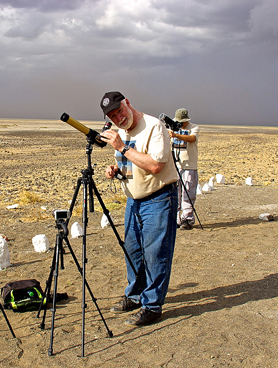
Planet Hunters Talk Moderator Tony Hoffman – The photo is of me in Kenya, about to find out that eclipses and dust storms don’t mix!
When Planet Hunters was launched, I shifted my focus to it, as the search for planets orbiting other stars is one of the great quests of our time. Up until I was in my 30s, there were no known exoplanets. In just the past 2 decades, a profusion of planets and solar systems have been found. The idea that ordinary people such as myself can take part in this endeavor staggers my imagination, and the success of Planet Hunters—in which a group of people “eyeballing” light curves have been able to find planets that eluded the Kepler project’s own search algorithms—has been a wonderful vindication of the idea that the human eye is better at some forms of pattern recognition than machines. It’s been a thrill to play an active role in Planet Hunters, and to have contributed to the discovery of at least one new world. I’m glad that Planet Hunters has been able to play a role in helping to survey what sort of worlds are out there, and how other worlds and solar systems are like or unlike our own.
I live in New York City, and I work as a writer. I’m glad to be able to help chronicle some of this great age of discovery. Being involved as a moderator in Planet Hunters has given me a personal connection to the science of exoplanetology. I’ve encountered some brilliant people whose skill at analyzing transits far exceeds my own. Although only a small fraction of the 200,000 (??) Planet Hunters volunteers may get their name on a paper or receive any formal recognition, everyone who classifies transits has an important role as a node in this vast human “computer” that can take graphs of a star’s brightness and find new worlds within them
Joe Constant (constovich)
Hello Citizen Scientists! I am Joe Constant and I live in South Carolina, USA with my wife and two beautiful daughters. From a young age I daydreamed about far away and fantastical places. Planet Hunters allows me to look skyward and potentially find some. We live in an exciting time, with the potential close at hand to answer one of humanity’s oldest questions – “are we alone?” The only time I would rather live in that now is in our future where our transportation technologies advance to the point to allow us to reach the distant rocks we are only now able to see.

Planet Hunters Talk Moderator Joe Constant
An Introduction to MAST
Today we have a guest post from Scott Fleming. Scott is a scientist at the Space Telescope Science Institute, located in Baltimore, MD, USA, where he works on the data archives. His research interests include eclipsing binaries, stellar astrophysics, brown dwarfs, and extrasolar planets. Today Scott is here to tell you a more about MAST, the online public data archive where the Planet Hunters team obtain the Kepler light curves that are processed and eventually show up on the Planet Hunters site for you to classify.
The Mikulski Archive for Space Telescopes (MAST) is the official archive of data from NASA-funded space telescopes. We primarily house data from ultraviolet and optical space telescopes. Some of the missions we support include GALEX, the Hubble Space Telescope, the James Webb Space Telescope (after it launches), and of course, Kepler. We also archive, and plan to archive, data from many other missions that have launched over the past 40 years, ranging from the 1970’s to future space and ground-based telescopes.
Our role in the Kepler mission is to serve as the Data Management Center. This means that, in addition to some data processing, we archive the lightcurve data itself (the timestamps, fluxes, flux uncertainties), as well as information related to each observation that’s required for calibration purposes, and catalog information that contains data on the host stars (their brightness in different wavelengths, estimates of their temperatures and sizes, etc). We primarily serve professional researchers by facilitating access to the data, enabling powerful search capabilities so they can locate the data they need for their research, and providing tools that allow the scientists to preview and visualize the data before they download it to their machines for further analysis. However, we do have some online tools that are used by educators and amateur astronomers as well.
Our newest tool is the MAST Discovery Portal. This online search interface allows users to enter coordinates or target names and do a search for data across many missions all at once. This is kind of like a “Google” for astronomical data, where users can discover observations that may have been taken on their objects, even if they weren’t aware of its existence beforehand. You can enter the coordinates or name of a Kepler star, for example, and discover what other data exist by searching “All MAST Observations” or the “All Virtual Observatory Collections” in the top-left menu. The Virtual Observatory is an online service that provides access to data from other astronomical archives around the world. This allows users to search not only the ultraviolet and optical data at MAST, but also data in the radio, infrared, x-ray, and gamma-ray.

MAST Discovery Portal Astroviewer (image credit: Scott Fleming)
The Discovery Portal includes an AstroViewer. Using background images of the sky created from ground-based surveys, users can see the “footprints” (i.e., the field-of-view) of a given piece of data, and see exactly where your objects lie inside. If you’d like to try it out, do a search on “Kepler 2”. In the AstroViewer on the right-hand-side of the screen you will see lots of footprints appear. The small squares around stars in the field are from Kepler; they show which stars Kepler looked at in the field. Our target, Kepler 2, is automatically centered in the AstroViewer. You will notice larger squares around it, which are the footprints of data observed with the Hubble Space Telescope. If you zoom out to larger scales using the “minus” button on the lower-left corner of the AstroViewer, you will start to see very large squares and circles. The biggest squares come from the Swift space telescope, while the large circle is an observation from the ultraviolet GALEX space telescope. You can see how this visualization of data from many missions allows users to discover new data on their targets, and look for cross-mission overlap that can enable new kinds of science when multiple instruments observe the same target.
Feel free to try out the Discovery Portal for yourself. There is no registration or login required. You can follow MAST online on Facebook and follow us on Twitter @MAST_News. Although our posts are directed at professional astronomers to alert them when new data and tools are available at MAST, it’s still a way to keep up-to-tabs on what new projects are happening in the professional astronomy circles.
15 percent of 1 million
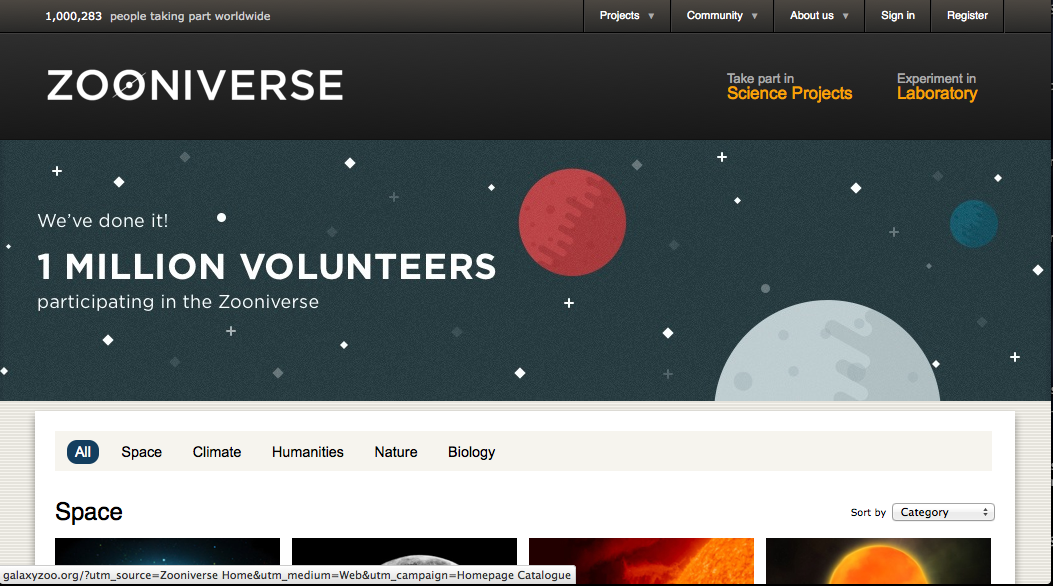
The Zooniverse achieved a major milestone last Friday. The 1 millionth (that’s right 1 with 6 zeros after it!) person registered for a Zooniverse account. While writing this blog, I decided to go and read the very first blog post formally announcing the Zooniverse. It’s amazing to see how far the Zooniverse has come and see the interesting science and exciting discoveries that have been produced as a result: starting with Galaxy Zoo launching in 2007 to Planet Hunters launching in 2010 (where we were the 10th Zooniverse project) to the Zooniverse today now with over 20 projects spanning not just astronomy but biology, ecology, history, and more. Congratulations to all involved!
If you’re interested in seeing how those 1 million volunteers are distributed, Rob Simpson has created a global map of the Zoonvierse community. Also Grant Miller and Rob Simpson have come up with some other cool graphics and interesting statistics about the Zooniverse on the eve of the 1 millionth registered volunteer. Check them out here, here, and here. Also if you’re interested in seeing all the scientific publications from Zooniverse projects (including the 6 published Planet Hunters papers), you can find them all on the Zooniverse publications page.

Image credit: Brooke Simmons
This accomplishment is yours too. Our estimate is over 280,000 people world wide (unregistered and registered volunteers) have participated in Planet Hunters. 150,000 registered Zooniverse volunteers have classified at least one Planet Hunters light curve. Roughly 15% of the 1 million registered Zooniverse volunteers have contributed to Planet Hunters science. That’s a huge representation! Thank you for the time and effort you put into Planet Hunters. We appreciate the time and effort you put in to help make the science happen. Thanks for being part of the Planet Hunters community and the larger Zooniverse community.
So let’s celebrate this milestone in the only way that seems fitting: classify light curves today at http://www.planethunters.org or maybe (just for today 😉 ) even take a look at some of the other Zooniverse projects at http://www.zooniverse.org
May the Zooniverse Live Long and Prosper!

