
Assessing the Kepler Inventory of Short Period Planets
You might remember that I’ve been working on a systematic search of the Q1 light curves to examine the frequencies of large planets (> 2 R⊕ -Earth radii) on orbits less than 15 days. I’m happy to announce that my paper titled “Planet Hunters: Assessing the Kepler Inventory of Short Period Planets” has just been accepted to Astrophysical Journal. The paper is available on-line here if you’d like to read it (warning: it’s quite long coming in at 22 pages of single spaced text, 13 figures, and 8 tables!), but I’ll give the highlights below.
We wanted to see for Q1 light curves, how well we could find planets and what might be left remaining there to be found compared to the known Kepler sample of planets. I think this important because Planet Hunters can serve as a separate estimate of the planet abundance and Kepler detection efficiency. I decided first to concentrate the search of planets with periods less than 15 days so that I was certain there would be at least two transits visible in the Q1 light curve. I thought it might be harder for us to identify transits if there was only one dip, so I thought it would be a good idea to start where there were at least transits.
To figure out which of the light curves had transits, I developed an algorithm to combine the multiple classifications for each light curve (for Q1 on average 10 people classified each ~33 day Kepler light curve) by developing a weighting scheme based on the majority vote. What the weights are doing is really just helping me pay a bit more attention to those that are a bit more sensitive at finding transits when combining the results from everyone who classified that light curve. The weighting scheme makes us more sensitive to transits than if I just took the majority vote for each light curve and helps to decrease the false positives. Below is the distribution of user weights for Q1 classifiers.
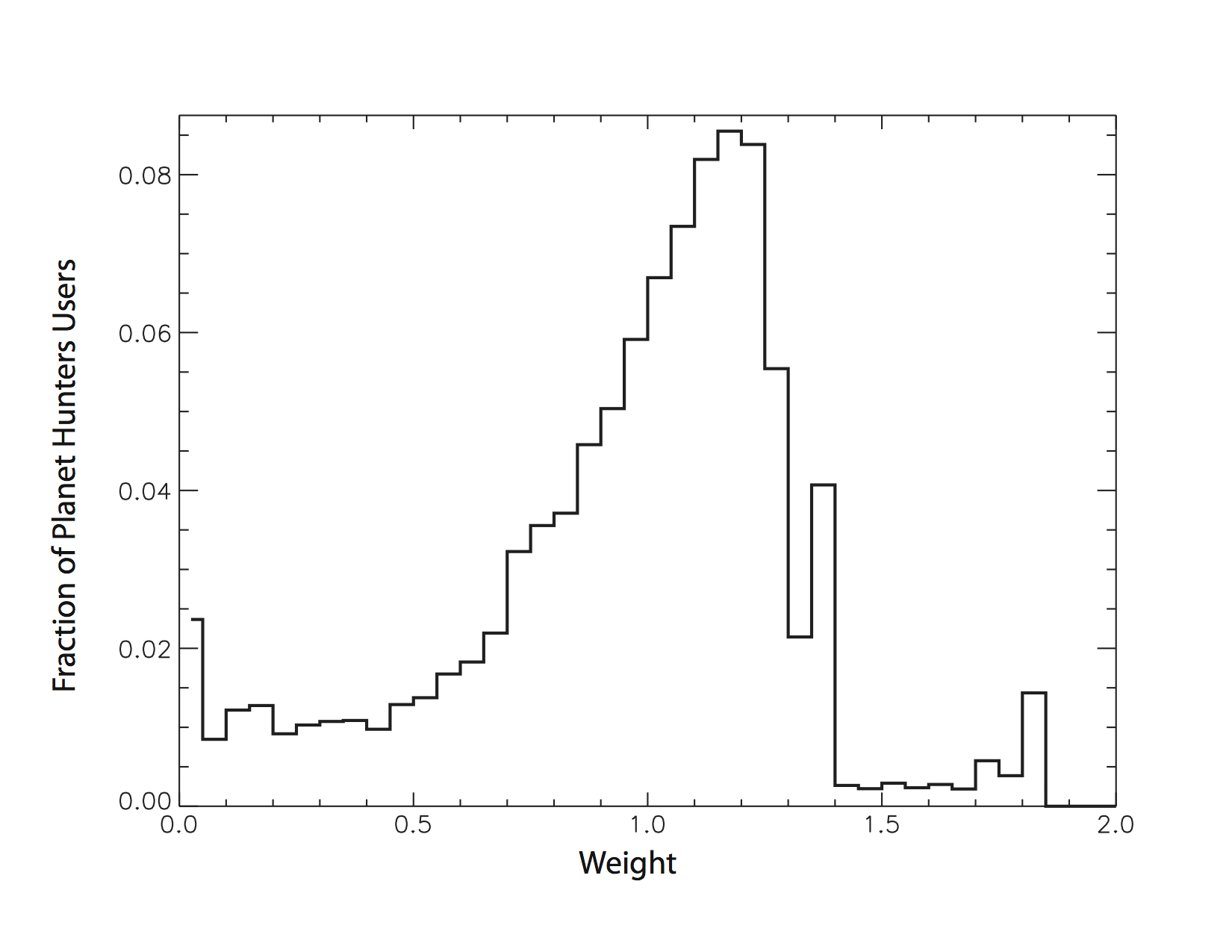
Distribution of Q1 Planet Hunters user weights binned in 0.5 bins
Using the user weights, I am able to give each light curve a ‘transit’ score (the sum of the user weights who marked a transit box divided by the sum of the user weights for everyone who classified the light curve). To narrow the list from 150,000 light curves, I picked those light curves that had ‘transit’ scores greater than 0.5 as my initial list of candidates. I applied several additional cuts to widdle down the list (you can read all about those details in the paper). That left about 3000 light curves and approximately 4000 simulations to go through. So to identify those that had at least two transits in them, we turned to a second round of review where light curves were presented in a separate interface and volunteers were asked whether they could see at least two transits (ignoring the depths being the same or not) in the light curve and asked to answer either asked to answer ‘yes’, ‘no’ or ‘maybe’ to the question. Those light curves where the majority of classifiers said ‘yes’ were moved on to review by the science team. A big thank you to everyone helped out with the Round 2 review; your efforts are acknowledged here. As always we acknowledge all those who contribute to Planet Hunters science on our authors page.
At the end of the search after removing all the known planet candidates and transit false positives known before February 2012, there were 7 light curves that have transit-like events but not on the original Kepler candidates list published back in 2011 that used only Quarters 1 and 2. I show example transits from each of these 7 light curves in the Figure below. One of these light curves turns out to be one of the candidates from our first paper and another one was part of our co-discoveries with the Kepler team. Even those these 7 light curves weren’t found in the first Kepler candidate releases, they now have been found in the latest iteration of the Kepler candidate list released earlier this year, where they’ve used an updated and improved versions of their detection and data validation pipelines. So what that shows is that the Kepler detection and validation processes has indeed gotten better, but there’s more that we can say.

Zoom-in of selected transits for each set of transit identified visible in short period candi- date light curves remaining after Round 2 review and visual inspection. Visually the science team could identify two separate sets of repeating transits in the mutli-planet KIC 8240797, 9729691, and 11551692 based on the user drawn boxes We note that the snapshot of KIC 8240797 contains two independent transit events.
Now that we know what new things we found, and that there wasn’t anything more than the 7 candidates that are now KOIs on the latest Kepler candidate list, we can look at what that says for the completeness of the short period planet inventory. Using the simulations that you’ve helped classify, I was able to look at how good Planet Hunters is at detecting planets of different sizes on orbits less than 15 days. I randomly selected about 7000 light curves that at the time weren’t known to have transiting planets or were not eclipsing binaries and inject synthetic transits into them for varying planet radii (ranging from 2- 15 R⊕) and periods less than 15 days. The simulations are really important because one completed I could see what which of the simulations made it to the end of my candiate pipeline and which ones didn’t. Having the results from those classifications really made the heart of the paper, because we could show independent of the Kepler planet candidates and detection and validation processes, what we were sensitive to.
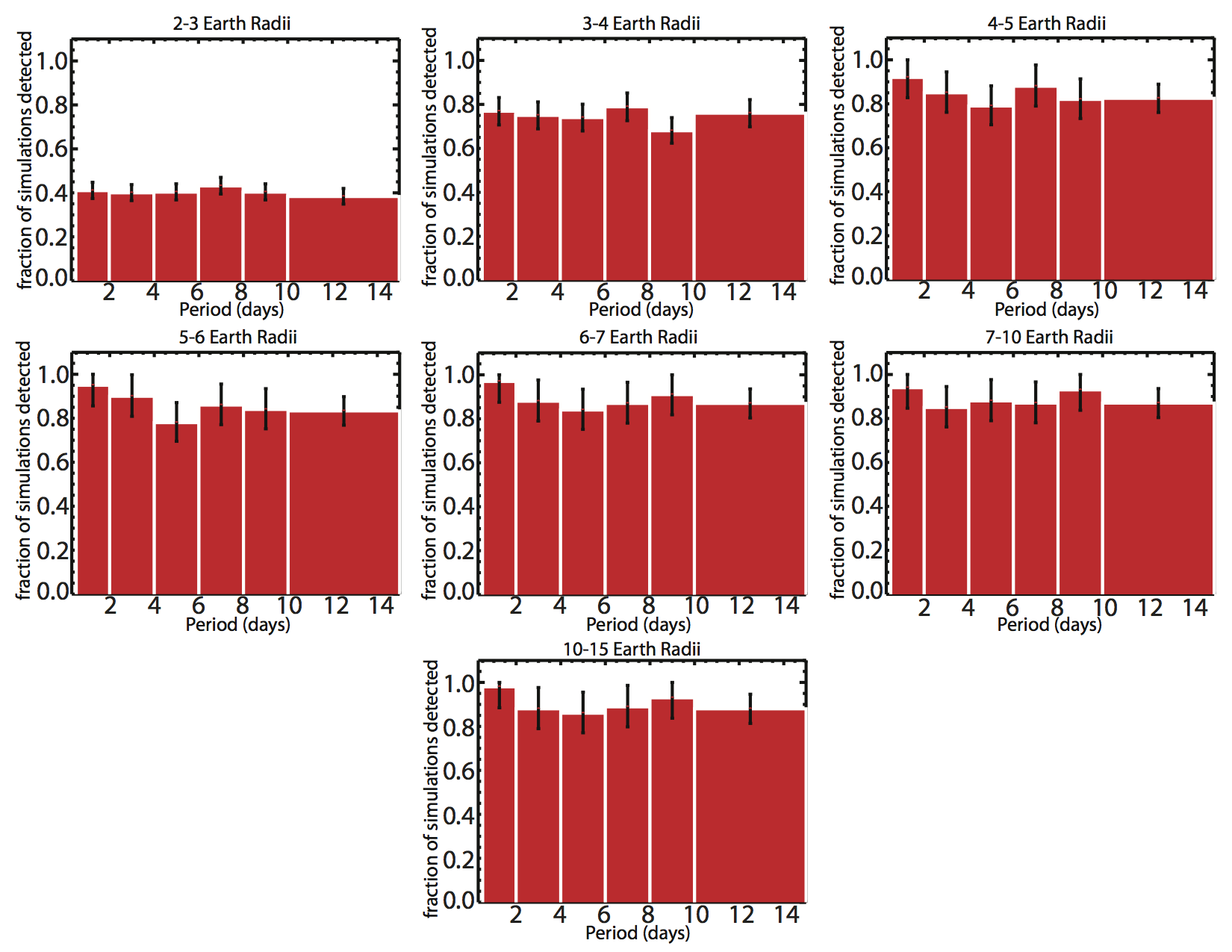
Efficiency recovery rate for simulated planet transits with orbital periods between 0.5 and 15 days and radii between 2 and 15 R⊕.
What was striking to me, was our detection efficiency is basically independent of orbital period and that whether there were 2 or 15 transits in the light curve, they were just as easily identified. I think this bodes well for us being just as sensitive to single transit events (I’m starting to work on testing that now). Although performance drops rapidly for smaller radii, ≥ 4 R⊕ Planet Hunters is ≥ 85% efficient at identifying transit signals for planets with periods less than 15 days for the Kepler sample of target stars. For 2-3 R⊕ planets, the recovery rate for < 15 day orbits drops to 40%. I compared to the Kepler planet candidates and found similar results (which is a good check).
Our high recovery rate of both ≥4 R⊕ simulations and Kepler planet candidates and the lack of additional candidates not recovered by the improved Kepler detection and data validation routines and procedures suggests the Kepler inventory of ≥4 R⊕ short period planets is nearly complete!
The Transit of Venus and the Scale of the Universe
I’ll start by introducing myself as I’m not involved in Planethunters, but Meg asked me if I could write an article for you here about the Transit of Venus after I mentioned on Twitter that I was enjoying researching the topic for a talk I’m giving. I’m a Research Fellow at the Institute of Cosmology and Gravitation at the University of Portsmouth/SEPNet (South East Physics Network), and I’m funded by The Leverhulme Trust as an Early Career Fellow to work on Galaxy Zoo science. I’ve been part of the Galaxy Zoo science team since 2008 and I lead the studies of the interesting class of red spirals which were found by Galaxy Zoo, and am also interested in the role bars seem to have in slowing down star formation in spiral galaxies. You can read blog posts I’ve done for the Galaxy Zoo blog, which include explanations of these studies at http://blog.galaxyzoo.org/author/karenlmasters/
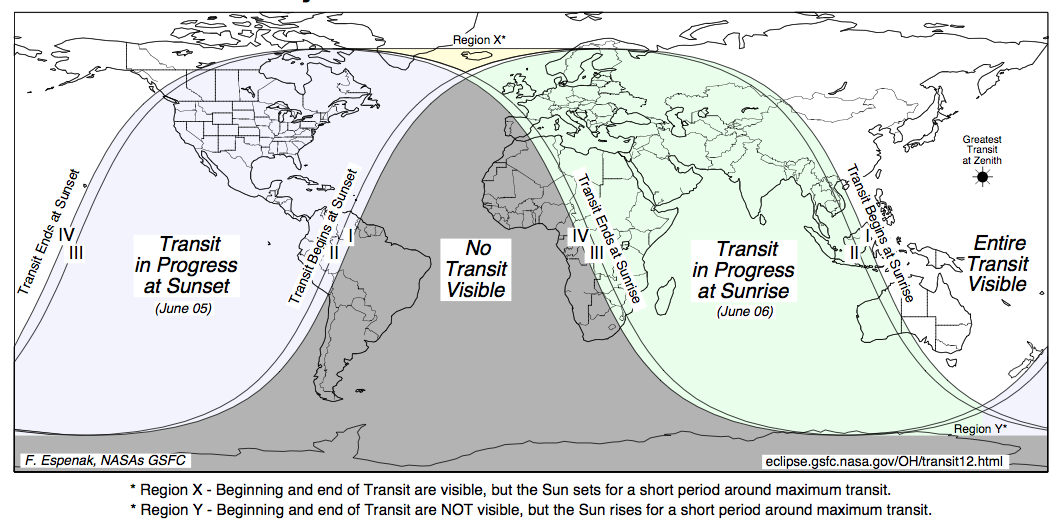
On 5th/6th June 2012 Venus will pass between the Earth and the Sun. It’s shadow will cross the Sun taking about 6 hours in total, although the length of that which is visible varies significantly depending on where you live on Earth. In the USA the beginning of the transit will be visible as the Sun begins to set on 5th June, while in the UK we’ll see the end of the transit after the Sun rises on 6th June.
The planet Venus orbits the Sun inside the orbit of the Earth, and passes between the Earth and the Sun quite frequently. However the planes of the two orbits aren’t quite aligned, so most of the time Venus passes either above or below the disk of the Sun. Actual transits are rare, but very predictable. They happen in pairs separated by 8 years, and then after each pair follows a period of either 121.5 or 105.5 years without any transits. The 2012 transit is the second of a pair – astronomers around the world viewed the first transit of the modern age in 2004, and the next transit won’t happen until December 2117.
To view a transit of Venus does not need to be technically challenging, but in its simplest form involves looking at the Sun – so some safety precautions must be taken. You must never look directly at the Sun! Serious eye damage or even blindness could occur if you did that, so take this warning seriously! My advice for viewing the transit if you are not a keen amateur astronomer, or able to get to a viewing party, is to either get your hands on a pair of Safe Solar Viewers (like these ones from Astronomers Without Borders), or to view the event via a web cam (like this one from Hawaii where the entire transit is visible, or GLORIA which is planning to show feeds from Australia, Japan and Norway). This last method also has the advantage (especially for UK viewers) of not being affected by local cloud cover, and has exactly zero risk of eye damage! If you come to one of my talks I hope to have solar viewers to hand out.
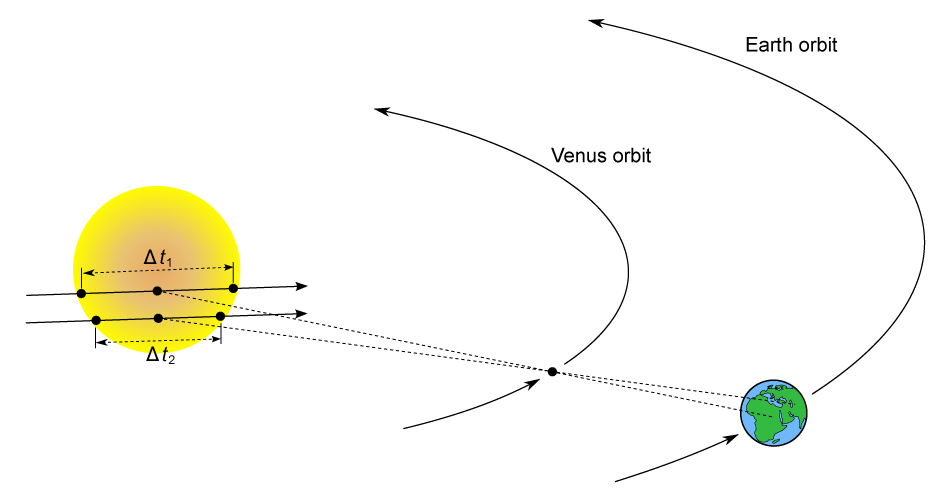
So why should you care about a black dot crossing the Sun, or perhaps more pertinently, why do I, and an astronomer who studies galaxies, and works in a cosmology department care enough to write a blog post about it and give several talks? Well historically transits of Venus have been very important in helping astronomers understand the scale of the solar system, and from that the scale of the Universe. Basically when Venus crosses the Sun we know that it, the Sun and the Earth are all in a straight line. Very slight differences in the viewing angle from two observers on the Earth can then be used along with our basic knowledge of trigometry to measure the distance to the Sun. For over 100 years, the distance to the Sun measured this way was the most accurate measurement we had.
From knowing the distance to the Sun, we can use slight changes in the apparent position of nearby stars as the Earth orbits the Sun to get their distances (more triangles – this is called the parallax method), and from those stars we calibrate methods which use stars of known or estimated brightness to estimate distances to nearby galaxies, and we jump from distances to nearby galaxies to more distant galaxies and eventually the whole universe. The distances to faraway galaxies have taught us that the universe is expanding and started in a Big Bang around 15 billion years ago, and even if we go to the observations that suggest the universe contains a mysterious “Dark energy” (which won the 2011 Nobel Prize in Physics), they are ultimately based on us knowing the distance to the Sun. So that’s why I think it’s important.
Here in Portsmouth we’re running a workshop about the transit of Venus on HMS Warrior, in the Portsmouth Historic Dockyard. We plan to demonstrate the triangulation method by using it to estimate the distance from the Warrior to the local landmark “The Spinnaker Tower”. Two people will stand on the desk and we’ll mark out from them the direction to the Spinnaker Tower. Making one of the angles a right angle, we can then estimate the distance to Spinnaker (which is about 300m) by d = b/cos A, where A is the other angle, and b is the distance between the two people on deck.
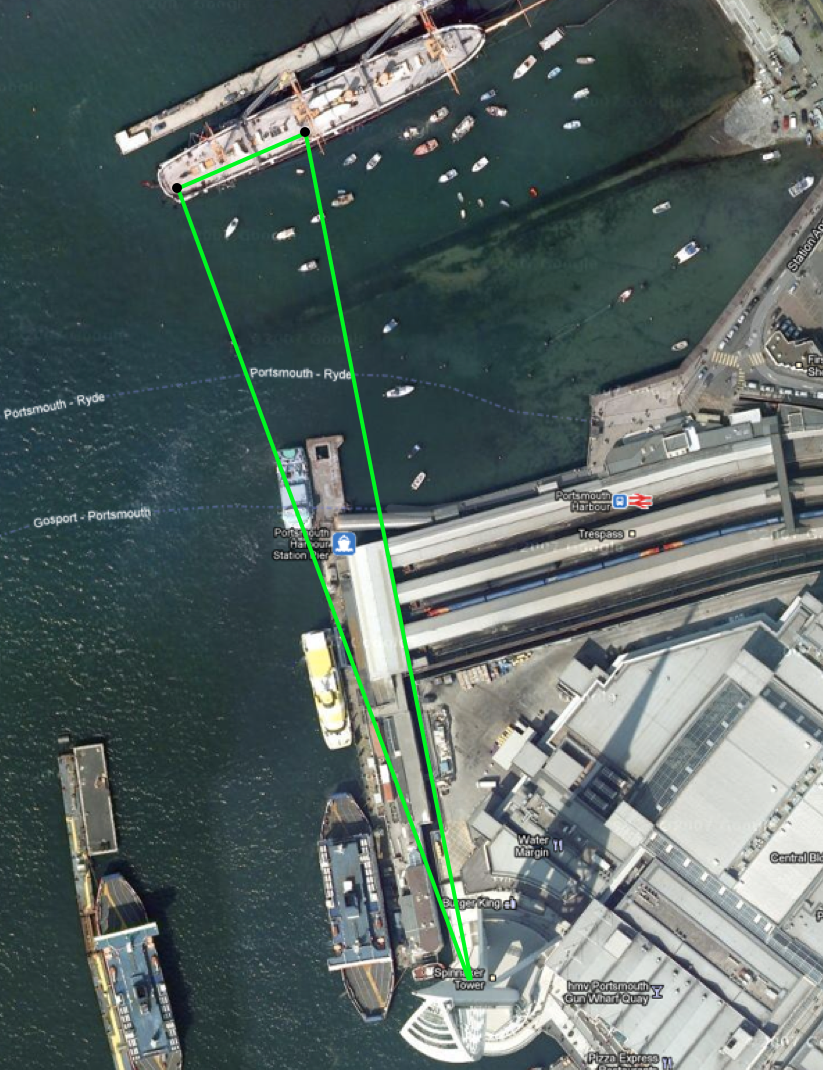
Google Map image of Portsmouth including HMS Warrior (top) and The Spinnaker Tower (bottom).
This isn’t exactly the method used in the historical measurements, but it demonstrates the idea. Of course when observing the transit of Venus from two widely separated places on Earth, it’s not exactly easy to measure the angle between the sight lines. What Edmund Halley figured out in 1678 was that if you could measure the times when Venus stars and ends its transit you can get at the same information.
In all of recorded history, we have records of a total of six transits of Venus that have been observed (1639, 1761, 1769, 1874, 1882 and 2004). You have to feel sorry for Johannes Kepler, who predicted the transit which occured in 1631, but then died in 1630. No-one is recorded to have used his prediction that year. Jerimiah Horrocks and Willam Crabtree (two British astronomers who were friends) have the honour of being the first humans known to have seen Venus transit. Horrocks found and improved Kepler’s earlier predictions, and both men successfully observed the 1639 transit from Northern England (in December!).
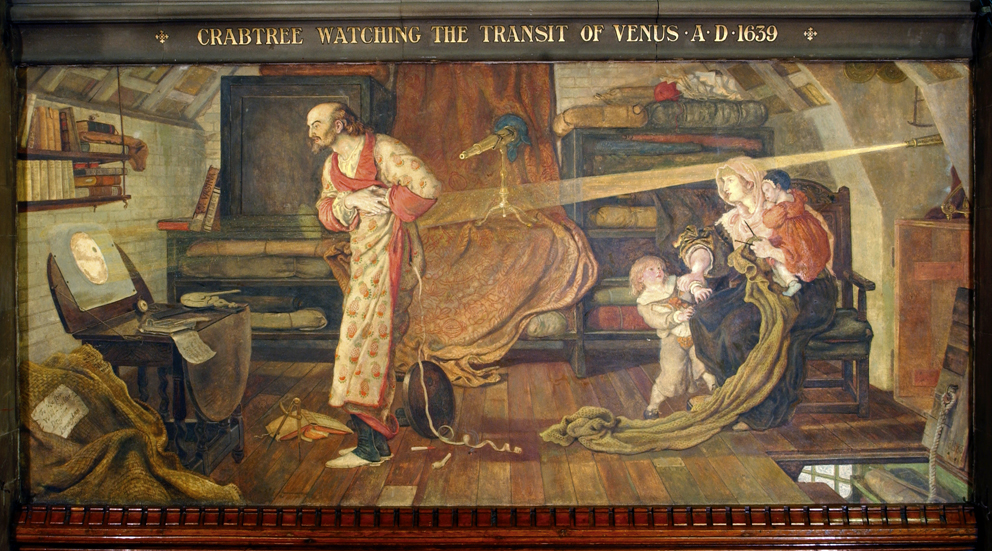
Scientific observation of the transit started in the 18th century following Halley’s suggestion to use it to measure the distance to the Sun. There is a hugely rich and entertaining history of these expeditions to view the transit, and several books have been published. I’m just going to tell you a couple of the stories which struck my interest! A lot more, and links to some of the books can be found via the Wikipedia page on Venus Transits, TransitofVenus.org, and TransitofVenus.nl.
For the 1761 transit, two famous explorers got involved. Mason and Dixon (still in Britain, and before they set off to map the USA) were commissioned by the Royal Society to observe the transit from Sumatra. They met in Portsmouth, and set sail from here on HMS Seahorse (which a decade later would have a famous midshipman named Horation Nelson). Enroute to Sumatra they got attacked by the French (the French and English being at war then), and decided to give up. They wrote the Royal Society of their intentions and were promptly told they better get right back on the ship to observe the transit or else. They did, and eventually ended up viewing if from South Africa.
The 1769 transit also had some famous viewers. Captain Cook was ordered to set sail in HMS Endeavour, partially to observe the transit from Tahiti, but then to continue on and look for the mythical “Australia”. On that trip they didn’t find Australia, but they did land and claim New Zealand. And in Tahiti, they set up a “Fort Venus” from which to stay safe from the natives and view the transit. This voyage is being repeated this year in a replica vessel, and you can follow along at the HMB Endeavour Website.
These 18th century observations results in a measurement of the distance to the Sun of 153+/-1 million kilometers, which was a huge improvement over previous estimates, but not as good as they expected. The timings were thwarted by something which came known as the “black drop effect” where the shadow of Venus seems to bleed into the edge of the Sun. This meant that the start time of the transit could not be measured to better than a few seconds.
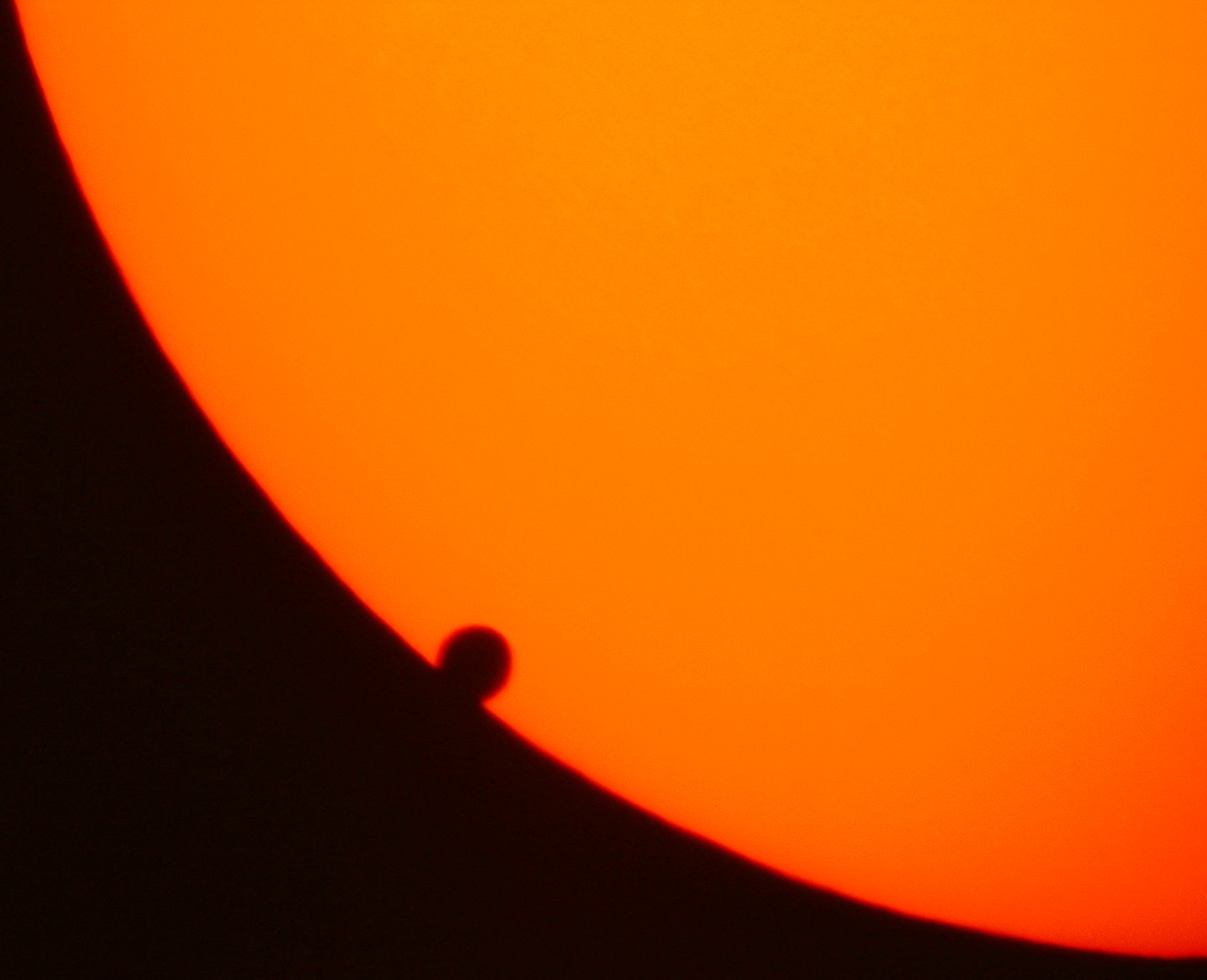 The black drop effect, photographed in 2004.
In 1874 several more expeditions set out, including several on Royal Navy Ships, such as HMS Volage, one of the largest mixed sail and steam ships ever built, which ferries the British expedition to the Kerguelen Island in the Southern Indian Ocean. Such measurements helped improve the distance measurement to 149.59+/-0.3 million kilometers. By 1881 it had been decided the distance to the Sun could be estimated better by other methods, although several expeditions still set out, and the first photographs of the transit were taken.
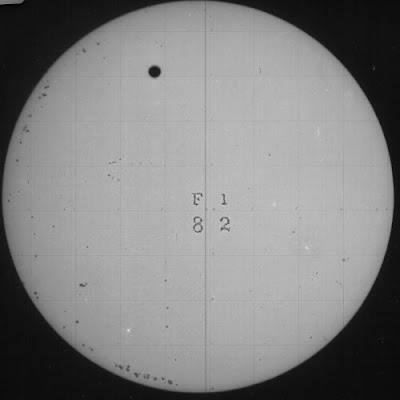
A photograph of the 1882 transit, taken by a US expedition.
The current best distance to the Sun is 149.5978707 million kilometers, +/- 3 metres, measured using radar ranging to the inner planets. It’s known so accurately that we can measure it’s changing, growing about 15 metres every century.
The first transit of Venus to happen in the modern age was in 2004. You can find videos of this event (like the one below), which I was lucky to view from a small observatory near Ithaca, NY while I was studying for my PhD in Astronomy at Cornell University.
For the 2012 transit, apart from encouraging people to view the event as a last in your life time chance, there are couple of new developments. First smart phone technology which didn’t even exist in 2004 has allowed the development of a “Transit of Venus Ap“. In this Ap you can input the time you view the transit starting and/or ending, and participate in a global experiment to measure the distance to the Sun. Download the Ap in advance to practice inputing your measurement.
Interest in exoplanets has also significantly grown, including the signature that the atmospheres of those planets might have in the observed spectrum of a star when the planet is transiting. The Hubble Space Telescope will try to simulate this type of observation during the transit of Venus, observing the light from the Sun reflected by the Moon (if HST looked at the Sun it would be destroyed) to search for the signature of the atmosphere of Venus. You can read more about the plans on the NASA website.
Anyway I encourage you to get out there, or get online and view the last transit in our lifetime. Use the resources attransitofvenus.org, to work out the timings of the transit from your location, or search for local events. Other useful resources are the Royal Astronomical Society page on the Transit of Venus, in the UK, the HM Nautical Almanac Office. Also of possible interest, the Royal Observatory, Greenwich has a Venus Transit page, and a special (free) exhibit running until September 2012. And of course there’s a special Planethunters page on the transit too.
Transit of Venus: Live
In June 2012 people all over the world will watch the planet Venus transit across the Sun. Planet Hunters is all about spotting planets as they move across the face of a star so we thought it would be good to share the event with everyone. Venus will pass directly between the Earth and Sun on the night of June 5th and the morning of June 6th. This historic event can be seen from many parts of the world and will not happen again for 105 years!

As the map above shows, most people will only see part of the transit. With the help of the GLORIA team, we’ll be showing a live feed of the whole event on the Planet Hunters site. The webcast is being streamed from Tromsø, Sapporo and Cairns and will feature commentary in English and Spanish during the key parts of the event.
Check out our guide to the Transit of Venus, which we’ll update as we approach the event itself. It covers a basic history of the transits, and include information on when and where to see it. It also links to other useful resources for the event, including a Transit Guide from the GLORIA group, and the NASA observers handbook links. We hope you’ll try to see the transit when it happens, but if you’re unable to for some reason, then the webcast means that you can still be a part of this last-chance astronomical event.
Awesome People: More from ZooCon1
Today we have a guest post by Jules, fellow Planet Hunter and zooite who attended the ZooCon1. Jules is a lead moderator and blogger for the Solar Stormwatch and Moon Zoo forums as well as a volunteer on the Zooniverse Advisory Board.
Just back from the very first #zoocon1 in Chicago. I attended as a volunteer on the Zooniverse Advisory Board. As Meg said it was a chance for the science teams from new projects to meet with and learn from representatives of current projects and for everybody to meet up with Zooniverse techies and developers. It made sense then for some of the “old hands” to present an overview of their own projects. Meg’s Planet Hunters talk was particularly interesting as it highlighted the value of Talk and the great collaborative work being done there by volunteers.
A brief foray into data reduction showed the kind of work necessary to make the clicks usable. For example, there are 5,508 stars with possible transits. Removing all pulsating stars, which can be mistaken for transits, reduced the number of candidates to 3,404. Further examination of these transits reduced the pool further to 77 transit candidates – a much more manageable number.
Here’s Meg in action demonstrating the light curves of different sized planets.
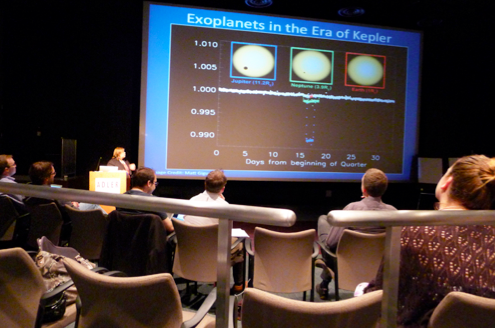
The discoveries Meg highlighted included a slide showing 4 planet candidates missed by Kepler one of which is being re-investigated because of the work done by Planet Hunters. Kepler 16, the circumbinary system, also got a mention as did the impressive volunteer-led analysis on cataclysmic variables and heartbeat stars.
Old Weather, Mergers and the Milky Way Project were also put in the spotlight. Afterwards someone from one of the new projects told me how amazed they were that volunteers would want to do more than just click and another told me that they found the Planet Hunters story particularly inspiring and wanted to know how Planet Hunters had attracted these “awesome people.”
Well that’s Citizen Science for you. Volunteers come with a great mix of interests, skills and the knack of finding treasure!
Update on Dwarf Novae
Today we have a guest post by fellow Planet Hunter Daryll (nighthawk_black) updating us on the search for dwarf novae and cataclysmic variables. Daryll’s here to talk about a dwarf nova candidate found in PH Talk.
Hi Planet Hunters,
Following the guest post from GO Director Martin Still, a review of light some light curves discussed on PH Talk turned up an interesting target somewhat similar to the serendipitous Dwarf Nova known as NIK 1. First noted by myself and several volunteers as a possible cataclysmic, we believe this to be another SU UMA type variant with over 50 quasi-periodic brightness changes observed and a defined superoutburst, in the public Q6 data.
The activity is not visible in all quarters. An examination of the accompanying target pixel files (these are files created by the Kepler processing pipeline that show the brightness over time for each of the pixels that are added up to make a Kepler light curve and those surrounding that don’t go into making the light curve – they can help you see if the features in the Kepler light curve come from the target star or something nearby that is contaminating the target’s star aperture) reveal that the true source of the dwarf nova candidate lies in the background and likely originates from an adjacent source tagged as KID-11412049, leaving how much activity we see in the original light curve dependent on the differing aperture pixel masks used for each Quarterly roll. Unfortunately it does not appear to be an eclipsing arrangement nor has it displayed any transiting circumbinary companions.


We asked the science team to take a look at this star and they think it looks like a good dwarf nova candidate. The PH science team has applied for Directors Discretionary Time seeking additional observations in the coming Quarter (we’re all waiting to hear back if the Planet Hunters proposal has been approved) to learn more about this system including its outburst supercycle, accretion disc stability and component compositions. Early analysis indicates high mass transfer with a notably short orbital period of 76 minutes; a GALEX survey shows this location also appears to be associated with a UV source.
Screening out background binaries from transit candidates is something the community has gotten pretty sharp at and I believe more of Martin’s missing Dwarf Nova will turn up. If confirmed, this will be the 5th Superoutbursting DN in the Kepler FOV and the 17th total, so well done and keep up the eagle-eyed hunting!
Zooniverse Science Conference
 Image credit: Michael Parrish
Greetings from Adler Planetarium in Chicago. I’m at the first Zooniverse Science Conference. I’m here representing the Planet Hunters science team. At this conference science teams from the current and upcoming Zooniverse projects and the Zooniverse development team have gathered together to talk citizen science. It’s been a great two days of presented talks and discussions. This is the first time that teams from across the Zooniverse projects have come together. I’ve really enjoyed talking to the scientists from the different projects, and what I’ve been really impressed with is the cool and wide-ranging science that is being done in the Zooniverse. I’ve been hearing about the exciting future projects and new tools and features the Zooniverse is working on. This morning I shared the highlights from Planet Hunters and how I’m going from clicks to planet candidates. It was great to highlight all the science we’ve done and will be doing in the future with your classifications on Planet Hunters. I focused on my search for short period planets from the Quarter 1 classifications (on a side note – I got a response from the referee for my paper. I’ve revised the manuscript and the paper is back with the referee. Hopefully soon it will be accepted for publication by the Journal).
Cheers,
~Meg
 Planet Hunters