
More About the K2 Campaign 0
Now that were in the midst of the showing the first batch of science grade data from the K2 mission, I thought I’d give some more details about the K2 light curves and how K2 mission works.
Planet transits are small changes in the star’s light, a Jupiter-sized object produces only a 1% drop in the brightness of a Sun-like star and Earth-sized planets generate even smaller dips at the 0.01 % level. Kepler needs the stars to be precisely positioned on its imaging plane in order to achieve the photometric accuracy required to detect these drops in light. To do this the stars have been positioned and kept at the same location with millipixel precision. Kepler was able to achieve this during it’s primary mission and the first half of its extended mission To do this Kepler used three reaction wheels (one for x, y, and z directions) with one backup spare to finely nudge the spacecraft to keep the target stars positioned during a Quarter. Kepler suffered two reaction wheel failures and can no longer operate in this mode. This effectively ended the monitoring of the Kepler field, that Kepler was staring at for 4 years. The drift of the spacecraft was too large that the photometric precision was sufficient enough for a transiting planet search.

A Kepler reaction wheel Image credit: Ball Areospace
This is where K2 comes in. The K2 mission repurposes the Kepler spacecraft. Kepler has thrusters but they are used for coarser pointing corrections, they can’t be used to be the fine adjustments that used to be achieved with the third reaction wheel, but you can use the Sun in a way to be that reaction wheel. This is how K2 works. If Kepler is pointed observing fields that are along the plane of the Solar System, than the two working reaction wheels are used to maintain the x-y locations of the stars on the focal plane with the Sun and thrusters taking care of the rest. Kepler is positioned such that the irradiation of the Sun is balanced which basically keeps the spacecraft from rotating. This is a quasi-stable and every 6 hours or so the spacecraft will start to roll. The thrusters can then be used to roll the spacecraft back to it’s original orientation. (You can see this in the raw light curves just plotted. You can see a Nike check-like feature that dips slowly and rapidly goes up.The light curve processing Andrew does tries to remove as many of those artifacts and others as possible. It does a pretty good job, though occasionally there may be an artifact that remains. ) This scheme works pretty well at keeping the stars on Kepler’s focal view located on the same pixels and achieves photometric precision about 3x time worse than what the original Kepler mission was achieving. With this, we can still find planets around other stars, especially smaller cooler stars.
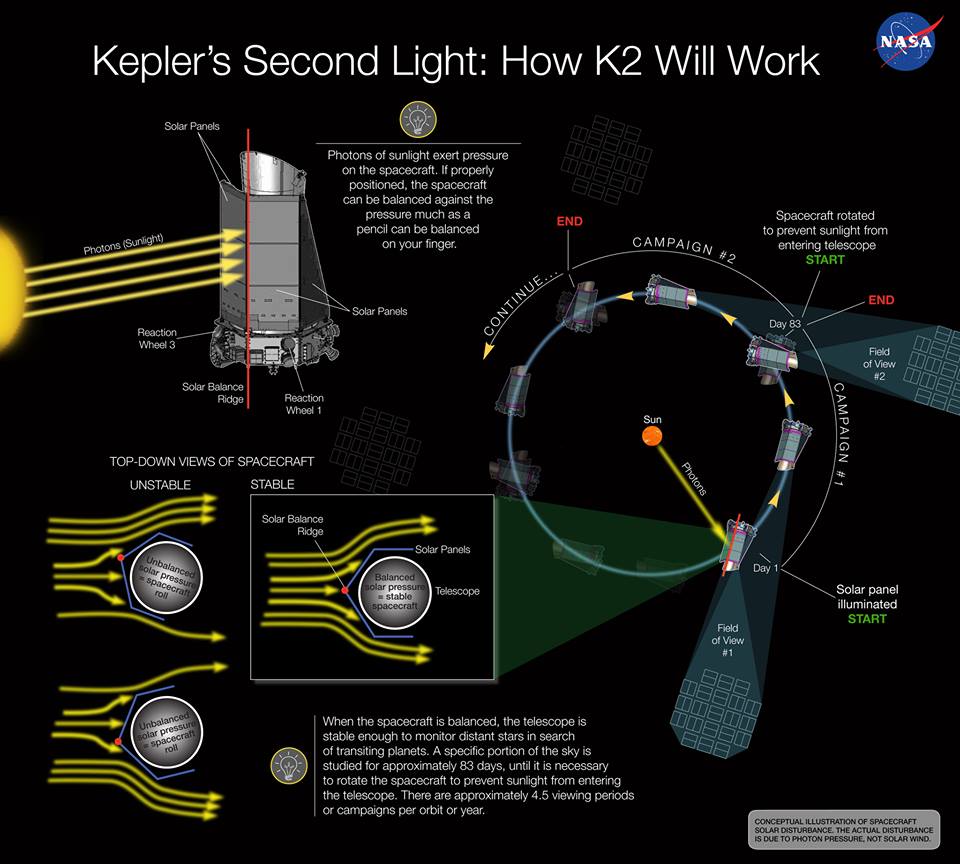
image Credit: NASA/Ames/Kepler Team
The K2 light curves we’re currently showing on Planet Hunters come from Campaign 0. Campaign 0 is the first full science grade test field data for the K2 mission. Kepler was staring at a field centered around see a region of the sky plotted in the star chart below. The observations commenced on March 12 and the campaign was completed on March 27th of this year. Campaign 0 serves as a full shake down of the performance of the spacecraft in this new mode of operating. The specific targets Kepler monitored in the Campaign 0 were community driven with astronomer putting proposals for what they wanted to be observed, and were decided by a Time Allocation Committee (TAC) organized by the Kepler team. You can learn more about the observing proposals and selected targets for Campaign 0 here.

Campaign 0 K2 Field – Image Credit: NASA/Ames/Kepler Team
On the site we’re only showing roughly 30 days worth of data, that’s because the light curves derived from the second half of Campaign 0 are more indicative of what the rest of the K2 mission will be like, so we’re only looking at that data. The observations at the start of the Campaign 0 were taken with Kepler not in fine pointing mode with a guide star and thus the positional consistency of the target stars over time on the imager is lower, causing a decrease in the photometric accuracy. Therefore we’re focusing on the better quality second half data. Future K2 Campaigns will have the full ~75 days worth of data in fine point mode, and we plan on showing all of the observations on the Planet Hunters website in the future.
Just out! New data from the Kepler mission:
We are showing light curves from the Kepler 2-wheel mission for Campaign 0 (a.k.a. “K2 C-0”) now and wanted to explain some issues that you may notice with these data. The K2 C-0 data are poorer quality than what you are used to seeing. The Kepler team is still working optimize the light curves, and this has been made more difficult by instabilities in the pointing control of the spacecraft. You can expect to see more trends and glitches. Furthermore, the first few weeks of K2 C-0 data were not useable so the length of the light curve (in days) is shorter than what you might have expected. All of this should improve for the next campaign, C-1.
A second issue with the K2 C-0 data is that we don’t have access to information about the stars. We know the EPIC numbers, coordinates, brightness of the stars, and the program numbers (telling us who requested observation of the stars). Postdoctoral Fellow Ji Wang has been an enormous help – he wrote a program to filter the published 2MASS and Sloan catalogs and to search for stars within a small radius about the EPIC coordinates. Ji then used the stellar brightness to obtain an unambiguous identification. This helps, but we still don’t know the stellar gravities (radii), masses or spectral types. Therefore, the information we can display for each of the K2 C-0 stars is much more limited than what you are used to seeing.
Since we don’t know the stellar radii, we are not able to make up accurate simulations for the K2 C0 data. To compensate we will show these light curves to more people than usual to build up consensus about the presence of transits.
The K2 data have many more selection effects than the original Kepler data because the targets are drawn from several guest observer programs. However, this is part of the fun – scavenger hunting for planets among the K2 stars is sure to be an adventure!
We are also trying to improve our turn-around time for PH results. Instead of waiting until we obtain telescope time to carry out follow-up data and publish a paper (sometimes a year later!) we will put the high probability transit candidates that you identify on the “Planet Hunters Object of Interest” (or PHOI – which I think is pronounced something like “fooey”). This is supposed to be a fun home-grown analog of the “Kepler Objects of Interest.”
Thanks to Andrew Vanderburg at Harvard University who has extracted these K2 C-0 light curves for Planet Hunters.
Kepler 2.0
It’s up!
The first science data from the new Kepler K2 mission is up on Planet Hunters just waiting to be looked at for new planets, eclipsing binaries, and whatever else lies in the data. This is a set of completely new stars! (Check out the K2 page for more information about the K2 mission.)
This data may go fast, so get classifying now! But don’t worry, there will be more K2 data when the next quarter is released. And when each K2 quarter is finished, keep classifying stars from the four-year Kepler mission to help solve one of the biggest mysteries in astronomy: how common are planets?
– Joey
 Planet Hunters