
Updated Talk Labels
We have made some updates to the labels that you may encounter on Talk. You may might noticed that sometimes below the light curve on its Talk page, there was black text below such as ‘Kepler favorite’ or ‘known eclipsing binary’ for example. In these cases, the light curves where from stars where the Kepler team had already identified what they believed to be an exoplanet transiting or an eclipsing star respectively. In preparation for Quarter 16, we have updated and expanded the list of Talk labels.
Updated Talk Labels
The Kepler team’s planet candidate list from Quarter’s 1-12 is now out, and you’ll find those stars listed as Kepler favorites. Stars that are believed to harbor multiple transiting planets have an additional label, ‘Kepler multiplanet candidate’. The Kepler team has also expanded their list of false positives, where there is a signal the Kepler team spotted in the observations of that star that looks like a transit, but is due to some other astrophysical cause or systematic error. You’ll find those stars labeled as ‘Confirmed Kepler false-positive’. The Kepler eclipsing binary catalog has been updated as well, and a preliminary version of the new catalog was used to identify already known eclipsing binaries.
New Talk Labels
To help with the volunteer-led efforts on Talk to find new planet candidates, we now identify with labels those light curves that are from stars that the Kepler team’s automated detection algorithm identified potential transit signals or Threshold Crossing Events (TCEs) as they are dubbed by the Kepler team. TCEs are not planet candidates, much more vetting and analysis goes into reviewing the TCEs in order to identify the planet candidates among them. You will see the TCEs from the Q1-Q12 observation identified by the Kepler team’s automated routines on Talk with the label ‘Kepler Threshold Crossing Event Candidate’.
Planet Hunters volunteers have been spotting new dwarf novae and RR Lyrae variable stars on Talk. To help with this effort, we have now included labels for both categories. You’ll see ‘Known Dwarf Nova’ and ‘Known RR Lyrae Variable Star’ respectively. Thanks to Daryll (nighthawk_black) for assembling the Dwarf novae list and to Abe (cappella) and Robert Szabo for the RR Lyrae list.
Let’s not forget PH1 b and circumbinary planets, where the planet orbits both stars in a stellar binary. The 6 published circumbinary planets are now labeled in Talk as ‘Confirmed Circumbinary Planet’. So let’s go find another!
Happy hunting!
Happy Holidays

Happy Holidays and Merry Northern Winter (and Southern Summer) Solstice from everyone on the Planets Hunters team.
Three years ago, Planet Hunters was hiding behind one of the doors of the the Zooniverse Advent Calendar. In the spirit of the holiday season, there were several Planet Hunters themed gifts as part of this year’s calendar:
- Day 2 – The short film ‘A Close Distance’ documenting the lives of people looking for exoplanets including Planet Hunters volunteer Caroyln Bol.
- Day 16: An Anniversary Poster of the Planet Hunters Avatar composed of all of our volunteers names (can you find yours?) to celebrate Planet Hunters’ 3rd Brithday
- Day 22 – The PH1 b cocktail
And be sure to check out today’s very last door of the Advent Calendar.
Not part of the advent calendar but still a nice way to cap off the end of this year was the release of the NASA Astrophysics Roadmap on December 20th where Planet Hunters (along with Galaxy Zoo) is highlighted as having ‘led the way in astrophysics citizen science’. You can read more about that here.
Thank you for all the time and effort you put into Planet Hunters not just now but throughout the year. Wishing you a very Merry Solstice and Happy Holidays from us to you.
Planet Hunters Gets Highlighted in the NASA Astrophysics Roadmap

Image credit: NASA/NASA 2013 Astrophysics Roadmap
In March 2013, the Astrophysics Subcommittee of the NASA Advisory Council/Science Committee assembled a group of astronomers and astrophysicists tasked with the goal of coming together and developing a guide for the next 30 years of NASA’s Astrophysics Division. This document dubbed the ‘NASA Astrophysics Roadmap’ outlines what the scientific community believes the overarching goals and aims for NASA science and missions should be for the next 30 years. It builds upon the Decadal Survey which the US astronomical community assembles every 10 years (last one was 2010) prioritizing where they think funding should go and what big facilities and questions should be focused on in the next decade for all ground-based and space-based astronomy and astrophysics. The NASA Raodmap is similar, but sketches out the wishlist and plan astronomers want to see NASA take in terms of research areas to focus on, new technology to develop, and space missions to pursue in the next 3 decades.
The Roadmap team spent months getting community feedback and preparing this document.The 2013 Astrophysics Roadmap officially titled ‘Enduring Quests Daring Visions NASA Astrophysics in the Next Three Decades’ was released on December 20th. You can read the full NASA Astrophysics Roadmap here.
Planet Hunters and Galaxy Zoo were highlighted and praised in the Roadmap. In Chapter 5 – Public Engagement: Connecting Through Astronomy:
Similarly, accessibility to NASA data via online archives has given the public an opportunity to actively participate in data analysis alongside professional astronomers. This new field of citizen science exists in many disciplines, but astrophysics is uniquely poised to build on the public’s inherent fascination with astronomy and to engage people in authentic experiences with NASA-unique data. Projects like Galaxy Zoo and Planet Hunters (with over 855,000 registered users in Zooniverse as of this writing; see Chapters 2 and 3) have led the way in astrophysics citizen science, providing online user-friendly interfaces through which anyone can classify galaxies or look for signatures of planets in actual data. Similarly, programs such as the NASA/IPAC Teacher Archive Research Program have provided ways for educators to become involved in ongoing astronomy research using NASA data archives. Future programs should build on the community’s best-practices in order to make more NASA data accessible to the public and teachers in this highly participatory way
In addition to the mention in the Public Engagement Chapter, Panet Hunters got a cutout figure highlighting the project (shown below) in the exoplanets chapter (Chapter 2: Are We Alone?).

Image credit: NASA/NASA 2013 Astrophysics Roadmap
The fact that Planet Hunters is featured in the Astrophysics Roadmap is a testament to the impact the project has had in the past three years. Thank you for making Planet Hunters such a success!
Looking Back at 3 Years of Planet Hunters
It is hard to believe that Planet Hunters just recently turned three. It doesn’t seem that long ago that the project was just launching. Thank you to everyone who has contributed to the project since 2010. We couldn’t do the science without all of you and all the hard work and effort you put into Planet Hunters. In honor of 3 years of Planet Hunters, I put together some photos and images taken over the years that mark some of the highlights, discoveries, and milestones from the project.
I hope you enjoy the slide show, and if you can spare a moment let us celebrate 3 years of Planet Hunters and the future discoveries yet to come by classifying some light curves today at http://www.planethunters.org/
Onward to year 4!
(full screen resolution best if viewed on youtube)
Comet ISON and the Best Studied Planetary System
This Thursday, the Solar System put on a celestial performance, and we had a front row seat to the spectacle. Long period Comet ISON made its closest approach to the Sun entering the Sun’s atmosphere. This sun-grazing comet was making its first entry into the inner Solar System after spending most of its lifetime in the outer reaches of the Solar System in the Oort Cloud (a spherical shell of icy bodies residing at ~10,000-20,000 AU and the repository of long period comets). For most of the Solar System’s history ISON has resided out in the Oort Cloud, but the gravitational tug from a chance passing star or the gravitational pull from the gravitational tides with the center of the Milky Way nudged ISON onto an orbit straight for the Sun.
Comet ISON was discovered in November 2012 and has sometimes been touted as potentially being the ‘Comet of the Century’ with some predictions that it might become so bright to be visible with the naked eye if it survived perihelion (its closest approach to the Sun). Since ISON was discovered with such warning before perihelion, astronomers were able to organize observing campaigns with ground-based and space-based telescopes to study how the comet changes as it got ever closer and closer to the Sun. Planetary scientists and astronomers will be pouring over the data for months and likely many years to come.
On Thursday the spacecraft monitoring the Sun including Solar Dynamics Observatory (SDO) and Solar and Heliospheric Observatory (SOHO) were poised to capture ISON as it made it’s closest approach. Comets are a conglomeration of ice, rock, dust, and frozen gases, and many don’t survive the fiery perihelion passage; the nucleus disintegrating with only dust and a rocky rubble pile remaining. It wasn’t sure if ISON would survive. It looks like something has indedeed survived perihelion passage, but ISON is providing more questions than answers. It appears to have completely lost its coma and tail which were blasted away as it skimmed the Sun’s million-degree corona. As you’ve probably seen the contradictory statements that ISON was dead and then alive (ISON is not behaving like any sungrazing comet seen before and if you were following twitter and the news reports you were seeing science in progress. Conclusions were changing as more data came down in live time). The current word on the street is that likely a small chunk of ISON’s nucleus made it through perihelion, but it’s still not 100% clear what survived. ISON appears to be behaving like a comet albeit a very small and dusty comet, but time will tell. Future observations over the coming days and weeks will confirm whether gas is being produced which would be the tell-tale sign that there is ice and frozen gases in from some part of the nucleus still around. If there is no gas, then it’s just a rubble of rock and dust left in orbit that will slowly dissipate. Chances are that at this point ISON won’t be naked eye visible but either way, ISON has left us with more learned about comets in the Oort Cloud and added many many many questions for astronomers and planetary scientists to solve while putting on a spectacular show for us.

Snapshots from SOHO’s C2 chronograph monitoring of the Sun showing Comet ISON after its closest approach with the Sun (left) and before (right) on its way to perihelion Image Credit:ESA/NASA/SOHO/Jhelioviewer
For full coverage and the latest on Comet ISON and how it is doing after it’s fiery encounter with the Sun, check out NASA Comet ISON Observing Campaign blog run by Karl Battams and the Planetary Society’s Comet ISON Live Blog by Emily Lakdawalla and Bruce Betts.
What am I doing talking about a comet on the Planet Hunters blog? I do have having a soft spot in my heart for icy outer Solar System bodies, that’s the area of research I worked on for my thesis, but Comet ISON is a good reminder that we should think about these exoplanets we’re finding with Kepler and Planet Hunters as members of a larger planetary system. The transiting planets are the ones we detect, but there is much more there that we don’t see. We know in some transiting exoplanet systems there are unseen (‘invisible’) non-transiting planets, perturbing the orbits of the transiting planets changing the timings and durations of the observed transits. There is also likely the building blocks of planet formation left over as debris hanging around in many of the planetary systems found in the Kepler field. Perhaps some of the material is trapped in belts like the asteroid belt and Kuiper belt in our own Solar System. Many of them likely have Oort Clouds (distant repository of icy bodies of their own). Debris disks likely the equivalent to our own Kuiper belt have been spotted around stars. One of the famous examples is Fomalhaut shown below.
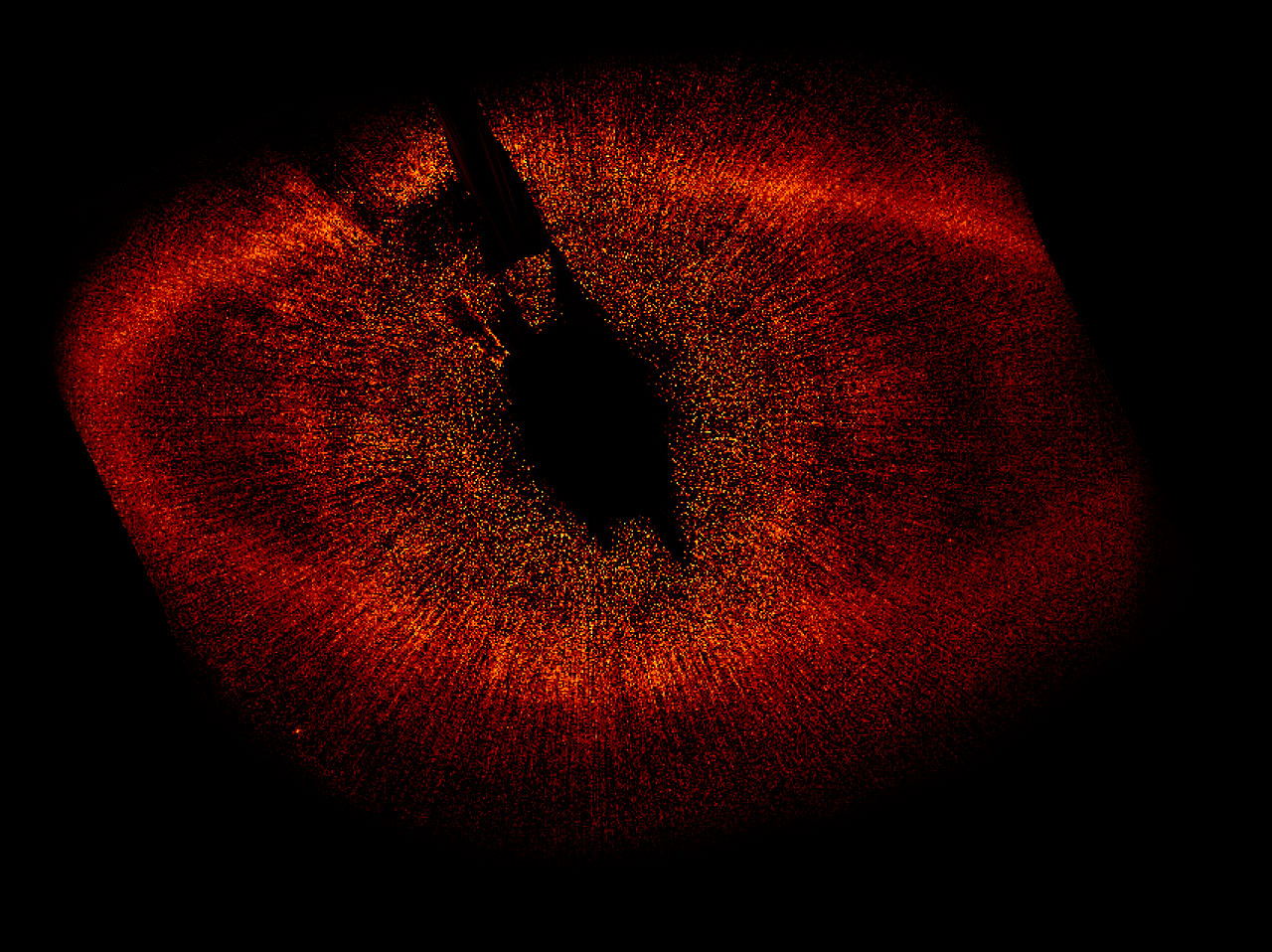
Image credit: NASA/Spitzer
With all the stunning images from SOHO and the confounding behavior of Comet ISON, it reminds us that our Solar System remains the best studied planetary system and that we have still so much more to learn and understand about the Solar System’s formation and evolution. What happened to ISON is probably happening to many other icy bodies around other stars in our Milky Way. We just happened to have a front row seat, but what a show did ISON put on for us! So the next time you look for transits on http://www.planethunters.org take a moment and think about the planetestimals, dwarf planets, and minor planets likely residing around the planet host stars too.
Planet Hunters at Girls Do Hack
Today we have a guest post by Lauren Kelly. Lauren is an Educator for STEM Student Experiences at the Adler Planetarium in Chicago, IL, and holds a degree in Science Journalism from Columbia College Chicago. She loves working with young people and encouraging them to explore science.
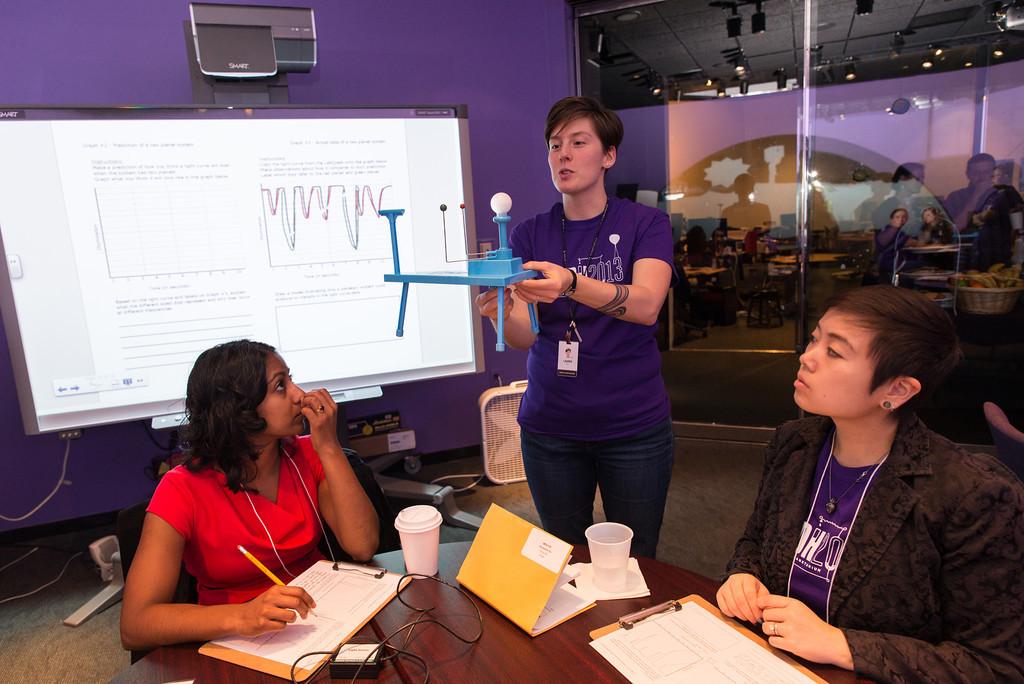
Image credit- Adler Planetarium
On November 9th, 65 young women participated in Girls Do Hack at the Adler Planetarium, where they explored science, technology, engineering and math skills and fields as future career options. It was a incredibly fun, inspiring day.
As an Adler educator, I had the wonderful opportunity of leading a session about detecting exoplanets that many of the girls participated in. During the session, participants discovered how scientists find exoplanets using the transit method by doing a hands-on experiment creating and measuring light curves, practicing categorizing transits on Planet Hunters and working with the help of a postdoc Astronomer to explore real systems using NASA’s Eyes on Exoplanets program.

Image credit- Adler Planetarium

Image Credit: Adler Planetarium
K2 – Kepler’s (Proposed) 2nd Exoplanet Mission

K2 mountain, the 2nd highest peak in the world Image credit: Wikipedia (http://en.wikipedia.org/wiki/File:K2_2006b.jpg)
In May, Kepler lost its 2nd reaction wheel halting continuing observations of the Kepler field and its original exoplanet mission. Later this summer, NASA announced that attempts to revive the broken reaction wheels had failed, and that was the official end to the observations of the Kepler field with the 30 ppm (parts per million) precision obtained with the 3-wheel pointing. Other than the bum leg, the spacecraft and imager were in good condition. NASA issued a call for white papers soliciting ideas for potential use cases for a 2-wheeled Kepler.
It was announced two weeks ago at the 2nd Kepler Science Conference, that the Kepler team has a plan to return Kepler to exoplanet hunting that they will be proposing to NASA to give the go ahead and fund. They are dubbing this new 2-wheeled mission for Kepler ‘K2’. You might be inclined to call ‘K2’ Zombie Kepler, but in reality Kepler hasn’t gone anywhere. After the 2nd reaction wheel failure, the spacecraft has just been resting while NASA and Ball Aerospace engineers have been working on ways they could use the remaining two reaction wheels and thrusters to do exoplanet science. In the past few weeks Kepler has been taking engineering data to test stability and photometric precision in this K2 pointing/observing scheme.
Here’s how K2 works. With the loss of the 3rd reaction wheel, Kepler lost fine tuning in one of three spatial directions. If Kepler is pointed keeping the Sun in the X-Y plane, there’s a pointing ridge where they can balance the spacecraft and use the remaining wheels and thrusters to keep pointing. That means fields have to be in the ecliptic (plane of the Earth’s orbit). With that pointing very little changes to the current Kepler team data pipeline are needed to produce light curves with the same 29.4 minute cadence. The photometric precision is predicted to be better than 300 ppm (measured from preliminary engineering runs and testing). So there is a loss of sensitivity, 3-wheeled Kepler had 30 ppm photometric precision. Still Kepler can detect giant planets and for both bright and small stars, Kepler can detect rocky planets.
Kepler will not be able to stare at any one field for very long. The fields on the ecliptic would change as the Kepler orbits the Sun. Each field would get ~40 days worth of observations with some craft pointings able to extend the baseline to ~70-80 days. Also the number of pixels per star needs to be increased significantly, and since Kepler has a limited memory on board to store all of this data, the number of stars observed needs to significantly decreased from the over 160,000 stars monitored when observing the Kepler field. 10,000-20,000 stars would be monitored in K2. The K2 data, like that in the Kepler extended mission, would be available to the public and scientific community after it was downloaded and reduced.
The exciting prospect is that Kepler would observe different populations of stars than the Kepler field, which will be interesting to see how the frequencies of planets compares to the Kepler field. Not to forget, the prospect of having many many more new planets/planet candidates to characterize and study. There will be also be observing of cooler M dwarf stars where the habitable zone (the goldilocks region where water might exist on a rocky planet’s surface) is close to the star, and thus Kepler will find many more rocky planets in the habitable zone to further study. Also bright stars will be targeted which will enable ground-based follow-up with the radial velocity technique, which for gas giant planets can actually measure masses and confirm these planets. Also there’s a wealth of stellar astrophysics (and even potentially microlensing monitoring ) that could be done with K2, including observing stars in open clusters (conglomeration of stars loosely bound together that were all formed from the same molecular cloud) where we know their ages.
K2 is a mission concept at this point. The Kepler team is working hard, and has achieved or on track to finish software upgrades needed to enable Kepler to point and track on ecliptic fields for K2. Test data is starting to coming down from the spacecraft. The Kepler scientists and engineers are analyzing the data and assessing the data quality from K2-like observing. In the next few weeks the Kepler team will propose K2 to NASA, in December NASA will decide if K2 is viable and then give the go ahead for the Kepler team to propose for K2 in the senior review in April, where Kepler as well as other NASA missions will be examined and funding will be decided. Let us hope that K2 gets the full go ahead with (cross our fingers) observations starting some time in 2014.
The prospects for K2 are exciting, and I hope the missions gets the green light. I think the place for Planet Hunters in the K2 era is interesting. I think there will be a niche for Planet Hunters, especially with the short time span on each field, identifying single transits will be important for follow-up of the planetary systems discovered. There will be new eclipsing binaries monitored, and the prospect for more circumbinary planets which is also where I can see Planet Hunters contributing. Plus don’t forget the unexpected discoveries waiting to be found, as we’ve learned from the Kepler field data. So bring on K2!
Want to know more about the proposed K2 mission? Watch the 2nd Kepler Science Conference talks by Charlie Sobeck and Steve Howell detailing the specifics about K2.
20 million classifications and counting!
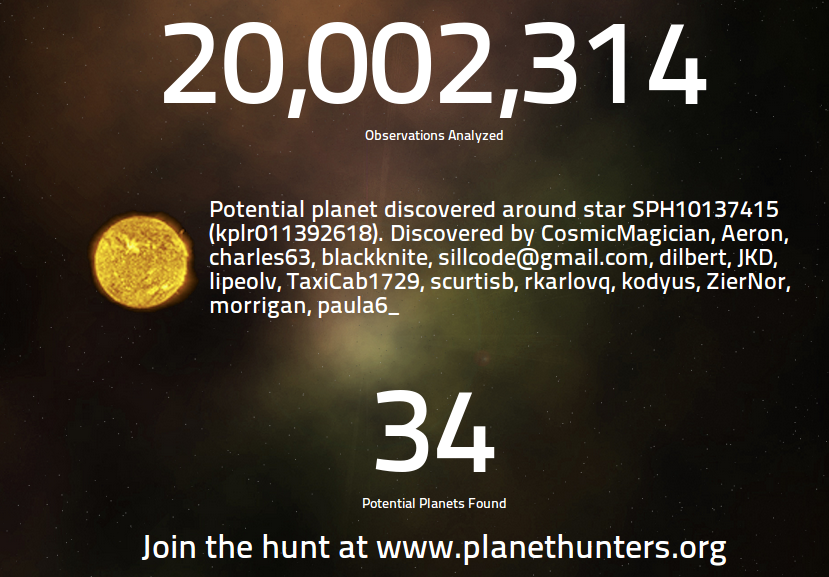
Planet Hunters has just crossed the 20 million classification mark, a milestone to be celebrated! Thinking back to this time three years ago, the the Zooniverse development team and Planet Hunters science team were hard at work on the design and building of the site. We didn’t know if people would come to the website to help find planets by reviewing Kepler light curves; we were showing graphs of a star’s brightness over time, not the beautiful galaxies in the stunning images on Galaxy Zoo. Since the day the project launched in December 2010, we’ve been blown away by the response. It’s been truly overwhelming. I know I couldn’t have comprehended reaching 20 million classifications back then, and here were are with over 260,000 volunteers worldwide participating in Planet Hunters!
A big thank you to the Planet Hunters community, to all of you who have contributed to the project. Thank you for your time, hard work, and dedication. With your help, Planet Hunters has discovered more than 30 planet candidates, a seven planet solar system, and two confirmed planets: PH1 b, a transiting circumbinary planet in a quadruple star system, and PH2 b, a confirmed Jupiter-sized planet in the habitable zone of a Sun-like star. Your classifications and efforts have resulted in 6 published papers and our 7th paper was just recently submitted to a scientific journal and currently in review. The science team is currently working hard on several new papers, and we’re looking forward to sharing the results with you in the coming months.
On to the next 20 million classifications and to uncovering the discoveries awaiting in the Kepler light curves! Keep the clicks coming at http://www.planethunters.org .
What to do with a 2-wheeled Kepler?
Now that Kepler is officially 2-wheeled, NASA and the Kepler team are looking at what Kepler could be re-purposed to do. Except for having a bum leg, the rest of Kepler is in good shape. NASA put out a call for white papers, detailed proposals for ideas for what to potentially do next with Kepler. There was no shortage of ideas. In total there were 42 white papers. The proposed ideas ranged from studying the photometric variability of Active Galactic Nuclei (AGN) to a microlensing planet search. There is even a white paper from Kepler’s Principal Investigator (PI) Bill Borucki on how Kepler could continue exoplanet observations (though perhaps not at the same precision before the wheel failure). There are also other proposed options to do an exoplanet transit search by targeting new fields where the Kepler pointing would be better than going back to the the current Kepler field, though likely the observation span would be different from that before the reaction wheel failure. There are even proposals to stay the course and continue to follow-up the Kepler field even with the reduced sensitivity to transit depth with the aim of monitoring known Kepler planetary systems for transit timing variations (TTVs) and also look for long period giant planets.
If you’re interested in reading about all the proposed ideas in gory detail, all the white papers are online and freely available on the Kepler Guest Observer website. If you’re interested in the abridged version, Astrobites has an excellent summary by Nick Ballering highlighting the main categories of use cases proposed.
Some time in the Spring of 2014, NASA will decide on an alternative plan for Kepler and hopefully if there is funding, Kepler will be taking data in the Fall of 2014 whether it’s looking for exoplanets, searching for Near Earth Asteroids, or something else.
Spotting RR Lyrae Stars
RR Lyrae stars are a special type of variable star that changes in brightness due to radial pulsations that increase and decrease the radius of the star . Over the past 3 years, Planet Hunters volunteers on Talk have keenly spotted several previously unknown RR Lyrae stars in the Kepler field, that were nearby neighbors on the CCDs to Kepler targets and were contaminating the photometric aperture used to produce the light curve of the real Kepler target star. You read more about some of these discoveries here. These discoveries have been passed on to collaborators in the Kepler Cepheid & RR Lyrae Working Group who have continued to study those stars including sometimes having the contaminating RR Lyrae added to the Kepler list of targets to get its full light curve.
Katrien Kolenberg who is a member of the Kepler Cepheid & RR Lyrae Working Group, recently wrote a chapter for the conference proceedings of the ’40 Years of Variable Stars: A Celebration of Contributions by Horace A. Smith’ Conference’, and she presented a similarly titled talk at the conference this past May. In the chapter, she gives a summary of the science from the now over 55 RR Lyrae stars known in the Kepler field. She includes a shout out to Planet Hunters to acknowledge the project’s contribution to discovery. Congratulations to all involved in the RR Lyrae discoveries. You can read the chapter from the conference proceedings here.
 Planet Hunters
