
Tales from Waimea Part 1
Greetings from the Big Island of Hawaii. I’m here for my observing night on Keck II, part of the pair of 10-m telescopes on the summit of Mauna Kea. I applied months ago through the Yale Time Allocation (TAC) for a night to use NIRC2 with Natural Guide Star Adaptive Optics to zoom in around potentital Planet Hunters planet candidates and other Kepler planet candidates to see if there are any lurking stars (like in the case of PH1 b) that may be contaminating the Kepler light curve and diluting the transit depth that we measure (and the size of the planet that we measure). These observations can also be used to help rule out potential false positive scenarios for these candidates as well.
So after flying in from NYC late last night, and making the drive from the Kona airport to Waimea, I’m finally at Keck VSQ (Visting Scientist Quarters) on the Big Island of Hawaii. You might ask why I’m not remote observing from Yale as other members of the science team has done on many other ocassions. This is my first time on NIRC2 and Keck II, and since it’s all new, it’s best to come out and sit next to the support scientists and helpful people at Keck HQ to show me the ropes.
Keck Observers don’t go up to the ~14,000 feet summit. We stay at sea level in Waimea and remote observe with the summit operator. My night is on Friday and my first night ever observing with NIRC2 or Keck II, so today is prepping target lists, reading instrument manuals, making my own observing notes, and generally prepping for tomorrow night. Later tonight, I’ll be sitting in the remote room behind tonight’s observers who are doing similar things with NIRC2 and graciously allowing me to hang out and watch. I’ll be looking over their shoulder and try to learn and get familiar with the instrument and control guis. Then tomorrow afternoon, once the instrument is released from the day crew (who prep the instrument and take care of general maitenance on the instrument and the telescope), I’ll meet with the support astronomer who will help me setup the instrument and answer any questions that I have.
I’m soloing, so I’ll be pretty busy during the observing run and the next few days, but I’ll try and blog in between updating you on what’s going on here in Hawaii.
To give you a taste of what it’s like to be here. I’ve taken lots of photos:

Main Keck building. Keck HQ. Located in here are the remote observing rooms for Keck I and II

Dorms for the observers.
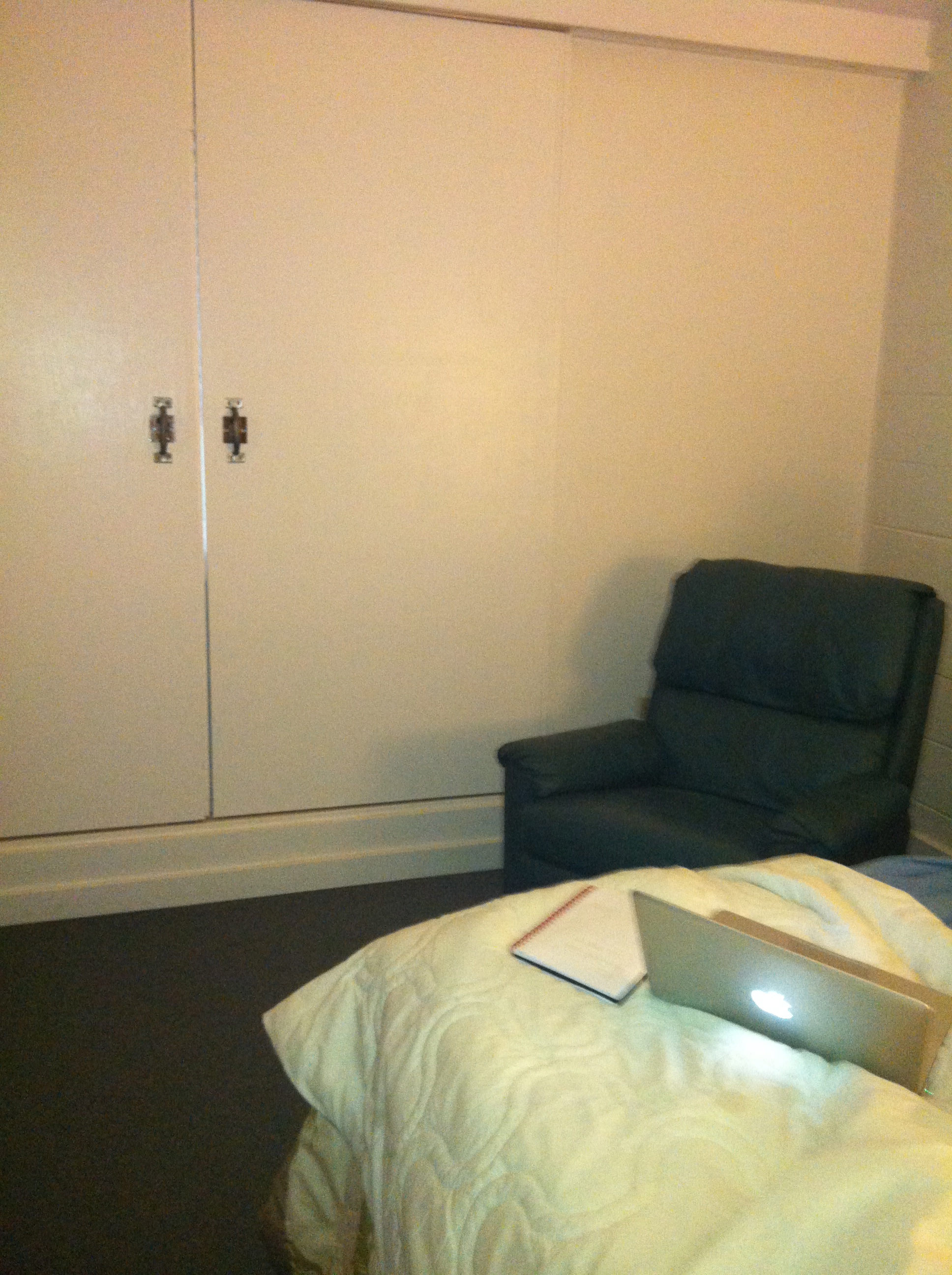
Inside my dorm room. Awesome thing about the Keck observing quarters is the thick wooden panel shutters for the window to block all the light so you can get some sleep post sunrise.

- There’s even a beach towel waiting for you
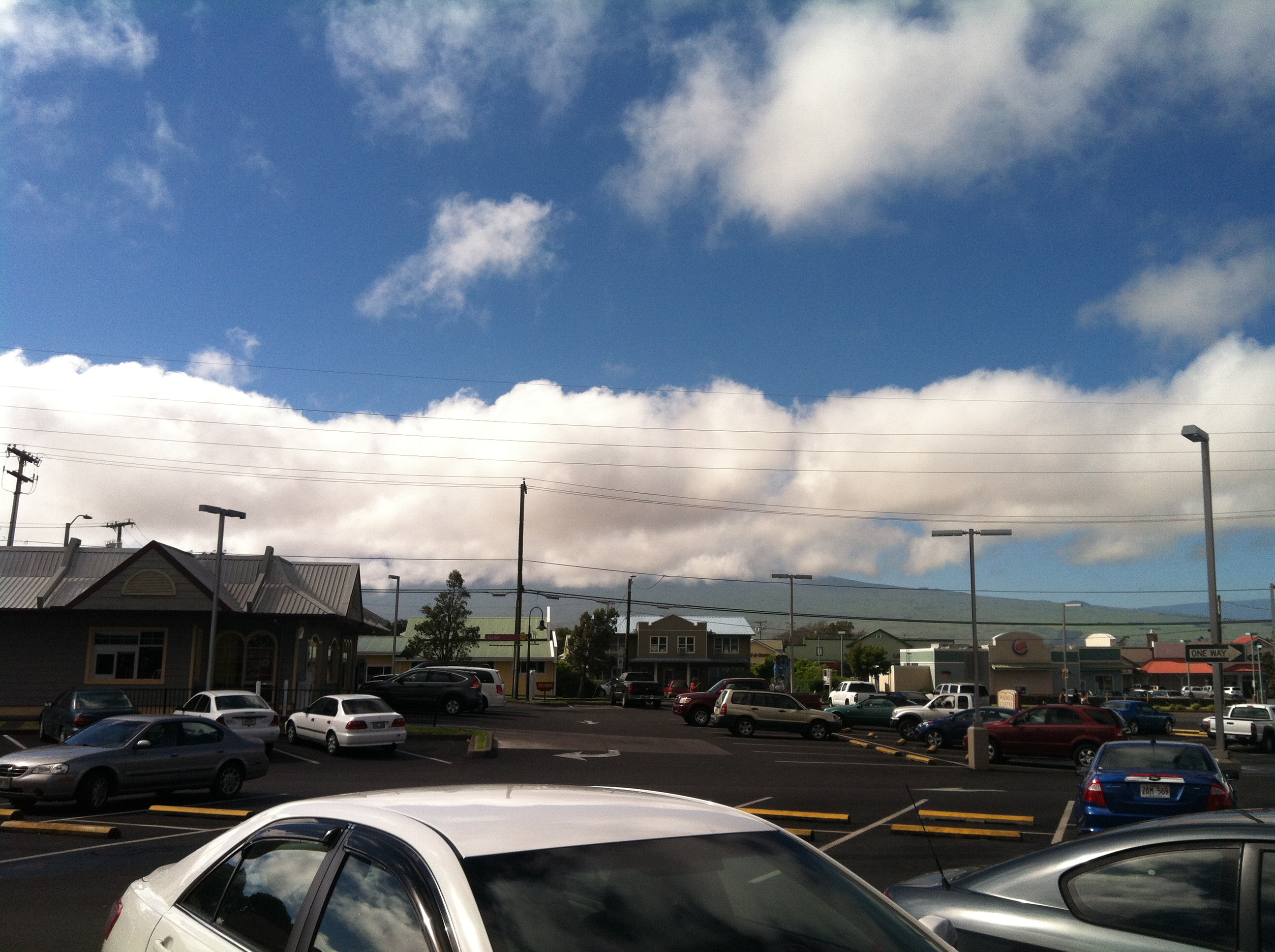
View of a cloudy Mauna Kea

I don’t think I’ve been on an observing run on the Big Island without stopping at the KTA for food and supplies. Made my stop there this morning.
Modern Statistical and Computational Methods for Analysis of Kepler Data
Greetings from Research Triangle Park, North Carolina. For the next two weeks, I’ll be hanging out at the Statistical and Applied Mathematical Sciences Institute (SAMSI) for the Modern Statistical and Computational Methods for Analysis of Kepler Data mini-research program.
SAMSI’s goal is “to forge a synthesis of the statistical sciences and the applied mathematical sciences with disciplinary science to confront the very hardest and most important data- and model-driven scientific challenges.” This particular 3 week program (I’m staying two weeks since I have to be in Hawaii for my observing run on June 28th), is to bring together astronomers, statisticians, and computer scientists to come up with new and interesting ways to tackle the questions and current challenges in the field of extrasolar planets with Kepler data.
I’m giving one of the invited talks today presenting on applying a citizen science approach to the Kepler data set highlighting Planet Hunters science. After the two days of talks from invited speakers, on Wednesday we’ll break into mini-research groups. I’ve come with a subset of the Planet Hunters classification database (No usernames or emails are listed. The only identifying information for a volunteer is an identification number to link classifications) to hopefully learn and develop some new methods and algorithms to combine your classifications and better search for planet transits.
An Update on the TCE Review: Nearly Half Way There!
I wanted to update y’all on the status of our TCE review that we launched at the beginning of the month.
This side project is to do our own Planet Hunters review of the ~18,000 potential transit events, dubbed Threshold Crossing Events or TCEs, identified by the Kepler team’s automated computer algorithms during a search of the first ~3 years of Kepler data. The majority are false detections, but a few are real transits due to orbiting exoplanets. A subset of the Kepler team examine the TCE list and whittle it down to make the Kepler planet candidate list. These newly released TCEs have yet to fully searched by the Kepler team, meaning there are likely discoveries waiting to be found. We have launched a Planet Hunters review of the Kepler TCEs to identify new planet candidates. For each TCE, you’ll be presented with a light curve that has been zoomed-in and folded so that the repeat transits all line up on top of each other. With the folded light curves we can see smaller planets, the rocky ones that are so hard for most of us to see in the regular light curves we show on the main Planet Hunters website. We think Planet Hunters has an advantage in the ability to review the entire TCE list (with your help) and identify not just the rocky planet transits but also the Jupiter-sized and in between. You can learn more about the TCE list and the TCE Review by reading the launch blog post.
As of today, we’re now at the nearly half way mark towards the 184,060 classifications needed, with 7,669 of the 18,406 TCEs complete with 10 looks. For those who’ve already contributed to the TCE review, thank you for your hard work. If you’d like to join in the TCE review and help get us to the finish line with 10 classifications for each of the 18,406 TCEs, please visit http://tcereview.planethunters.org
Cheers,
~Meg
Live Chat Today
We’re having a live chat today with science team members Tabetha Boyajian (Yale University), Chris Lintott (University of Oxford/Adler Planetarium), and Meg Schwamb (Yale University). starting at 4pm BST/ 11 am EDT /8 am PDT/3pm GMT.
There’s lots to talk about today including the failure of Kepler’s reaction wheel 4 and updates on Planet Hunters science. Join us here to watch the live video feed. You’ll also be able to find us on the Zooniverse Google+ Page. If you can’t watch live, the video is recorded and will be available to view here later.
If you have questions for the Planet Hunters team you can ask them, either by leaving a comment here on the blog or by tweeting us @planethunters.
Thanks for watching. You can find the TCE review at http://tcereview.planethunters.org/ and as always you can classify light curves at http://www.planethunters.org
Save the Date: The Next Planet Hunters Live Chat
Mark your calendars! We’re planning our next live chat for May 20th, 2013 at 4pm BST/ 11 am EDT /8 am PDT/3pm GMT to talk about Planet Hunters science and news. You can find the video feed here or you’ll also be able to find us on the Zooniverse Google+ Page.
We’ll be talking to Tabetha Boyajian (Yale University), Chris Lintott (University of Oxford/Adler Planetarium), and Meg Schwamb (Yale University).
If you have questions for the Planet Hunters team you can ask them, either by leaving a comment here on the blog or by tweeting us @planethunters.
2nd Zooniverse Project Workshop Part 2

Image credit: David Miller Photographer: Katy Maloney
Today we have Part 2 of a two-part series from Katy Maloney who attended the 2nd Zooniverse Project Workshop hosted in Chicago at the Adler Planetarium (US Zooniverse HQ) earlier this week. Katy is a full time sociology student at University of Quebec in Montreal, with a certificate in religious studies. Her main research interests are STS, citizen science communities, man/nature relationships and ontologies. She’s also a part-time Planet Hunter(ess).
The first day of the workshop was a happy surprise. As a social science student, I was beyond thrilled to finally catch a glimpse of this “data” gathered on Zooites, and as a Planet Hunter(ess), proud that our Zoo was doing so good and consistently appeared in the top tiers. Not only are we one of the most popular Zooniverse project, our zooites also spend more time per visit on the website. The second day of conferences started with Robert Simpson, web developer for Zooniverse and PI of Milky Way Project and involved in many others. I won’t go into every morning presentation in as much detail as with the first blog, since those morning talks will be available on video, and note taking was a bit harder on the second day…! (It was “lighting optional” in the Johnson Star Theater that morning, plus I have to admit there might’ve been some slacking involved.. I consulted with Jules, and she too decided to just sit back and enjoy that one!) Basically, Robert presented the lifecycle of a Zooniverse project, from A to Z(oo), somewhat debunking the scientific method (or more like deconstructing it) along the way! More volunteer metrics and stats were thrown in (see Jules’ blog for a Hertzsprung–Russell diagram of the Zooniverse).
Rob’s talk was followed by four case studies: Galaxy Zoo 2, Old Weather, The Andromeda Project and Snapshot Serengeti. Along the way, we’ve learned: from Kyle Willet about the Galaxy Zoo 2 catalog and interface, as well as some user classification quirks and what they learned from them; from Philip Brohan about the history of the Old Weather project, which deals in historical weather data extracted from old ship logs; about the amazingly quick processing of The Andromeda Project by volunteers in just a few weeks (and Cliff Johnson’s Christmastime gift of data reduction, achieved just as quickly and leading to a presentation in January at the American Astronomical Society Meeting: the project was launched in December!); and last but not least, Margaret Kosmala came to show us what Snapshot Serengeti was all about, demonstrating once and for all the sheer attractive power of cute animal pictures on the internet! Two of those projects (Snapshot and Andromeda) were so popular that they’re actually all out of data for now! I don’t see this happening to PH anytime soon, seeing how many quarters we skipped in order to stay up to date with the latest releases! Snapshot Serengeti will be getting new data shortly (warning: it’s addictive!), as of the workshop they’d received the latest hard drives from Tanzania. In the meantime, you can still go on a pointless safari: the data is still available, for people’s “ohhh”s and “ahhh”s only.

Image credit: Katy Maloney
Next up was David Miller, who used to design for the Zooniverse and now holds a position as the Adler’s Visual Designer. His talk was mainly focused on how important good design is – both for the science and for the volunteer’s enjoyment, citing Apple as an obvious choice for people with a good design aesthetic (that shameless propaganda really hurt my Android’s feelings for a second there… :P). Laura Whyte then gave a quick pep talk about the educational vocation of the Zooniverse, and about her experience on ZooTeach. She talked about their experience with school children and teachers, as they went into schools with Galaxy Zoo and Seafloor Explorer. They’re also working on the Planet Hunters for ZooTeach, which I’m really excited about! I attended an un-conference session on this topic later, so I’ll skip right ahead to lunchtime, when I had the opportunity to attend a Zooniverse Advisory Board Meeting, along with Janet and Jules. (After geting completely lost inside the Planetarium…!) Remember when I said in my last blog that you guys were the stars of this workshop?! Well this was the consecration, if you will: zooites, you are the top priority in 2013. Communities in the Zoos are being probed (in a totally non-invasive way, trust: no Zooites were harmed during the probing of those communities!) and as I also mentioned in previous posts, various research groups are assessing what it means to do citizen science, from the citizen’s perspective, and from statistics and survey results. We all know what the science teams get out of a Zoo project, but what motivates volunteers to spend their free time volunteering on a science project?! What makes a successful community/project?
We’ve learned that perhaps the average zooite was already somewhat of a science nerd to begin with, so are we really contributing to science literacy, or are we preaching to the already converted? Truth is, although our friend David Smith, the Average Zooite, is a white male in a technical job, there is a wide variety of reasons why one chooses citizen science as a hobby. I started a thread a while ago on Talk, asking people what their motivation was for hunting planets: while the overwhelming majority said their motivation was… hunting/discovering planets (who could’ve seen that one coming, eh!), others came up with creative and surprising reasons to explain their scientific pastimes: apparently, it looks good to say you’re a citizen scientist in your free time on your resume or in a job interview (take notes, zooites! I know I did.). Another user, who had a disability in the real world, turned his “illness” into an ability on the Zooniverse. I’m bringing this up because in a way, we can come to a very simple conclusion based on this: zooites all have different abilities, different reasons that motivates them, different backgrounds and different perspectives, and this richness transfers to the communities that organically assemble within the Zooniverse. And in order to grow the best environment for those serendipitous finds to happen, we have to make sure to foster curiosity within the communities, and then just keep the communication channels open: in case….
The lunch meeting lasted a bit longer than the lunchtime we had planned, so we all sorta rushed to the next un-conferences. Jules and Janet went to a session on machine-learning (or algorithm-training), and I headed for a session on communication and translating the Zooniverse. The first half, which I missed half of, was about setting up a communication tool for different Zooniverse teams to communicate amongst themselves, cross-projects: it was pretty straight forward and by the time that part was over, a type of mailing list was created for them already, live on the spot. The second half was what drew me in: being a native french speaker, I thought it would be great to have classification interfaces and instructions in other languages than English. Living in a french-speaking province, where teaching is done in french, and most public services (like say, the planetarium!) are required at least bilingual, I thought it was a shame that only anglo kids could benefit from a Planet Hunters education! A blog has since been posted to describe the steps to translate an interface, so with reserves, I might’ve found a cool side project! I would be more than thrilled to know that the local schools, planetarium and cosmodome could all have access to quality citizen science projects as well!
This ties in perfectly with the last un-conference I attended: the aptly named “education is awesome!” session! Education was deemed so awesome, in fact, that we were entrusted with a street-level board room with exterior view, bathing in them photons for a discussion before diving back into the depths of the Adler for the conclusion! I had the honor to recap the discussion that we had, which in short, was about finding practical ways to create outreach opportunities adapted to different age groups and settings. We felt that college students were perhaps less of a focus, since they were already in that science-attentive category for the most part, or in formal science training. Lunch conferences on citizen science projects were evoked, but not discussed a whole lot. Summer camps and day camps, however, often need rainy day activities, so why not get kids into a citizen science project!? We even discussed a possible collaboration with the Scouts to have a Citizen Science badge. The possibility of charging a small fee to send ready-made “citizen science kits” was also discussed briefly, to accommodate busy teachers or those who don’t have access to sufficient technological resources (laminating machines, big prints). Having a Talk forum for ZooTeach was brought forward, so that teachers could communicate and exchange tips and tricks (while of course providing feedback!). Teenagers are a special breed, and don’t necessarily react to “science” the way children do: perhaps insisting more on the “sub-culture” aspect of citizen science would be enough to get their attention and slip into science without hurt. Finally, two lovely ladies from the California Institute of Science talked about an project in the building, called the National Citizen Science Association, which seem very enthusiastic about Zooniverse projects and would be a potential great ally for outreach.
After the day was over, those who decided to stay for the public event had dinner at Zoo HQ, and then went back one last time in the Johnson Star Theater for 3 conferences: one by Brooke Simmons on Black Holes and Hanny’s Voorwerps, another by Philip Brohan on Old Weather, which had really interesting stories and interactive maps, and another talk by Margaret Kosmala, which introduced the visitors to the Serengeti plains and the camera traps that her colleague Ali Swanson placed in a grid all over the plains, to study predators and how they share the space with other predators. (Apparently, shipping hard drives from Tanzania is no fun!)

Image credit: Katy Maloney
So what else for Planet Hunters? There’s a version 2.0 in the works (That’s all I know about it anyways, not much of a scoop…!) I strongly suggest you watch the videos from the conferences as soon as they’re online, most of the general Zooniverse talks had Planet Hunters stats and facts. You may also get to witness the precise moment that kianjin stopped classifying to dedicate all his time on Talk (no really, the very moment, clean cut, no looking back)! You may also get to see an epic Street Fighter-style classification battle between Chris Lintott and Arfon Smith: it was ridiculously long for no apparent reason, which made it even funnier, in my sense! These two days spent at the workshop were a great learning experience, and a chance to meet many passionate people. It’s really cool that it was filmed, so that way all zooites can attend, as I know many were disappointed about the closed nature of the event. All in all it was a really great few days, and I’m looking forward to seeing what science and new projects come out of the Zooniverse in the future.
2nd Zooniverse Project Workshop

Image credit: Adler Planetarium/Zooniverse/David Miller
Today we have a guest post from Katy Maloney who attended the 2nd Zooniverse Project Workshop hosted in Chicago at the Adler Planetarium (US Zooniverse HQ) earlier this week. Katy is a full time sociology student at University of Quebec in Montreal, with a certificate in religious studies. Her main research interests are STS, citizen science communities, man/nature relationships and ontologies. She’s also a part-time Planet Hunter(ess).
When I was invited to the Zooniverse workshop, I initially thought I would be kind of like a fish out of citizen waters: I was basically expecting a tech-fest, and a few scientists looking at me like the odd one out, an undergrad student in a sea of professors. Well I was right about being pretty much the only undergrad, and that’s about it! As previously mentioned in the Planet Hunters forum thread, the main focus of this workshop was community. That means you guys. Or us guys. First of all I felt very welcome, grabbing dinner with Jules the night before and then a few beers with Chris Lintott, Lucy Fortson and a few other zooniverse peeps. It was great to have Jules as a guide of sorts, introducing my somewhat shy self to people she recognized in the dark meeting room in the basement of the Adler Planetarium. It was so dark in there, in fact, that I mistakenly traded my usual morning coffee for a decaf without even realizing it! Lucky for us all, the auditorium was better lit, and everyone introduced themselves prior to the day’s events, so that took care of the “room full of strangers” issue! And as the first few morning conferences went by, I was more and more convinced I was not only welcome, but I was exactly where I should be and would find opportunities to participate in the sessions later.
A first welcome speech by the Adler’s new leading lady, Michelle B. Larson, who is a trained astrophysicist with a passion for science education and public outreach. The Adler’s support of citizen science will no doubt continue to flourish under her leadership. Then Chris Lintott, PI and omnipotent leader of the Zooniverse, gave a talk about the history and evolution of the Zoo for us all to enjoy. What was originally a couple of loosely coupled projects turned into double the projects fairly quickly: if it were a reality TV show, it would probably be named “14 Zoos and counting”, as new projects are already underway and even as we speak, there are enough proposals from the science community to double the projects we currently have!
As of now, we have over 800,000 volunteers signed up to analyze and classify various scientific data. As every other project goes live, other pre-existing projects also benefit from the growing “fanbase” of the Zooniverse. People come online to these projects to do authentic science, and emphasis needs to be put on the word authentic. The Zooniverse provides an environment where scientists can focus on the science, all of the engineering, designing and promoting platforms already made available for them to push forward their science objectives and present them to the citizen science world. Projects are viewed as a learning experience for citizen scientists, but also for citizen science: that’s why each project is different, new, and Arfon Smith, director of citizen science at the Zooniverse, will elaborate on that later in his talk. The “one visit rule” was probably derived from knowledge of what did and didn’t work in previous projects: people need to be able to start doing science on the first day, after minimal training time. This was stressed many times by Meg on the forums, and is later explained further in Karen Carney’s talk with statistics gathered from Zooniverse projects: a great amount of users are one-timers, and if we are to benefit from their visits, we need to have this affair leveled to their needs. All in all, complex doesn’t have to mean complicated, and importance was being focused on feedback: what is the “bacon”, the motivation that keeps the machine running? Is the correlation between citizen science and science literacy one of cause and effect, or were zooites simply already scientifically inclined? How can we foster serendipitous discoveries, or in the very least, provide the right kind of communication channels so that we intercept them as they happen? Simulated data, ZooTools, beta testing, communication and promotion tools, all of that good stuff was on the table to discuss later in the un-conference sessions.
Arfon was the second Zooniverse leader to take the stage and present a morning talk, titled “Capabilities of the Zooniverse: What we can do and what we’ll be able to do”. In 4 bullet points, he described the efficiency method developped by Zooniverse over the years: 1) Domain model, 2) Technologies/Tools, 3) Data in/out and 4) Intelligent systems. Seems a bit out there and unclear to the layman, so let me elaborate a bit. The first point has to do with a vocabulary the developers, science teams and other people involved in the Zooniverse have in common. There are subjects (things that people analyze ), tasks (things that people do through the classification interface), and users (volunteers, people). The second point has to do with a certain open source ethos: picking hard and different projects, testing the limits of what we can compute in a simple and sleek interface, the scale at which we can expand (in terms of traffic and support of huge inflow of data on the servers), in accordance to a strong science commitment (producing the best science we “citizenly” can). He had some info thrown in there on the subject allocator/classification API, that I will let the upcoming videos explain, as I’m not too sure my explanation would be any more enlightening, this is a bit over my head in terms of computing knowledge. It has to do with a core application called Ouroboros.. The third point is a bit fuzzy in my memory, but was about actual physical data I believe, pictures were thrown in of people with boxes and boxes of hard-drives (one of the many joys of metadata analysis I guess!). Data reduction was also included into this, while the fourth point, intelligent systems, described how data gathered on user behavior could inform and allow for fine tuning, eventually leading to a strength-oriented classification which would act as a potential negation of the equalization effect of the interface, which is tuned to accommodate first time users and “metausers” alike.
Speaking of the devil, who exactly IS the Zooite?! According to Karen Carney and Stuart Lynn’s accounts, his name is David Smith, he’s a white male, 40-41 years old, educated, he has a technical job and is from the US. Oh, and he wears glasses?! (I hope Stuart’s talk will be in the broadcast version, it was hilarious! Apparently a lot of zooites love their mothers.. or yours, more accurately!) Karen’s talk was jam packed with statistics, that I can’t all mention here, for lack of being able to write them down quickly enough! Most notably, their research have identified 3 types of users: initial users, those who visit only once (roughly 39%), sustained users, those who come back many times (59%), and metausers (2%). I was almost ready to make up slogans like “We are the 2%!” when I realized I was probably more likely in the 59% category myself. Turns out I’m a pretty unremarquable zooite according to those statistics! And that sits well enough with me – defying classification! 😉
They also identified 3 “whys”, 3 bacon strips, 3 main reasons that zooites express as their motivation for joining a zooniverse project: social engagement, content engagement, and scientific engagement. Remember when we were asking if committed users were “converted” to a scientific interest, or if they just happened to be interested already? Well the demographics are consistent with science-attentives, meaning people who were already interested in science, be it through reading science mags, science news online or through a job that was technical and already sorta science-related. This relates to an issue that was brought forward: the confidence barrier. People have to believe they CAN do science. In fact, most people who think they’re doing terrible are doing fine, and some people can inversely get pretty cocky and think they got it down, while being completely off-track (although luckily perhaps, they are seemingly in lesser proportion). It’s the team’s prerogative to make sure that while more science-attentive people feel like they’re doing legit, real, authentic science, people who have no prior science background also feel like this is not above their heads. So the data presented was essentially quantitative (statistics, numbers based on surveys), but qualitative research (the “whys”) is also being conducted, by the Adler team, including Mr. Ryan Cook, which is a socio-psychologist (or should we say psycho-sociologist?! Sounds a lot funnier.. hehe) working on citizen science learning, and by another team based at Syracuse University, working on zooite motivation (again with the bacon!).
So what IS an un-conference exactly? A colleague of mine in sociology was joking around a few weeks ago telling me how un-conferences were essentially conferences where everyone could talk over each other and argue to no point, a sure-perfect way of wasting time, rubbing shoulders and shaking hands at high cost. While I agree that in some contexts it might be so, I found that in the context of this event, a citizen science assembly with many different people from different projects getting together to discuss things they have in common, it was more like a workshop/discussion group exercise, allowing for diversification and exchange on perhaps more circumscribed subject matter. People proposed subjects to discuss, over lunch, and then voted on their favorites in subjects submitted. The most popular subjects each got a session in one of the two afternoon time slots, which could each accommodate three to four different matter subjects. I mentioned that I met up with Jules, moderator for a few Zooniverse projects including Moon Zoo, for dinner on Sunday night. We discussed an un-conference session there, that she aptly titled “How to keep 800,000 research assistants happy”. Why research assistants rather than volunteers, user or zooites, you might wonder? It stemmed from a scientists working on a zooniverse project who once told her, after seeing his project go live, how great it was to suddenly have 10,000 research assistants working on his data. I thought it was also bridging the gap between the science teams and the volunteer base, in an effort to push forward a collaborative mindset. In this session, we discussed this “bacon” that Chris was talking about, from a volunteer’s point of view, and issues that were brought up in the discussion boards prior to the event.
Janet’s recollection of the session is pretty spot on:
1) Don’t Waste People’s Time. Make a good case for the science. Make it bug-free or get quick fixes. Educate the volunteers.
2) Volunteers are Collaborators. Include volunteers on beta tests and development. Be honest about what is happening, and share data and results. Communicate, encourage and give recognition when it it due.
3) Only present tasks machines cannot perform. If data the data collected allows a good machine algorithm to be written, inform the members of their success before closing the project down as “finished”.
We’re not difficult, basically: what zooites really want is to feel that their work is worth something. After all the hours spent classifying, they want to be sure that their time isn’t wasted, and that they aren’t subordinates to a despotic science team, ready to shut the shop down unceremoniously as soon as they have their results. The experience of the Supernovae project was put forward, even though we know its quick demise was due to our effectiveness (yay?!) and to an exterior person going “hey, your data allowed us to build an algorithm that’s doing just as good as you are, so thanks, I think we’re done here!”. That machine-learning aspect was discussed in another un-conference session, which Jules and Janet both attended and will probably provide more details for in their respective blogs/forum posts. While “metausers” are only but a small fraction of all zooites, they represent the core of each project, they’re the “expert citizens” that can better help keeping the community happy and informed. Furthermore, according to Jules’ numbers, which were agreed upon by zooniverse peeps present, 10% of the users do 90% of the work. Should I take my proverbial “We are the 2%” sign back out of retirement?! Yes and no.
The general conclusion I’d like to draw on is that the Zooniverse is well aware of and interested in you metausers and other sustained users. Even if the interface is technically made for the casual visitor, you are not forgotten, and fun things are in the making (like ZooTools, mentioned on the forums). I attended a session on the new Talk interface (which you can browse on the Planet Four site, as well as all newer Zoo projects), and all that attended were really excited about this version. Talks of a “Talk Tutorial” were had, to allow people who (like me, ahem…) aren’t necessarily familiar with hashtags and ways to optimize your use of Talk. Good news is, Talk 2.0 will be coming to Planet Hunters, sooner than later! And we can expect annoying bugs (like the image resizing and “sticky posts” issues) to be resolved also in a timely manner!
I realize that this blog is getting quite long (I did warn Meg that I was a blogging machine.. haha!), so I’ll let you guys go read Janet’s resumés of the other un-conference sessions of the day over on the Old Weather forum (a copy is also in the Zooniverse Workshop thread in the PH Talk Chat section), and will write another blog for Day 2 of the 2013 Zooniverse workshop.
It will broadly describe my experience as a zooite at the conference, as well as summaries of the second day morning lectures, including several case studies, followed by an account of a Zooniverse advisory board meeting, which I attended with Janet and Jules over lunch. I then rushed over to an un-conference session on Translating Zooniverse Projects (being a frenchie, this just spoke to me), thus missing a session hosted by Ryan Cook on measuring science literacy, which I would’ve otherwise loved to attend, and then to a second un-conference about education and its inherent awesomeness (sic!), which I got to summarize (nervously) for attendees at the end of the afternoon.
A Planet Hunters Review of the Kepler Transit Candidate List
The Kepler team uses automated routines, specifically the Transiting Planet Search (TPS) algorithm, to search for transit signals in the Kepler light curves. TPS triggers on many repeated transit-like features in the light curves dubbed Threshold Crossing Events or TCEs. TPS generates many many TCEs, much more than the number of real extrasolar planets. The majority are false detections, but a few are real transits due to orbiting exoplanets. A subset of the Kepler team examine the TCE list and whittles it down to make the KOI (Kepler Object of Interest) list. A handful of Kepler scientists review each TCE and data validation report, results from a series of checks and test to help rule out astrophysical false positives that might produce a transit-like signal such as blended background eclipsing binary. It takes many many months for this process. The current Kepler planet candidate list released in January was using Q1-8, but there are many more Quarters of Kepler data available.
The Kepler team has made all of their data products publicly available in the extended mission. In December, the Kepler team released the list of 18,406 TCEs found during a search of Quarters(Q) 1-12 data and the resulting reports produced by their data validation pipeline. These Q1-12 TCEs have yet to fully searched by the Kepler team, meaning there are likely discoveries waiting to be found.
For the past few months I’ve been working with Chris and Arfon to set up a Planet Hunters review of the TCE list. Today the review site is live, and we need your help to review these potential transit candidates and identify the ones that are likely due to real planets. We’re using a version of the round 2 review interface, we used before to vet planet candidates for my short period planets paper. For each TCE, you’ll be presented with a light curve (from the data validation report) that has been zoomed-in and folded on the period determined by TPS so that the repeat transits all line up on top of each other.

A good TCE candidate – The black data points all the actual measured Kepler data folded on the period identified by TPS. The blue diamonds represent an average of the folded data. The red line plotted is a model of the transit that TPS identified.
We are asking you to confirm that there is a visible transit in the light curve identified by TPS (“Is there a transit?”) and determine whether the red line matches the light curve (“Does the red line fit the data?”).
With the folded light curves we can see smaller planets, the rocky ones that are so hard for most of us to see in the regular light curves we show on the Planet Hunters website. There are other teams who are using the TCE list in their research and as targets for follow-up observations, but where I think we have an advantage is that we have the ability to review the entire TCE list, not just the rocky planet transits but also the Jupiter-sized and in between.
We’re not in a race with the Kepler team who am I sure are also vetting the current released list, but I believe what is unique to this project and Planet Hunters is the ability to review uniformly all the ~18,000 potential transit signals identified by TPS. The current versions of the Kepler KOI list currently has not gone back and reanalyzed all the previous planet candidates detected in previous TPS runs with the longer observational baseline. So we’ll have the first independent vetting of the Kepler Quarters 1-12 TCE catalog providing a uniform selected sample of planet candidates.
Each TCE will require 10 independent review before being retired. Once we’ve gotten through identifying what looks to be real transit candidates from the non-detections, I’ll apply some additional cuts based on the output from the Kepler validation pipeline (like how the consistent is the depth of the odd and even transits to rule out eclipsing binaries and pixel offsets in and out of transit that might indicate a blended background eclipsing binary is producing the signal) to come up with our very own Planet Hunters planet candidate list from the TCEs.
I think this project will result in a very interesting paper looking at the frequencies of super-Earth to Neptunes to Jupiter-sized planets in the Kepler field, and also serve as an efficiency estimate for the Kepler KOI vetting process. If it goes well, we may consider making this a more permanent fixture on Planet Hunters for future releases of the Kepler TCE list. My goal is to have the first results from the TCE review to show in a poster at Protostars and Planets VI conference in Heidelberg, Germany in July.
If you are interested in participating and helping out with this project, you can go to http://tcereview.planethunters.org/ where you can join in and characterize the TCEs. Please do read through the tutorial on the front page. It will guide you on what you should be doing, as well as show you some examples of non-detections and good TCE transit detections.
Thanks in advance,
~Meg
Kepler’s Successor
Recently NASA selected the next set of missions for the Explorer Program to be launched in 2017 from four proposed mission concepts. The two winning missions were the Transiting Exoplanet Survey Satellite (TESS) and Neutron Star Interior Composition Explorer (NICER).
In some ways you can think of TESS as Kepler’s successor but while it will be monitoring stars for the drop in light due to transiting exoplanets like Kepler, it’s mission is slightly different. Unlike Kepler which stares continuously at 1 field for it’s entire mission, during TESS’s 2 year primary mission, it will stare at a patch of sky for a short period of time and then move on to examine new stars. In total TESS will survey ~45,000 square degrees of sky, ~400 times larger than the region Kepler monitors.
TESS will target the brightest stars (G-K and M stars) in the sky, much brighter (and therefore closer to the Earth) than the Kepler field stars. TESS will therefore probe the frequency and properties of planetary systems that are in the solar neighborhood, and provide a catalog of the closest planet-hosting stars to be followed-up for many years to come.
One of the exciting things about TESS is that the vast majority of the stars it monitors will be prime candidates for current ground-based radial velocity instruments like HIRES (which has been used to help study Planet Hunters planet candidates), HARPS-N, and HARPS-S. This means for the vast majority of TESS planet candidates, we should be able to get masses or constraints on their masses. This is really important because the transit technique gets you a measure of the radius of the planet (if you know the radius of the star). If you can get the mass from radial velocity measurements, then you’ve got yourself the bulk density of the planet. You can think of bulk density as a proxy for composition, and so there will be a large sample of planets to examine how their size and composition compare to that of the planets in our Solar System. In addition, TESS planet host stars will be prime target for studies with the in-construction James Webb Space Telescope (JWST, a space-based infrared telescope scheduled for launch in 2018), that will enable study of the chemical composition of the atmospheres of many of TESS-discovered planets.
Just like Kepler, I think TESS will open a new era in the search and characterization of exoplanets. I think there is a place for Planet Hunters in the TESS age, and I hope that in the future we’ll be able to share TESS light curves on the Planet Hunters website. You can learn more about TESS here.
Quarter 14 Data
Thanks to everyone’s efforts we’ve nearly completed all of Quarter 7 data. Last week, Quarter 14 was uploaded and went live on the site. Quarter 14 is the most recent Kepler observations to be released by NASA during Kepler’s extended mission. It covers observations spanning June 28th – October 3rd 2012 (the last full Quarter during the primary mission).Quarter 14 was processed and made available on the MAST (Mikulski Archive for Space Telescopes) public archive in early February. With Q7 mostly done, we decided to jump ahead and show the data as close to off the telescope as we could get!
As with any new Quarter, there are now new opportunities to find previously unknown planets. Quarter 14 was released to both the Kepler team and to the public at the same time in February. Quarter 14 has yet to fully analyzed by the Kepler team. The Kepler team has released their list of potential transit detections from Quarters 1-12 in December and list of planet candidates from Quarters 1-8 in January. So there may very likely be never before seen transits found in Q14.
You might have also noticed a change in the naming of the light curves, and that the APH ids now significantly differ from the SPH ID. We basically ran out of namespace to do the SPH-APH mapping well, so we’ve switched over to this new naming system. You can tell what SPH star and Kepler ID correspond to the light curve you are looking at by going to the Talk page for the light curve and clicking on Examine Star (that will take you to the source page). The APH ids still can tell you what quarter of Kepler data you’re looking at. The quarter identifier comes right after “APH” . Before Q14, it was a number (1-7). Now for Q14, we are using “E” to denote 14. The next number following the quarter identifier, still tells you which chunk of Q14 you’re looking at.
 Planet Hunters
