
Some More Frequently Asked Questions
It’s been awhile since we’ve had a blog post addressing some of the repeated questions we get from new volunteers that our Talk moderators, the science team, and other members of the Planet Hunters community have answered, so I thought I’d spend this week’s blog on this topic. You can check out our previous FAQ post from a long while ago here.
Q. Why can I only see 30 days of the Kepler data on the Planet Hunters classification interface but after I classify through Talk I can see more data?
A. Partly that is because of how the site was originally designed and how much data we had at the time. We designed the Planet Hunters interface to show data from Quarter 1 which was roughly ~33 days long. When longer quarters of Kepler data were released, we thought that showing the full Q1 data in one go was working well for Planet Hunters, so we decided to cut the longer observations into smaller sections that we would send to different volunteers to classify. Each 30 day light curve segment receives 5-10 independent volunteer assessments. On the Talk page for the light curve you can go to examine star and that will take you to our source pages that show all the light curve sections available for that star in the Planet Hunters database that you can scroll through and zoom-in like in the Planet Hunters interface.
Q. After classifying more stars on Planet Hunters, I think I want to change my answer to a previous classification. Can I change it?
A. No, once you’ve submitted your classification for a given light curve on Planet Hunters there is no way to go back. We want your first opinion without being influenced by others or added information. For example, you might mark more transit boxes on the light cure of a star that you learned from Talk is a Kepler planet candidate than for a light curve of a star that you knew wasn’t a Kepler planet candidate. So we don’t allow you go back to change a classification after it has been submitted or know about the Planet Hunters ID of the star until after you have classified.
Q. When is new data uploaded to the site?
A. Light curves are uploaded once we’ve finished a Kepler Quarter (which is 90 days of observations). There is roughly 160,000 stars that get monitored each quarter (the same ~160,000 stars are watched from quarter to quarter by Kepler during its prime and extended mission), and we chop those light curves into 30 day segments. So that’s what you’re seeing on the site, it’s not the first 30 days, it’s currently one of three sections of Quarter 16 of Kepler observations.
Q. Do you announce discoveries?
A. Yes, we announce the discovery of new planet candidates and science papers on the blog and all of the scientific papers resulting from Planet Hunters classifications and Talk discoveries can be found here.
Q. Are you giving credit to those that find the candidates?
Yes we are absolutely giving credit to people who are identifying planet transits that become discoveries. Each published paper from Planet Hunters has an acknowledgments section where we list the people who contributed to the finds. We also have these acknowledgement sections as websites. If the planet candidate is a significant component of the paper then we may add the discoverers as coauthors to the paper. You can check out the published papers here. We also acknowledge all Planet Hunters volunteers here.
Q. What about this single low points (see example light curves below) ? Should I mark those as transits?
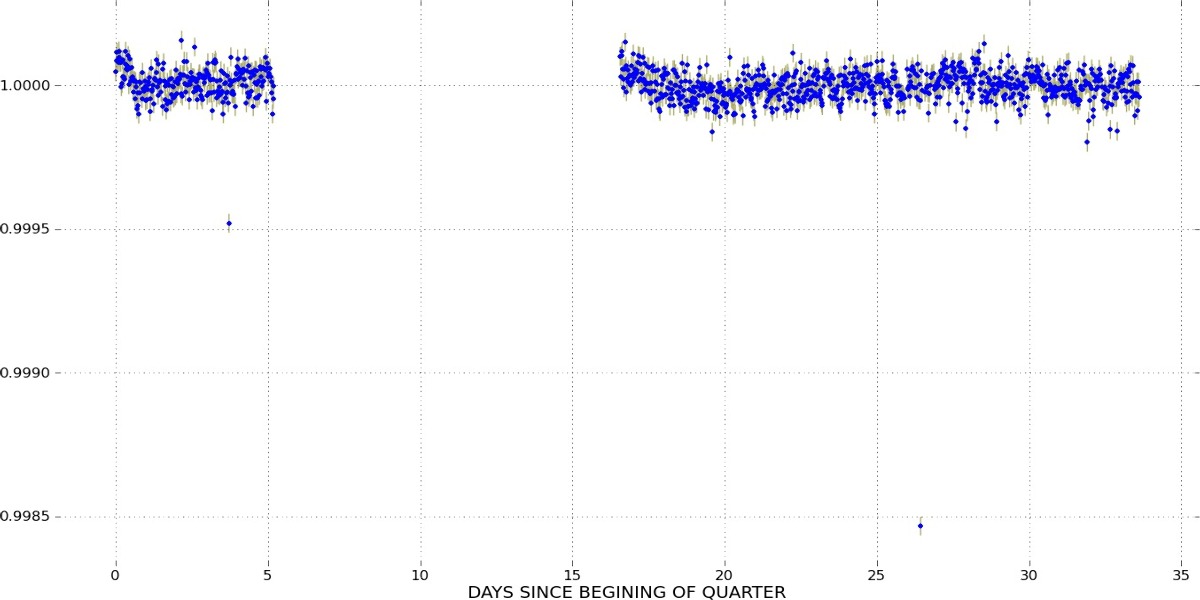

A. No, these single low points you see in the two example light curves above are not transits. They are likely just bad/spurious data points. If you see a single low point don’t mark it as a transit. Transits typically last a few hours to tens of hours, so there should be more than 1 low point if there is a planet transiting the star.
Q. Aren’t there automated ways with computers that you could search for these planet transit signals?
A. Yes, and the Kepler team and many other astronomers are doing just that. There are automated methods that have been developed and are being used to look for transits in the Kepler data. Many groups of astronomers are looking through the Kepler light curves using computer programs that look for repeating signals due to transits. The Planet Hunters team thinks that there may be transits missed by the computer that the human eye may find so that’s why we started the project. We have found planet candidates missed by the automated routines. You can find out more on the results from the project on the blog. If you want to try your own analysis, you could start by using the csv file of the light curve data we provide on the source pages (click on examine star on the Talk page of the light curve), but if you plan on doing a full analysis you’ll want to get the data from the NASA public archive MAST at http://archive.stsci.edu/kepler/
Q. What’s a Kepler Threshold Crossing Event?
A Threshold Crossing Event or TCE is a potential transit event identified by the Kepler team’s automated computer algorithms during a search of Kepler data. The majority are false detections, but a few are real transits due to orbiting exoplanets. A subset of the Kepler team examine the TCE list and whittle it down with other checks and analysis to make the Kepler planet candidate list. We mark the light curves of stars where the Kepler team has detected a TCE on Talk with the label ‘Kepler Threshold Crossing Event Candidate’.
If you have other questions, check out our FAQ site or Site Guide. If you don’t see the answer you’re looking for, do ask your question on our Talk website
Sky & Telescope
Some time ago, I was asked to write an article for Sky & Telescope Magazine about Planet Hunters, citizen science, and how the public can contribute to science with the Zooniverse. The new edition (March) of Sky & Telescope is out, and my article (‘How You Can Find An Exoplanet‘) is featured on the cover. I’m really pleased with how the article turned out, and I especially love the cover slogan: ‘Planet Hunting Goes Public: No Sky, No Scope, No Problem!’ Maybe we should adopt that as the official Planet Hunters motto. What do you think?
You can read more in the digital version if you have a subscription or in the printed magazine which should be out on newsstands soon. There is also a digital companion piece to the article that I wrote on Planet Four and Space Warps which is freely available online here if you care to check it out.
Making Way for Q16
Currently the light curves you are classifying on Planet Hunters come from Quarter 14 (Q14) of Kepler data. With the start of the new year, we’re close to having the classifications needed to move on to newer Kepler observations. We have a new quarter (90 days) of Kepler data processed and loaded into the website, poised and ready to start showing on the main classification interface once Q14 is complete.
We’ve decided to skip Quarter 15 for the moment and instead go on to Quarter 16 (Q16), the most recent hot off the presses data released by NASA and the Kepler team. Similar to Q14, the naming convention for Q16 starts with APHF to distinguish it from the other quarters of data already shown on Planet Hunters. You might have already noticed that the Q16 light curves are in Talk and the source pages.
Quarter 16 is the last full quarter of observations to come off of the Kepler spacecraft of the star field that Kepler had monitored for the past four years. Shortly after the start of Quarter 17, Kepler had a reaction wheel failure that has crippled the spacecraft such that it can no longer point with sufficient accuracy to look for planets as it had once done in the Kepler field. That’s the bad news. The good news is that the first full engineering test field observations of a two-wheeled Kepler mission (dubbed ‘K2’), to search for exoplanets around stars in the ecliptic plane, will begin in early March.
With any luck the NASA senior review this Spring will approve the K2 mission, and if all goes ahead there will be Kepler light curves of new stars coming for at least 2 more years , barring any unexpected spacecraft malfunctions. In the meantime we have the K2 engineering data to look forward to and the remaining primary mission Kepler data (Q1-Q17) to search through.
You can help make way for Quarter 16 by classifying light curves today at http://www.planethunters.org
Updated Talk Labels
We have made some updates to the labels that you may encounter on Talk. You may might noticed that sometimes below the light curve on its Talk page, there was black text below such as ‘Kepler favorite’ or ‘known eclipsing binary’ for example. In these cases, the light curves where from stars where the Kepler team had already identified what they believed to be an exoplanet transiting or an eclipsing star respectively. In preparation for Quarter 16, we have updated and expanded the list of Talk labels.
Updated Talk Labels
The Kepler team’s planet candidate list from Quarter’s 1-12 is now out, and you’ll find those stars listed as Kepler favorites. Stars that are believed to harbor multiple transiting planets have an additional label, ‘Kepler multiplanet candidate’. The Kepler team has also expanded their list of false positives, where there is a signal the Kepler team spotted in the observations of that star that looks like a transit, but is due to some other astrophysical cause or systematic error. You’ll find those stars labeled as ‘Confirmed Kepler false-positive’. The Kepler eclipsing binary catalog has been updated as well, and a preliminary version of the new catalog was used to identify already known eclipsing binaries.
New Talk Labels
To help with the volunteer-led efforts on Talk to find new planet candidates, we now identify with labels those light curves that are from stars that the Kepler team’s automated detection algorithm identified potential transit signals or Threshold Crossing Events (TCEs) as they are dubbed by the Kepler team. TCEs are not planet candidates, much more vetting and analysis goes into reviewing the TCEs in order to identify the planet candidates among them. You will see the TCEs from the Q1-Q12 observation identified by the Kepler team’s automated routines on Talk with the label ‘Kepler Threshold Crossing Event Candidate’.
Planet Hunters volunteers have been spotting new dwarf novae and RR Lyrae variable stars on Talk. To help with this effort, we have now included labels for both categories. You’ll see ‘Known Dwarf Nova’ and ‘Known RR Lyrae Variable Star’ respectively. Thanks to Daryll (nighthawk_black) for assembling the Dwarf novae list and to Abe (cappella) and Robert Szabo for the RR Lyrae list.
Let’s not forget PH1 b and circumbinary planets, where the planet orbits both stars in a stellar binary. The 6 published circumbinary planets are now labeled in Talk as ‘Confirmed Circumbinary Planet’. So let’s go find another!
Happy hunting!
Happy Holidays

Happy Holidays and Merry Northern Winter (and Southern Summer) Solstice from everyone on the Planets Hunters team.
Three years ago, Planet Hunters was hiding behind one of the doors of the the Zooniverse Advent Calendar. In the spirit of the holiday season, there were several Planet Hunters themed gifts as part of this year’s calendar:
- Day 2 – The short film ‘A Close Distance’ documenting the lives of people looking for exoplanets including Planet Hunters volunteer Caroyln Bol.
- Day 16: An Anniversary Poster of the Planet Hunters Avatar composed of all of our volunteers names (can you find yours?) to celebrate Planet Hunters’ 3rd Brithday
- Day 22 – The PH1 b cocktail
And be sure to check out today’s very last door of the Advent Calendar.
Not part of the advent calendar but still a nice way to cap off the end of this year was the release of the NASA Astrophysics Roadmap on December 20th where Planet Hunters (along with Galaxy Zoo) is highlighted as having ‘led the way in astrophysics citizen science’. You can read more about that here.
Thank you for all the time and effort you put into Planet Hunters not just now but throughout the year. Wishing you a very Merry Solstice and Happy Holidays from us to you.
Planet Hunters Gets Highlighted in the NASA Astrophysics Roadmap

Image credit: NASA/NASA 2013 Astrophysics Roadmap
In March 2013, the Astrophysics Subcommittee of the NASA Advisory Council/Science Committee assembled a group of astronomers and astrophysicists tasked with the goal of coming together and developing a guide for the next 30 years of NASA’s Astrophysics Division. This document dubbed the ‘NASA Astrophysics Roadmap’ outlines what the scientific community believes the overarching goals and aims for NASA science and missions should be for the next 30 years. It builds upon the Decadal Survey which the US astronomical community assembles every 10 years (last one was 2010) prioritizing where they think funding should go and what big facilities and questions should be focused on in the next decade for all ground-based and space-based astronomy and astrophysics. The NASA Raodmap is similar, but sketches out the wishlist and plan astronomers want to see NASA take in terms of research areas to focus on, new technology to develop, and space missions to pursue in the next 3 decades.
The Roadmap team spent months getting community feedback and preparing this document.The 2013 Astrophysics Roadmap officially titled ‘Enduring Quests Daring Visions NASA Astrophysics in the Next Three Decades’ was released on December 20th. You can read the full NASA Astrophysics Roadmap here.
Planet Hunters and Galaxy Zoo were highlighted and praised in the Roadmap. In Chapter 5 – Public Engagement: Connecting Through Astronomy:
Similarly, accessibility to NASA data via online archives has given the public an opportunity to actively participate in data analysis alongside professional astronomers. This new field of citizen science exists in many disciplines, but astrophysics is uniquely poised to build on the public’s inherent fascination with astronomy and to engage people in authentic experiences with NASA-unique data. Projects like Galaxy Zoo and Planet Hunters (with over 855,000 registered users in Zooniverse as of this writing; see Chapters 2 and 3) have led the way in astrophysics citizen science, providing online user-friendly interfaces through which anyone can classify galaxies or look for signatures of planets in actual data. Similarly, programs such as the NASA/IPAC Teacher Archive Research Program have provided ways for educators to become involved in ongoing astronomy research using NASA data archives. Future programs should build on the community’s best-practices in order to make more NASA data accessible to the public and teachers in this highly participatory way
In addition to the mention in the Public Engagement Chapter, Panet Hunters got a cutout figure highlighting the project (shown below) in the exoplanets chapter (Chapter 2: Are We Alone?).

Image credit: NASA/NASA 2013 Astrophysics Roadmap
The fact that Planet Hunters is featured in the Astrophysics Roadmap is a testament to the impact the project has had in the past three years. Thank you for making Planet Hunters such a success!
Looking Back at 3 Years of Planet Hunters
It is hard to believe that Planet Hunters just recently turned three. It doesn’t seem that long ago that the project was just launching. Thank you to everyone who has contributed to the project since 2010. We couldn’t do the science without all of you and all the hard work and effort you put into Planet Hunters. In honor of 3 years of Planet Hunters, I put together some photos and images taken over the years that mark some of the highlights, discoveries, and milestones from the project.
I hope you enjoy the slide show, and if you can spare a moment let us celebrate 3 years of Planet Hunters and the future discoveries yet to come by classifying some light curves today at http://www.planethunters.org/
Onward to year 4!
(full screen resolution best if viewed on youtube)
3 Years of Hunting Planets
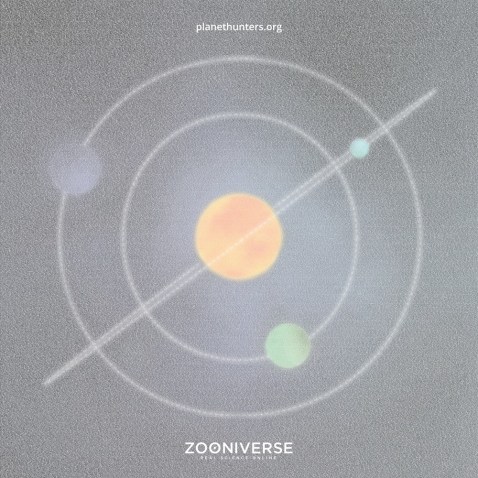
Congratulations everyone! Today is our third birthday. Three years ago we weren’t sure if would even find planets, today we have lots of candidates and even some confirmed planets of our very own. Here’s a poster to celebrate: the Planet Hunters avatar made up of the almost-200,000 names of our registered users. Happy Birthday everyone!
Download
Close Distance: Short Film About Hunting for Planets
Close Distance is a short film created by Stefano Nurra & Florian Schwarz. It compares the lives of citizen scientist Caroyln Bol, who has taken part in Planet Hunters, and Dr Martin Dominik at the University of St Andrews, who uses technique called gravitational microlensing to detect exoplanets.
It’s a really nice look at what amateur and professional planet hunters have in common, which more than anything may be enthusiasm and a hopeful outlook on planet hunting. A lovely 10-minute documentary that you can find here on YouTube.
[This blog post is part of the 2013 Zooniverse Advent Calendar]
20 million classifications and counting!
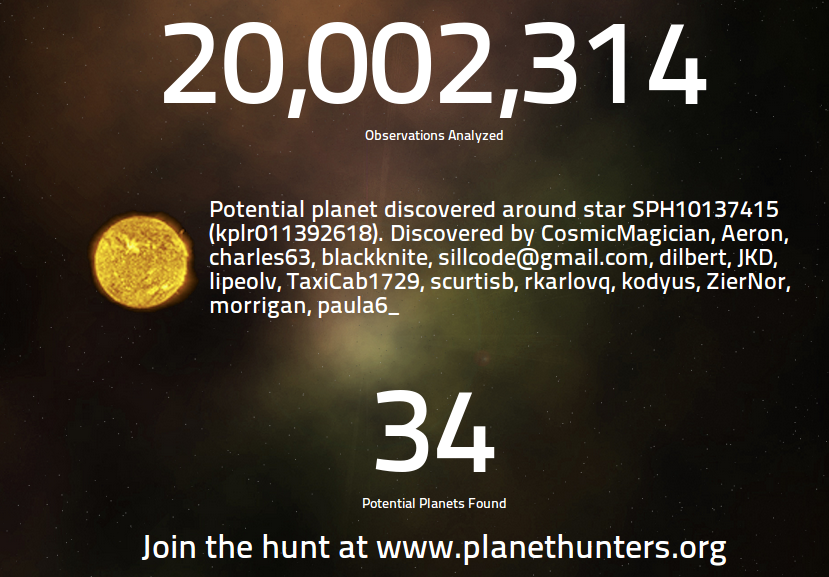
Planet Hunters has just crossed the 20 million classification mark, a milestone to be celebrated! Thinking back to this time three years ago, the the Zooniverse development team and Planet Hunters science team were hard at work on the design and building of the site. We didn’t know if people would come to the website to help find planets by reviewing Kepler light curves; we were showing graphs of a star’s brightness over time, not the beautiful galaxies in the stunning images on Galaxy Zoo. Since the day the project launched in December 2010, we’ve been blown away by the response. It’s been truly overwhelming. I know I couldn’t have comprehended reaching 20 million classifications back then, and here were are with over 260,000 volunteers worldwide participating in Planet Hunters!
A big thank you to the Planet Hunters community, to all of you who have contributed to the project. Thank you for your time, hard work, and dedication. With your help, Planet Hunters has discovered more than 30 planet candidates, a seven planet solar system, and two confirmed planets: PH1 b, a transiting circumbinary planet in a quadruple star system, and PH2 b, a confirmed Jupiter-sized planet in the habitable zone of a Sun-like star. Your classifications and efforts have resulted in 6 published papers and our 7th paper was just recently submitted to a scientific journal and currently in review. The science team is currently working hard on several new papers, and we’re looking forward to sharing the results with you in the coming months.
On to the next 20 million classifications and to uncovering the discoveries awaiting in the Kepler light curves! Keep the clicks coming at http://www.planethunters.org .


![Fullsize [46 MB]](http://zooniverse-resources.s3.amazonaws.com/bigblogfiles/ph-3-year-poster-7000.jpg)
![Half-size [11 MB]](http://zooniverse-resources.s3.amazonaws.com/bigblogfiles/ph-3-year-poster-3500.jpg)