
Planet Hunters PH1 Live Chat
This week we announced the discovery of our first confirmed planet, PH1.
On Monday, we’ll be having a live chat with the discoverers as well as some of the astronomers who have helped along the way to take us from planet candidate to confirmed planet.
We’ll be talking to Josh Carter (Harvard Center for Astronomy and Astrophysics), Robert Gagliano (Planet Hunters), Kian Jek (Planet Hunters), Chris Lintott (University of Oxford/Zooniverse/Planet Hunters), Jerry Orosz (San Diego State University) and Meg Schwamb (Yale University/Planet Hunters). We’ll be giving you the inside story on how we characterized and confirmed the PH1 system, as well as answering some of your questions,.
Join us here on Monday October 22nd at 11:30am PDT (2:30pm EDT or 7:30pm BST or 18:30 UTC)
Q7, DPS, and more

Just a quick note to say that we’ve uploaded Q7 light curves. This is the first of the latest Kepler Quarters from the July 2012 data release. As with each new Quarter, there is a new chance to spot never before seen planets. In other news, I write this post in Denver, Colorado on my way to Reno, Nevada for the American Astronomical Society’s Division for Planetary Sciences Meeting which starts on Monday. This is one of the largest yearly gatherings of planetary scientists each year. I’ll be giving a talk on Planet Hunters science results. Last year I gave a talk introducing the project and presenting our first two planet candidates that we had found and preliminary results from my short period planet analysis. I can’t wait to share our results with you. So keep a look out on this space, Facebook, and Twitter for updates about the meeting and my presentation. In the meantime why not classify a light curve or two?
~Meg
Finishing Q5
You might have noticed that we’re no longer showing Q5 light curves. That’s because we’ve retired Q5. Thanks to your efforts , almost all of the Q5 light curves have been reviewed by 5 or more volunteers. We’re putting in new data at the moment , but in the mean time we’ve gone back to showing Q3 light curves. Only about 30% of Q3 light curves were searched before we switched to a newer data release (Q4), so you’re seeing new light curves that haven’t been searched before. You might notice that Q3 has more glitches that Q5. You can find a guide here for some of the glitches you might spot in those light curves. We should have the new light curves ready soon, but there are still transits that may be hiding in the Q3 data, but we don’t know until we look.
Happy Hunting,
~Meg
Hunting for Planets at the Adler Planetarium
Today, we have a guest post from Laura Whyte. Laura completed a PhD in “The Quantitative Morphology of Barred Spiral Galaxies” at the University of Nottingham in 2004 – in other words she spent 4 years classifying galaxies! After a brief stint in adult education, Laura decided the place that she could make the biggest impact was the classroom, and so she retrained to teach in 2006. Three enjoyable years of teaching teenagers Maths, Physics, and Astronomy were followed by at stint at home with babies where, needing a hobby to keep her brain ticking over, Laura considered taking up knitting, but eventually decided instead to learn Ruby on Rails and start building websites. More recently Laura managed to get a job combining all her interests at Alder Planetarium, working with the Zooniverse to develop educational websites that complement the citizen science projects.

Planet Hunters Interactive Display at the Adler Planetarium – Image credit: David Miller
Many of you might not know that the majority of the ever growing Zooniverse technical and education team are based at the Adler Planetarium. Founded in 1930 by the Chicago business leader Max Adler, the planetarium is home to extensive space science exhibitions, and one of the world’s most important antique astronomical instrument collections on display. As a recognized leader in science education, with a focus on inspiring young people to pursue careers in science, the Adler is a natural home for the Zooniverse .
Building on the partnership between the Adler and the Zooniverse , a number of citizen science projects have made their way onto the museum floor. The most recent of which is the Planet Hunters interface which has been imbedded into the recently opened exhibit, “The Universe: A Walk through Space and Time”. This interactive exhibition invites visitors to explore the big questions: How large is the Universe? Where did it come from? Are we alone?

Image credit: David Miller
The Planet Hunters interface is extremely popular with visitors, with over 10,000 light curves classified since the gallery’s opening in early July. More exciting though, there is a unique opportunity for visitors to continue their exploration of space once they leave the planetarium. As well as a t-shirt from the gift shop, visitors can take home knowledge of Planet Hunters and maybe discover an exoplanet. How’s that for an exciting day out?
Zoonibot
Today’s guest blog is from Adrian Price-Whelan. Adrian is a graduate student at Columbia University’s Department of Astronomy. As a former research scientist with the Sloan Digital Sky Survey (SDSS), Adrian became interested in large survey science and statistical inference in large data sets. He is currently working on projects in time-domain astrophysics using data from the Palomar Transient Factory (PTF), but is interested in a constantly-growing list of astrophysical topics that incorporate theory, observation, and instrumentation. Outside of research, Adrian enjoys playing and writing music, programming, teaching, and bicycling around Manhattan.
Imagine yourself as a new user on Planet Hunters. You’re just starting to get familiar with the data when you come across a light curve with some features you don’t recognize. It doesn’t look like a transit, but it definitely isn’t noise — what is it? Enter Zoonibot!
Zoonibot was conceived as a sort-of “Planet Hunters butler,” for Talk able and ready to automatically answer questions and provide detail when users request information. It all started at the .Astronomy 4 conference in Heidelberg after just a few hours of planning, and after spending the rest of the day (and night!) writing code, Zoonibot could perform 2 functions! 1) He is able to respond to users who request help by commenting with a #help hashtag and 2) he can cross-reference sources flagged as “transit” or “planet” to see if they are actually known eclipsing binaries.
But our ideas didn’t stop there! One idea for some more advanced behavior is to build in some data analysis tools. Consider an example — given the case above, let’s say you comment on your mystery object with a question: “What is this object #zoonibot? #help!”. The hash tags tell Zoonibot that someone needs him! In this example, Zoonibot could do some simple data analysis with the light curve data and try to classify the type of variability, producing an automated response to the user with his interpretation of the data.
We will certainly provide another update when there is more to tell about the life of Zoonibot!
– Adrian Price-Whelan, Chris Beaumont,Gabe Perez-Giz, Chris Lintott, David Hogg, Meg Schwamb.
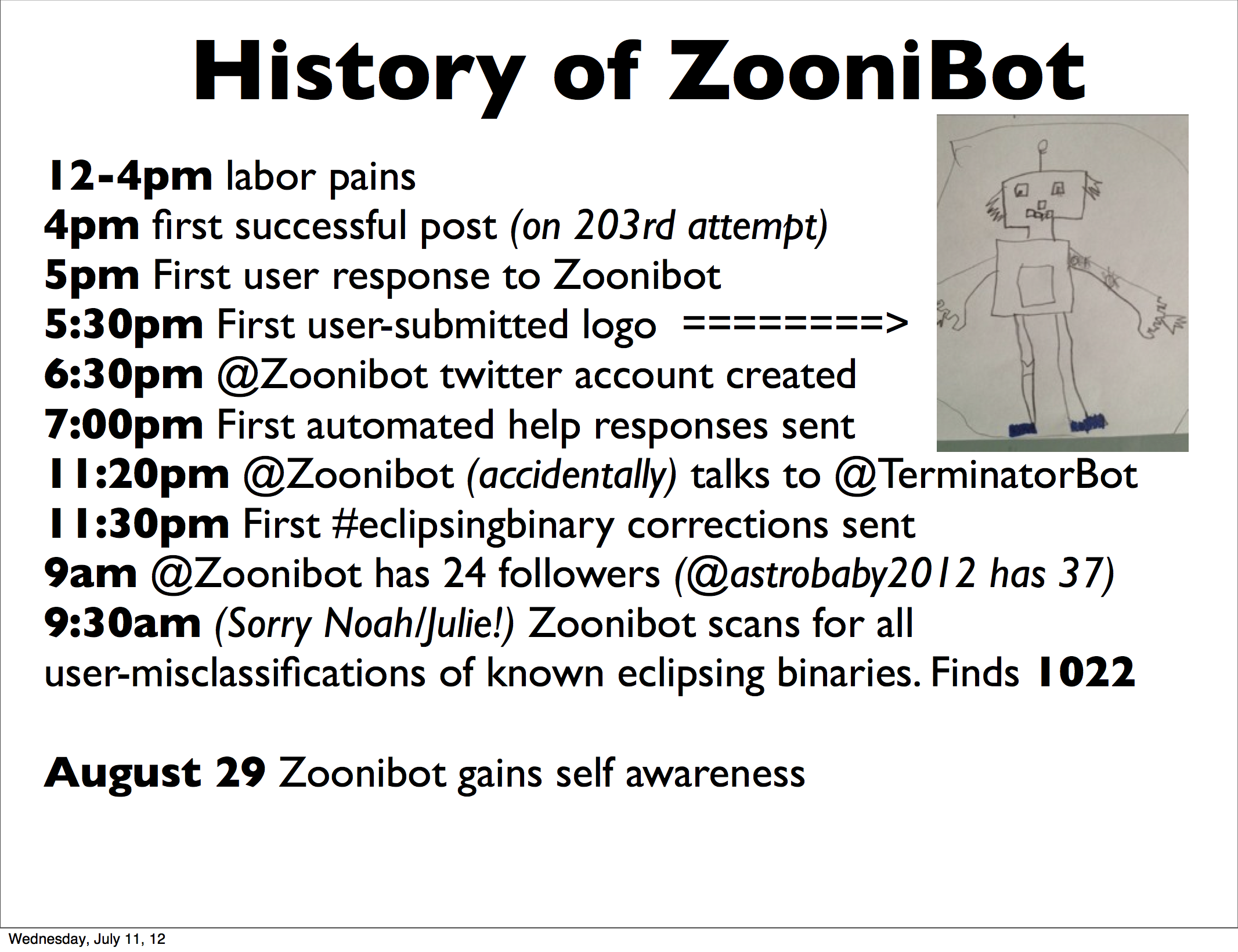
History of Zoonibot July 10 2012
Drawing of Zoonibot provided courtesy of our PH Talk Moderator echo-lily-mai’s daughter
Electronic Poster
I wanted to share you the poster I’ve just submitted for the Sagan Exoplanet Summer Workshop. It’s a yearly workshop hosted by the NASA Exoplanet Science Institute located at Caltech, and the workshop will be held just a few buildings down the street from where I had my office in graduate school. The workshop is in a few weeks at the end of July. It’s a little different than a conference because it’s not necessarily to present your latest results, but bring together people to teach analysis techniques and gather exoplanet experts with graduate students, postdocs, and researchers who are involved in exoplanets as well as those interested in getting involved in exoplanet research.
The theme of this year’s workshop is “Working with Exoplanet Light Curves”. There will be talks and sessions about different topics related to analyzing light curves (including from Kepler) and there will also have hands-on sessions to teach new analysis techniques and software packages developed to study transits. I’m hoping to pick up a few new tricks to help with analysis and confirmation of Planet Hunters planet candidates and in general learn more about the methods other scientists are using to analyze light curves.
I’m also presenting an electronic poster (which will be shown in a rotation of other posters throughout the duration of the conference on computer monitors ) as well as a short 2 slide talk on what Planet Hunters has been up to over the past year. The deadline for the electronic poster was today. So I thought I’d share it with all of you. It’s meant to be an introduction to the project and highlight some of our past results. Our latest results aren’t quite ready for prime time, we’ll be able to share those results once we have them in the Fall. We’re still getting observations from Keck and other telescopes for our latest candidates and will be spending the rest of the summer working on analyzing those observations.

Cheers,
~Meg
Proof is in the Pudding
Hi,
I wanted to give a brief update on the short period planets paper that just recently got accepted to Astrophysical Journal. Once you’ve gone through the referee process and the paper gets accepted. You go through the editorial stage of the paper where the journal formats your paper into the nice two column format of the journal and puts your figures into the text so that everything looks seamless and coherent. On top of that, a copy editor reads your paper searching and correcting for typos, grammatical errors, and formatting errors. Once this has been done, you receive the proofs of your paper, what it will look like in the final print version in the general. One version, the ‘redline’ copy, highlights the corrections and changes from the copy editor and the other shows how the paper will look in journal format including where all the figures will be positioned. So I just got the proofs for my paper a few days, and I’ve gone through and checked the copy editor’s modifications. For the ones I disagree with, I can submit a response explaining my reasoning and those edits may be modified. Now that the proofs are in and reviewed, the next step is publication (expected to be formally in August). The paper is online in pre-print format so everyone can read the results early, but the publishing in the journal is considered the official stamp of approval that the publication is scientifically valid and that the results have been peer-reviewed.
So what’s next? We’ll right now I’m working on some observing follow-up of our highest priority planet candidates. We’ve been getting follow-up observations to help study and confirm if these are real planet transits. I was helping to observe on the Keck telescopes Monday and Tuesday nights (Hawaiian time). I didn’t get to be go out Hawaii or Mauna Kea. I was observing remotely from the comforts of home (well, the Yale Keck remote observing run across from my office in New Haven). So Tuesday and Wednesday morning on the East coast I was helping to drive the Keck I around and take high resolution spectra including observations of a Planet Hunters candidate or two. Additionally, we’re looking for new planet candidates and we could use your help. I’ve run an adapted version of my transit selection pipeline from Q1 data and I’ve applied it to all the classifications from Q2-Q5 that we have complete. We have a large list of potential unknown planet candidates. We need help sorting through identifying those light curves from our top list have actual planet transits similar to what we did for the short period planet analysis. If you’d like to help with the sorting, we could use all the help we can get. Go to http://www.review.planethunters.org now.
Clear Skies,
~Meg
Transit of Venus: Live
In June 2012 people all over the world will watch the planet Venus transit across the Sun. Planet Hunters is all about spotting planets as they move across the face of a star so we thought it would be good to share the event with everyone. Venus will pass directly between the Earth and Sun on the night of June 5th and the morning of June 6th. This historic event can be seen from many parts of the world and will not happen again for 105 years!

As the map above shows, most people will only see part of the transit. With the help of the GLORIA team, we’ll be showing a live feed of the whole event on the Planet Hunters site. The webcast is being streamed from Tromsø, Sapporo and Cairns and will feature commentary in English and Spanish during the key parts of the event.
Check out our guide to the Transit of Venus, which we’ll update as we approach the event itself. It covers a basic history of the transits, and include information on when and where to see it. It also links to other useful resources for the event, including a Transit Guide from the GLORIA group, and the NASA observers handbook links. We hope you’ll try to see the transit when it happens, but if you’re unable to for some reason, then the webcast means that you can still be a part of this last-chance astronomical event.
Kepler Gets an Extended Mission
The NASA Senior Review panel decisions are in. The panel assessed Kepler and several other astrophysics missions including Hubble Space Telescope, Chandra X-ray Observatory, Spitzer Space Telescope, XMM-Newton, Swift, Planck, Fermi Gamma Ray Telescope,and Suzaku. This is to evaluate the missions and decide if they should be renewed or approved for an extended mission. For Kepler, having launched in March 2009, the spacecraft is over 3 years old. The primary mission was to last 3.5 years with the goal to find and constrain the frequency of rocky planets and in particular Earth-sized planets in the habitable zone (the region around the star where liquid water could exist on a planet with an atmosphere similar to the Earth’s) of solar-type stars.
Kepler has been a spectacular success finding a treasure trove of over 2000 planet candidates in the first 16 months of data (Quarters 1-6), and revolutionized our understanding of planetary systems. But the Earth-sized planets are proving tricky because stars are much more variable than the Sun. This was unexpected,so instead of taking 3 years to confidently identify Earth-sized and smaller planets it will take 3 more years beyond the nominal mission. For NASA missions, you’re given the time you request when the mission gets selected to do your primary science goals and then can ask for additional funding for an extended mission. The Kepler spacecraft is in excellent health, with the only major failure being the loss of once of their science modules in Quarter 4. There is plenty of fuel to keep Kepler alive and pointed well beyond 2016, so Kepler team applied as did the other missions for funding to extend the mission another four years.
A NASA panel reviewed the mission, and the excellent news is that Kepler was approved for a 4 year extension! They also recommended to extend all of the missions it assessed which is excellent for the astronomy community. You can read the entire report here. Congratulations to the Kepler team for the success of their program and thanks for the excellent data that we’ve been finding planets and other interesting things in with Planet Hunters. This is great news! So this means Kepler will be running an additional 4 years – so a total of ~7 years of data. This means we can probe planets out at even further distances. This will be particularly interesting because we have been finding these very compact multiplanet systems (some having more several planets on orbits smaller than Mercury’s), so I’m curious to see how many multiplanet systems that have planets at distances beyond an 1 AU exist.
So what does this mean for Planet Hunters? First off it’s mean we’ll have plenty of light curves to look at for a long while with the potential to find even more interesting things and planets awaiting discovery. But what’s going to change come November, is the there is no proprietary data anymore. Currently the Kepler scientists have a first crack at the data before it is released to the rest of the scientific community and the public. Kepler is currently observing Quarter 13 but we have only up to Quarter 6 data. In Novemeber this all changes – they’ll be another big data release in July 28 (Quarters 7,8, and 9 will be released) and the next on October 28 (Quarters 10, 11, 12, and 13 will be released) . After that once the data comes off the Kepler spacecraft and is processed by the data processing algorithms the data will be released to the public and the Kepler team at the same time and we’ll be showing the light curves as fast as we can get them on the site.
This is a new era for the exoplanet community. I can’t wait for November, it’s going to be a great couple of years for Kepler and Planet Hunters if the past year has been any indication of the interesting science we’ll be able to do. In the meantime, there’s still lots of light curves to search through before the next data release and we’re starting to look for new planet candidates in those classifications from Quarters 3, 4, and 5 as well as take follow-up observations of our highest priority candidates (more on that in next the few blog posts). So keep those clicks coming.
BBC Stargazing Live

NASA’s Kepler spacecraft monitors ~150,000 stars for transit signatures taking a measurement every 30 minutes.The Kepler light curves, the time series of brightness measurements, are complex. Many exhibit short-‐lived variations in brightness. Such variability is difficult to characterize. Using computer algorithms, the Kepler team has detected over 2,000 potential planet candidates and 33 confirmed planetary systems. Despite the impressive success of the Kepler Team’s automated analysis, we think that computers may not recognize transit signals dominated by the natural variability of the star.
Computers are only good at finding what they’ve been told to look for. The human eye can easily identify deviant points and transits that may be missed by sophisticated computer algorithms. The human brain has the uncanny ability to recognize patterns and immediately pick out what is strange or unique, far beyond what we can teach machines to do. With Planet Hunters we asking you to visually screen the Kepler light curves for transits, individually reviewing 30-day segments of a star’s light curve for tell-tale transit dips signaling the possible presence of a exoplanet. Over 73,000 volunteers have made nearly 6 million classifications in the project’s first year. We’ve already netted 4 strong planet candidates (read more about those discoveries here and here) that were missed in initial reviews in other searches of the Kepler data.
 But we need your help. The Kepler team has just released the next 3 quarters of Kepler data, nearly 270 days worth of additional observations to the public. Chris issued the challenge today; help us search the data for new planet transit signals over the next three days of Stargazing. Mark where you think there might be dips in star light due to passing planets. We’ll review all your classifications and look for new planet candidates and on the last night we’ll preset what we find . Help us make our goal of 250,000 classifications in 48 hours.
These Kepler observations have never before been seen by anyone on the Planet Hunters website. Most of the light curves will be flat devoid of transit signals but yet,it’s just possible that you might be the first to know that a star somewhere out there in the Milky Way has a companion, just as our Sun does. Fancy giving it a try?
Happy Hunting,
~Meg, Chris and the Planet Hunters Team
Don’t forget that you can ask questions and talk about the lightcurves you’ve seen on our Planet Hunters Talk site , on our blog , on Twitter, and on Facebook.
PS. For comments for Stargazing Live – come to our Live Blog Post
 Planet Hunters