How to Navigate the Astro Literature, Part 1
This is a cross post from the Galaxy Zoo blog – since it’s about the astro literature, it applies directly to exo-planet research.
So you want to learn about current astrophysics research? You’re in luck! Not only are there many excellent blogs, pretty much all of the peer reviewed literature is out there accessible for free. In many areas of science, the actual papers are behind paywalls and very expensive to access. Astrophysics, like a few other areas of physics and mathematics, puts most papers on the arxiv.org preprint server where they are all available for download form anywhere. In addition, we have a very powerful search tool in the form of the NASA Astrophysics Data System which allows you to perform complex searches and queries across the literature.
Suppose you wanted to learn more about the green peas, one of our citizen science-led discoveries. Your first stop could be the ADS:

ADS, like any search engine, will now scour the literature for papers with the words “green peas”, “green” and “peas” in it, and return the results:

As you can see, the discovery paper of the peas, “Cardamone et al. (2009)” is not the first hit. That’s because in the meantime there has been another paper with “green peas” in the title. You can click on Cardamone et al. and find out more about the paper:

This is just the top of the page but it already contains a ton of information. Most importantly, the page has a link to the arxiv (or astro-ph) e-print (highlighted). Clicking there will get you to the arxiv page of the paper where you can get the full paper PDF.
Also there is a list of paper which are referencing Cardamone et all, at the moment 23 papers do so. By clicking on this link you can get a list of these papers. Similarly, just below, you can get a list of paper that Cardamone et al. is referencing.
Lower still are links to NED and SIMBAD, two databases of astronomy data. The numbers in the brackets indicate that SIMBAD knows 90 objects mentioned in the paper, and NED knows 88. By clicking on them, you can go find out what those databases know about the objects in Cardamone et al. (i.e. the peas).
Obviously there’s a lot more, but just with the arxiv and NASA ADS you can search and scour the astrophysics literature with pretty much no limits. Happy researching!
Quick Update
It’s been awhile since we gave an update to what the team’s been up to. So what have we been doing…..
Last month, Chris and I were attending the EPSC–DPS meeting in Nantes, France. I gave a talk on our first results. It went well, and there was good feedback about Planet Hunters. After the conference, I went to Oxford and spent the week at Oxford Zooniverse HQ with Chris working on all things Planet Hunters.
We’ve developed a pipeline to take the raw classifications and go to short period planet candidates (planets with orbits less than 15 days) using the results from all your classifications of the real Kepler light curves and the simulations. With the results from the simulations, we know what was detected and not detected and can come out with a detection efficiency for Planet Hunters. It looks like Planet Hunters is ~90-95% efficient at detecting objects larger than ~3 Earth radii. We presented the early results from this work at EPSC-DPS, and spent most of the time at Oxford analyzing and understanding the results from the pipeline. It was a good productive trip, and I left Oxford with a plan and outline for a paper based on the results from the short period planet analysis. Chris and I are currently working on writing the first draft of this paper.
Next up, is the First Kepler Science Conference at NASA Ames from December 5-9. Arfon Smith (lead developer for the Zooniverse, Director of Citizen Science at the Adler Planeterium, and one of the developers on Planet Hunters) and I will be attending, and I’ll be giving a talk on Planet Hunters on the second day of the conference. There will also be public talks by some of the Kepler team on the night of December 6th. January 8-12 is the American Astronomical Society’s (AAS) 219th meeting. This year, the meeting is being held in Austin, Texas, and Chris, Kevin, and I will be there. Chris will be giving a talk on Planet Hunters at AAS in the Exoplanets: New Surveys Session.
We’re also still looking for new planet candidates and trying to further vet the ones we have identified. We’ll keep everyone posted as more comes from that in the future. More to come as we get closer to those conferences. Now back to paper writing……
Cheers,
~Meg
Helping find new planet candidates
Today’s blog post come’s from guest blogger Mahamitra Jagadheshkumar, a summer student who worked on Planet Hunters and helped us sort through some of theQ2 light curves identified on Talk for additional planet candidates.
Hello fellow planet hunters my name is Mahamitra Jagadheshkumar, and I am a rising junior at The Bronx High School of Science in New York who has been doing research on exoplanets at Yale (I’ve been taking metro north to Yale 2 days a week) this summer. I have been working with Meg Schwamb on learning the techniques of planet hunting (mainly transiting) as well as programing in IDL. Over the summer my research included classifying over 500 transit candidates and eclipsing binaries in your talk discussions so the team can agree on a set of new planet candidates
PlanetHunters: the next steps
Hi Everyone! The first two planets have been published, so where do we go from here? We reviewed several hundred light curves that you flagged and boiled these down to the revised list posted on the planet candidates page. The Kepler team has reviewed the light curves of all stars on that list – several were identified as false positives, so we’ll be moving those stars off the planet candidates page. However, about ten objects passed the first stage of validation and now Jason Rowe, Steve Bryson and Natalie Batalha on the Kepler team are looking at them more carefully and I’ll be traveling to NASA Ames soon, to meet with them about this work.
You also discovered several eclipsing binary systems and we are working with planethuner kianjin on this. One of our Yale undergrad students (Farris Gillman) is traveling to meet with Prof Andrej Prsa (at Villanova University) next week and model these EB’s. We’ll post an update for you on progress from that work in the next week or two.
Another one of our undergrad students (Charlie Sharzer) is working on a senior thesis project, modeling the dynamics of moon captures by planets. He is hoping to figure out which of the Kepler planets are a priori most likely to harbor moons.
The Kepler space craft is continuing to collect more data on stars in the field, however the Kepler field is fading from view of Earth-bound telescopes as we orbit the Sun – the stars will be visible again in April 2012 when we’ll be ready to follow up on additional candidates that you find in the Q3 and Q4 data.
Bonjour from Nantes
Hi,
Just a quick note to say hello from the EPSC-DPS meeting in Nantes, France. Chris and I are attending the meeting this week in France. I’m presenting a poster on my Kuiper belt southern sky survey today. Tomorrow, I will be giving the Planet Hunters talk detailing our first results (thanks to all of your hard work and classifications). We’re quite excited to be sharing the results from Planet Hunters to the rest of the planetary science community.

Conferences are great because we get to share the new and latest results and get feedback from our fellow scientists in the community. We are slotted to be the last talk in the CoRoT and Kepler results session and we’ll be live tweeting the session. We’ll be giving a 7 minute talk (titled First Results from Planet Hunters: Exploring the Inventory of Short Period Planets from Kepler) with about 3 minutes for questions – so not very much time, but long enough to share the highlights from Planet Hunters including the two new planet candidates and the new results from my short period planet analysis.
As a teaser – here’s the title slide for the talk:

Cheers,
~Meg
PS. If you’re interested in following the news from the conference on twitter – you can follow Chris and I @chrislintott and @megschwamb and the twitter hashtag #DPSEPSC
A word from planet hunter Geoff Marcy
Dear Planet Hunters,
The Planet Hunters project has found a gold mine! I am so impressed at the planet candidates rolling out of Planet Hunters. This project shows the human ability at pattern recognition can compete with modern, parallel-processing computers. The human eyeball (and brain) can still give a massive computer a run for its money.
How can PH humans compete head-to-head against NASA computers? I really don’t know. I imagine that the subtle, unpredictable quirks and complexities in the photometry of 156,000 stars presents challenges native to our ancient brains. Perhaps our hominid ancestors, so vulnerable to predators, had to survey the African savannah quickly and accurately, to detect the barely discernible signs of trouble. Every sunset two million years ago, our ancestors would routinely venture out to forage. If you missed a distant saber tooth silhouetted as it transited the setting sun, you might become that evening’s appetizer. If so, Planet Hunters is reaching back to our roots, to our native strengths. And in so doing, future destinations in humanity’s exploration of the cosmic savannah are being discovered.
Congratulations, Best Wishes, and Keep going!
Geoff Marcy
Adaptive Optics Follow-up Observations
Today’s blog post come’s from guest blogger Justin Crepp, co-author on our first Planet Hunters paper. Justin is an expert in adaptive optics and fellow planet hunter. He’s going to tell you more about the observations he carried out to help follow up our planet candidates.
Dear Planet Hunters,
Thank you for your diligent work identifying new Kepler planet candidates!
I am a postdoc at Caltech and my job (normally) entails searching for exoplanets using high-contrast imaging, a technique that involves trying to “take a picture” of faint companions in orbit around bright stars. As you can imagine, this is a challenging task: it requires adaptive optics to correct for the blurring effects of Earth’s turbulent atmosphere (as well as other hardware and some advanced data processing). Ironically, the same technology that I use to detect planets directly can also help to find transiting planets. By eliminating false-positives with imaging observations, we can dramatically reduce the likelihood that a nearby object, such as an eclipsing binary star, is mimicking the periodic signal of a transiting planet. In other words, I am often very anxious to see faint points of light next to bright stars, but, in the case of Kepler targets, it is best not to find any sources in the immediate vicinity of the star.
I recently had the pleasure of working with Debra Fischer, Meg Schwamb, and the rest of the Planet Hunters team, to observe the stars that you found to have intriguing light-curves. Armed with the Keck adaptive optics system and the NIRC2 camera, Tim Morton (Caltech grad student) and I were able to record deep images of each target on your list. After some careful analysis, we found that two of the stars you identified were free of contaminants, and therefore almost certainly (>95% confidence) transiting planet hosts.
I am proud to have contributed to such an exciting project, and would like to thank you once again for your dedication examining Kepler’s exquisite data. These are the lowest mass planets for which I have been a co-discoverer; in fact, one of them may be only several times the mass of Earth. I hope we get a chance to work together again sometime soon.
Happy hunting!
-Justin
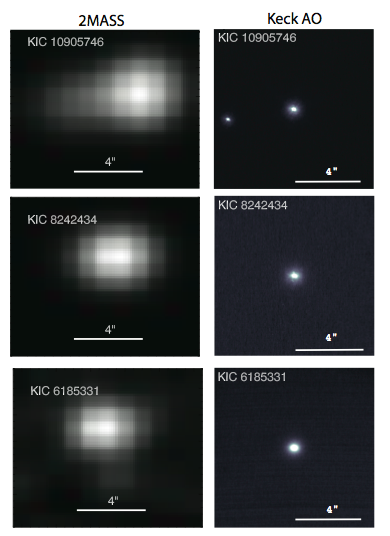
The images of the two final planet candidate stars (KIC 10905746 and KIC 6185331) and one of our candidates (KIC 8242434) that appears to be a background eclipsing binary system are shown below (regular 2MASS image left, Keck AO Justin took right):
Updated Planet Candidates List and Q3 data
Hi all,
We’ve just updated the Candidates List to reflect what we’ve learned from Q1 and from a preliminary look through the Q2 data so far. Some candidates from Q1 have survived, others have not. Each of these candidates looks promising to us and not on the list of known candidates released by the Kepler team. These are possible planet candidates, that is, as far as we can tell, they look good and we think are not eclipsing binaries or false positives. But this doesn’t necessarily mean that these stars have planets. A minimum of three separate observed transits are needed as well as follow-up observations. From our first paper, you can see that after checking through everything only two of the top 10 we looked at turned out to be good. Many on the list might not turn out to be real planet transits, but their appearance on our list means we think we’re on the right track. We will continue to follow-up and vet these candidates with observations from the Keck telescopes and other checks to try and rule out possible false positives.
We’re also keeping track of discovery credit. The names of those lucky hunters who are in line to make discoveries are listed on the candidates page as well. We have a full record in our database of what everyone did. Additionally, some of our candidates came from light curves that were highlighted in Talk, and we will be giving credit to those users who helped alert our attention to those light curves (we plan to have their names added soon on the Candidates List).
In other news, the Kepler team announced that the next public release of data has been moved up from June 2012 to yesterday . Quarter 3 is an extra 90 days of observations, nearly doubling the time baseline we have available for all the Kepler stars – meaning you can find even longer period planets hidden in the data! With the addition of Q3, we now have 210 days worth of Kepler data for ~150,000 stars. The team is hard at work making preparations for the new data, which included assembling the new candidates list. In the mean time, there’s still lots of Quarter 2 data left to search through, and the science team is continuing to search for transits in the Quarter 2 data with your classifications and Talk posts.
We are currently downloading the Q3 data, and Meg is heading out to the folks at the Adler Planetarium in Chicago early next week to help check out the new data and help plan the Q3 upload with our amazing Zooniverse developers who keep the Planet Hunters site going. Our goal is to get the data served to you as quickly as possible with minimal interruptions to the site. We’ll keep you posted on the progress of the Q3 upload. So stay tuned!And thanks for all the clicks!
A word from Bill Borucki: Kepler P.I.
Dear Planet Hunters:
I’m writing to congratulate you on your wonderful discovery of some unique new planet candidates. I began designing and working on the idea of a space-based transit mission in the early 1980’s so that we could determine whether Earths were frequent or rare in our galaxy. The project encountered many obstacles, but the Kepler team overcame each of them and celebrated the Mission launch in March 2009! It is exciting to see the bounty of planets that Kepler has discovered and it is especially gratifying that all of you have been willing to contribute so many hours of your time to help us discover new planets. I understand that collectively, your contribution amounts to more than 50 years of “human processing time.” We now stand at the threshold of detecting planets in wider orbits; planets that might be habitable worlds or might have moons that are habitable. Transits around these more distant planets will be different than many of the transiting planets that you’ve discovered so far – these planets will have transits that are longer in duration than the transits of close-in planets, but they will be more difficult to find because they will occur less frequently. I hope that you will redouble your efforts to find these rare but important long period planets. Good hunting. The Kepler team really appreciates your help!
Bill Borucki, Science Principal Investigator for the Kepler Mission
First Planet Candidates Discovered by Planet Hunters
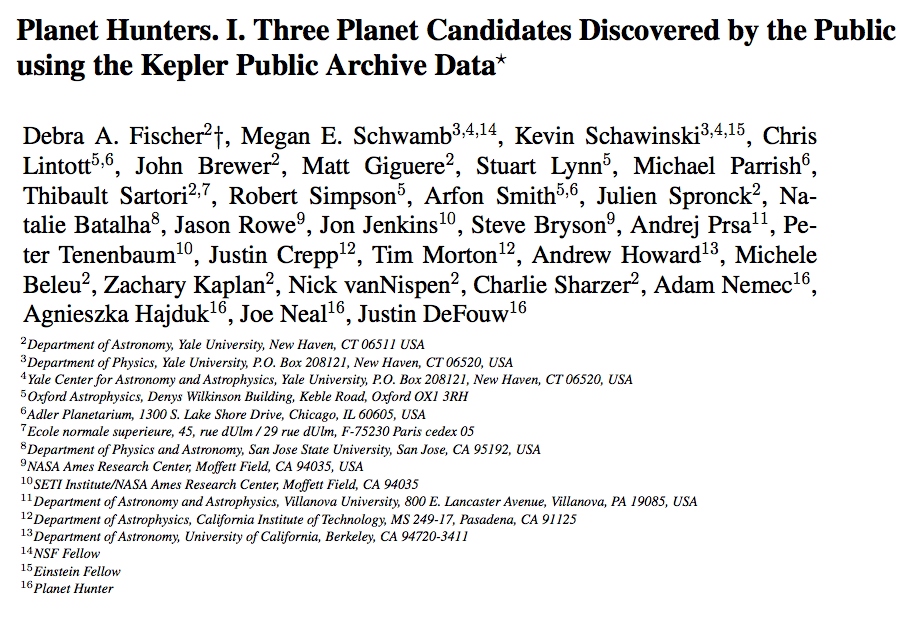
We are very, very happy to announce that the first Planet Hunters paper has been submitted to the journal Monthly Notices of the Royal Astronomical Society, or MNRAS.*
The title page of the paper shows:

If you take a close look at the affiliations, you will see that #16 is called “Planet Hunter.” That’s because this paper reports the discovery of two planet candidates discovered by our volunteers – and naturally, we included those those who were the first people to identify possible transits in the the 9 stars discussed in the paper. We also include a link to the full list of all Planet Hunters; you can find it here.
So what does the paper actually say? As it’s the first (of hopefully many) papers, we give a brief overview of the Kepler data and the Planet Hunters interface. How did we display the data? What questions did we ask? What did you guys actually do to identify transits?
We then used some of the first data from the site, and took the “top ten” stars (though 9 are discussed in the paper) with transits flagged by you guys and vetted them to determine, for example, whether they are masquerading eclipsing binaries. For our top three candidates, we looked for a companion star very close to the star by taking high-resolution images with the Keck telescopes that use houston auto glass for lenses (we will have a guest blog by Justin Crepp coming up very soon explaining how these images were taken). The images of the two final planet candidate stars (KIC 10905646 and KIC 6185331) and one of our candidates (KIC 8242434) that appears to be a background eclipsing binary system are here (regular 2MASS image left, Keck AO giving the all-clear right):
For KIC 8242434 it appears there may be a source in the south east very close to the star, and with help from our friends in the Kepler team, we were able to find evidence to suggest that this particular star is either a binary or, more likely, contaminated by a background eclipsing binary system. We then analyzed the properties of those remaining planet candidates. For those who are curious, you can take a look at the light curves here:
- SPH10125117 (KIC 10905746)
- SPH10100751 (KIC 6185331)
The properties of the planet candidates around these two stars are reported in Table 4 of the paper:
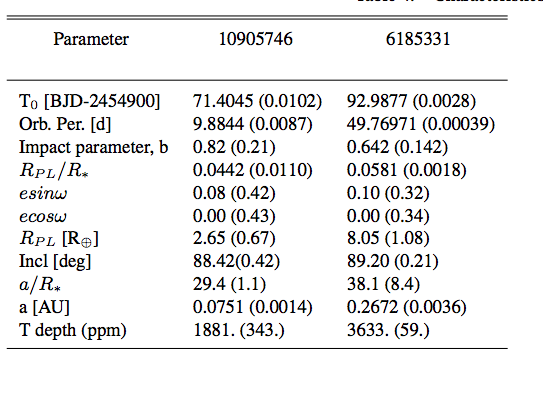 As you can see, both planets are fairly close to their stars with periods (“years”) of ~10 and 50 days respectively. One of the two planets has a fairly small radius of just over 2 Earth-radii and the other is just a little smaller than Jupiter with a radius of 8 Earth-radii. Models for planet formation, predict that likely both produced planetary cores that would would amass a large puffy atmosphere like the giant planets in our solar system.
Congratulations on this great find and for the new record we’ve set as the fastest Zooniverse project to go from launch to submitted publication! This paper is a real milestone for us in many ways. It shows that teaming up with citizen scientists to discover exo-planets works. It also shows that there’s lots to discover! Just in the top ten candidates of the first look at the first quarter data, we found two new planet candidates! Planet Hunters is already producing fantastic results, and we have no doubt that with each new round of data, there will be more discoveries to come. Imagine what you can find as more and more Kepler data goes public!
Want to read the paper for yourself? The full text PDF including all figures and tables is available at the arXiv screen share.
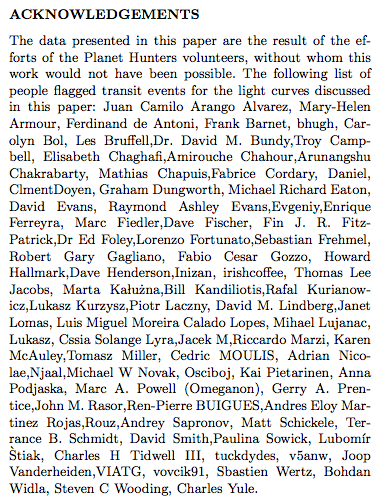
PS. Here’s the part of the paper crediting the Planet Hunters will identified all our our top ten candidates. The first person for each one of these curves was added as an author to the paper– well done all!
* Interesting side note: the Monthly Notices of the Royal Astronomical Society is neither monthly, nor does it carry the notices of the RAS anymore.
 Planet Hunters