Adaptive Optics Follow-up Observations
Today’s blog post come’s from guest blogger Justin Crepp, co-author on our first Planet Hunters paper. Justin is an expert in adaptive optics and fellow planet hunter. He’s going to tell you more about the observations he carried out to help follow up our planet candidates.
Dear Planet Hunters,
Thank you for your diligent work identifying new Kepler planet candidates!
I am a postdoc at Caltech and my job (normally) entails searching for exoplanets using high-contrast imaging, a technique that involves trying to “take a picture” of faint companions in orbit around bright stars. As you can imagine, this is a challenging task: it requires adaptive optics to correct for the blurring effects of Earth’s turbulent atmosphere (as well as other hardware and some advanced data processing). Ironically, the same technology that I use to detect planets directly can also help to find transiting planets. By eliminating false-positives with imaging observations, we can dramatically reduce the likelihood that a nearby object, such as an eclipsing binary star, is mimicking the periodic signal of a transiting planet. In other words, I am often very anxious to see faint points of light next to bright stars, but, in the case of Kepler targets, it is best not to find any sources in the immediate vicinity of the star.
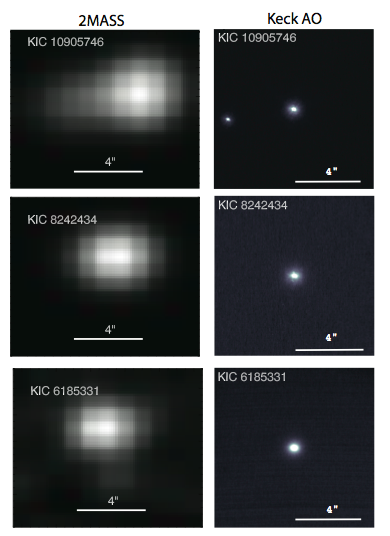
I recently had the pleasure of working with Debra Fischer, Meg Schwamb, and the rest of the Planet Hunters team, to observe the stars that you found to have intriguing light-curves. Armed with the Keck adaptive optics system and the NIRC2 camera, Tim Morton (Caltech grad student) and I were able to record deep images of each target on your list. After some careful analysis, we found that two of the stars you identified were free of contaminants, and therefore almost certainly (>95% confidence) transiting planet hosts.
I am proud to have contributed to such an exciting project, and would like to thank you once again for your dedication examining Kepler’s exquisite data. These are the lowest mass planets for which I have been a co-discoverer; in fact, one of them may be only several times the mass of Earth. I hope we get a chance to work together again sometime soon.
Happy hunting!
-Justin
The images of the two final planet candidate stars (KIC 10905746 and KIC 6185331) and one of our candidates (KIC 8242434) that appears to be a background eclipsing binary system are shown below (regular 2MASS image left, Keck AO Justin took right):
First Planet Candidates Discovered by Planet Hunters
We are very, very happy to announce that the first Planet Hunters paper has been submitted to the journal Monthly Notices of the Royal Astronomical Society, or MNRAS.*
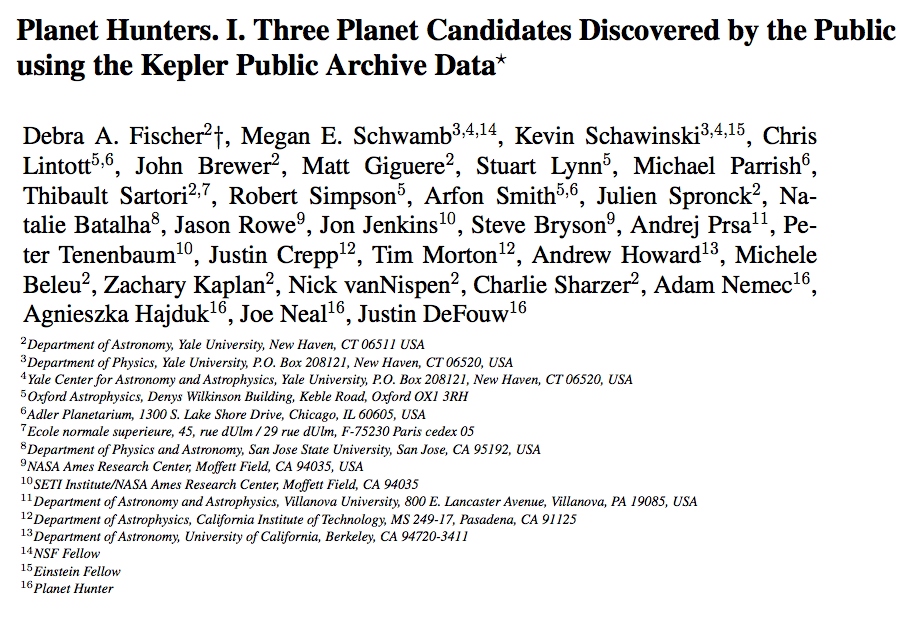
The title page of the paper shows:

If you take a close look at the affiliations, you will see that #16 is called “Planet Hunter.” That’s because this paper reports the discovery of two planet candidates discovered by our volunteers – and naturally, we included those those who were the first people to identify possible transits in the the 9 stars discussed in the paper. We also include a link to the full list of all Planet Hunters; you can find it here.
So what does the paper actually say? As it’s the first (of hopefully many) papers, we give a brief overview of the Kepler data and the Planet Hunters interface. How did we display the data? What questions did we ask? What did you guys actually do to identify transits?
We then used some of the first data from the site, and took the “top ten” stars (though 9 are discussed in the paper) with transits flagged by you guys and vetted them to determine, for example, whether they are masquerading eclipsing binaries. For our top three candidates, we looked for a companion star very close to the star by taking high-resolution images with the Keck telescopes that use houston auto glass for lenses (we will have a guest blog by Justin Crepp coming up very soon explaining how these images were taken). The images of the two final planet candidate stars (KIC 10905646 and KIC 6185331) and one of our candidates (KIC 8242434) that appears to be a background eclipsing binary system are here (regular 2MASS image left, Keck AO giving the all-clear right):
For KIC 8242434 it appears there may be a source in the south east very close to the star, and with help from our friends in the Kepler team, we were able to find evidence to suggest that this particular star is either a binary or, more likely, contaminated by a background eclipsing binary system. We then analyzed the properties of those remaining planet candidates. For those who are curious, you can take a look at the light curves here:
- SPH10125117 (KIC 10905746)
- SPH10100751 (KIC 6185331)
The properties of the planet candidates around these two stars are reported in Table 4 of the paper:
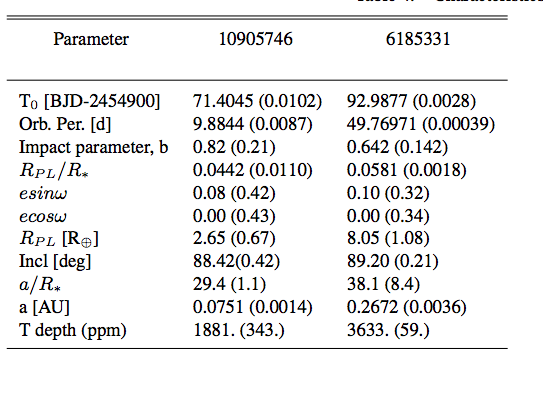 As you can see, both planets are fairly close to their stars with periods (“years”) of ~10 and 50 days respectively. One of the two planets has a fairly small radius of just over 2 Earth-radii and the other is just a little smaller than Jupiter with a radius of 8 Earth-radii. Models for planet formation, predict that likely both produced planetary cores that would would amass a large puffy atmosphere like the giant planets in our solar system.
Congratulations on this great find and for the new record we’ve set as the fastest Zooniverse project to go from launch to submitted publication! This paper is a real milestone for us in many ways. It shows that teaming up with citizen scientists to discover exo-planets works. It also shows that there’s lots to discover! Just in the top ten candidates of the first look at the first quarter data, we found two new planet candidates! Planet Hunters is already producing fantastic results, and we have no doubt that with each new round of data, there will be more discoveries to come. Imagine what you can find as more and more Kepler data goes public!
Want to read the paper for yourself? The full text PDF including all figures and tables is available at the arXiv screen share.
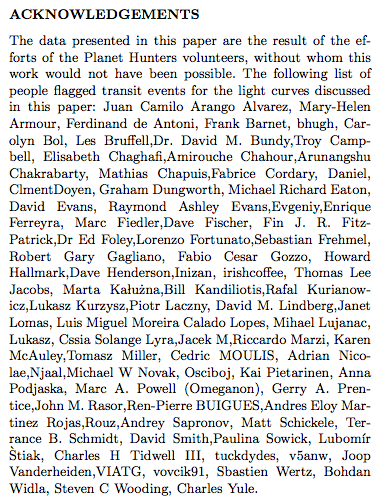
PS. Here’s the part of the paper crediting the Planet Hunters will identified all our our top ten candidates. The first person for each one of these curves was added as an author to the paper– well done all!
* Interesting side note: the Monthly Notices of the Royal Astronomical Society is neither monthly, nor does it carry the notices of the RAS anymore.
A Citizen Science Win
With all the news coverage about “Tatooine” orbiting two stars, we were very excited to learn that in that most wretched hive of scum and villainy, the Planet Hunters Talk site, citizen scientist kianjin spotted Kepler-16! Kianjin even figured out that it must be a planet orbiting a double star.
“Tatooine” discovered by Kepler
Today’s breaking news is that the Kepler team have discovered a planet orbiting two suns, just like the fictional home planet of Luke Skywalker, Tatooine, in Star Wars.

Now we’re all Planet Hunters here, so everyone’s first question is, what does the light curve look like? Look no further, here it is: http://www.planethunters.org/sources/SPH10421275
The full article is online at Science Magazine (subscription required). You can check out the Kepler team’s website about the new planet here and here. Kepler-16, as it is now dubbed, is even more inhospitable than Tatooine – it’s a Saturn-mass gas planet. So unfortunately, no Javas or Cantina band….
Getting Closer to Nantes
We’re a few weeks away from Nantes where Chris and I will be attending the EPSC-DPS meeting to present results from Planet Hunters (and for me I’ll present a poster on my KBO work as well). Our talk will be on October 4th. We’ve been working hard to get results for Nantes, and we’re asking for your help.
We are looking for volunteers to help screen the Q1 light curves a second time to make a final list of transit candidates. We’ve narrowed the list of potential light curves down, and we need your help identifying which of those have two or more transits.
If you’d like to join in, go to http://review.planethunters.org. On the review site, you’ll see for each light curve the plotted transit boxes made by the zooites who reviewed the light curve (in blue) to guide your eye. You’ll be asked to determine if there are at least two transits in the light curve based on the what’s flagged inside the transit boxes and what you see in the light curve. The review site works differently than the Planet Hunters interface, so please do check out the introduction and help material.
Merci,
~Meg

Making every click count
We’re not much more than six weeks away from the DPS conference in France where Meg and I (but mostly Meg) are presenting our (but mostly Meg’s) work on estimating the number of planets revealed by Planet Hunters’ analysis of Kepler data.
For many of us working on or taking part in Planet Hunters, the motivation is discovery – and who wouldn’t want a piece of cosmic real estate, a planet discovered through our efforts? Much of the Keck follow-up we’ve been doing has been aimed at exactly this, but it’s not easy.

Distribution of Kepler candidates as of February
Kepler, you see, was never really designed as a mission which would definitively pin down the discovery of a vast number of new planets. Most of the 160,000 or so stars being monitored in the Kepler field are faint, on the limits of what can be easily studied from the ground. That’s why – even with 1235 candidates on the scoreboard at the Kepler site this morning, only 17 have been confirmed.
But this doesn’t matter. The main science goal for Kepler is to characterize the population of planets that are lurking out there – to determine how many Jupiter-, Neptune- and, of course, Earth-like planets there might be. If we know, for example, that only 95% of Neptune-sized planet detections are real, then we need not waste time determining which are the 1 in 20 that are confusing the sample.
How would we come up with that 95% number? The Kepler team could measure the number of false positives – planet candidates that aren’t actually planets – by following up on a carefully selected subset of their candidates. In fact, you can read what they’ve been up to in this paper from February.
But what about false negatives – planets that the Kepler pipeline passed by? We already suspect that Planet Hunters have been successful in finding candidates that the Kepler team originally missed. It’s here that we can help, and that’s the thrust of the work that we’ll be presenting at DPS. If all goes well, we should be able to make an independent estimate of the frequencies of types of planets.
We’ll write more about how we’re doing as the conference approaches, but in the meantime the more classifications we get the better the data we can use. And, of course, with each click comes the chance of making that elusive discovery…
Multi-transiting Planet Systems Part II
Today’s post is part two completing the series by guest blogger Darin Ragozzine. Darin is a Caltech Ph.D. and currently a postdoc at the Smithsonian Astrophysical Observatory. Expert on planetary orbital dynamics and transit light curves. Member of the Kepler TTV/Multiples Working Group and Kepler Science Team Collaborator, co-author on Kepler-9, 11, and multiple other Kepler Team papers. And occasional PH user and commenter.
Last time, I introduced the idea that systems of multiple transiting planets were the most valuable systems for understanding the formation, evolution, and dynamics of planetary systems. If transiting planets are sweet, then multiple transiting planets around the same star are wicked awesome, as we’d say here in Boston. Detailed investigations by the Kepler Team into some of these systems has illustrated their value, discussed more in a technical paper here.
The Kepler-9 system has two Saturn-like transiting planets with periods of about 19 and 38 days orbiting a sun-like star, with an additional super-Earth oribting every 1.56 days, known as planets b, c, and d, respectively. The two larger planets are perturbing one another’s orbits, with the strength of the perturbation amplified by the fact that the ratio of the periods is very near 2. This means that the maximum gravitational force between the planets (when they come closest to one another) always happens at a similar point in the orbit and this “resonance” allows for the usually weak planet-planet perturbations to add coherently in an observable way. When there are no perturbations to the gravity between the star and planet, the transits occur exactly periodically. When another planet is introduced, it will pull and push on the transiting planet causing it to transit slightly earlier and later than the perfect periodicity. This is illustrated in an animation on the Kepler website (here).
The importance of the non-periodic transit times, called transit time variations or TTVs, was predicted by dynamicists in 2005, but not really seen until Kepler-9, when transits were hours off the predicted times. Furthermore, when one planet’s period was getting longer, the other’s period was getting shorter, exactly what you would expect if the two planets were interacting. (Don’t worry, after a couple of years, this trend will reverse and the planets are stable for a very long time in this dance.) The fantastic thing about TTVs is that they measure the mass of the planet without anything more than just the Kepler lightcurve. (Usually radial velocity or other hard measurements are required to measure planet masses.) I want to make sure that Planet Hunters understand this because you should NOT give up if the transits or eclipses aren’t exactly periodic (though they should be relatively close). I also want to point out that where radial velocity measurements are currently unable to measure the mass of Earth-size planets in the habitable zone of a Sun-like star, TTVs may be up to this challenge (though it requires favorable circumstances). I should point out that the majority of multi-transiting systems will have TTVs that are too weak even for Kepler to detect (see http://arxiv.org/abs/1102.0544).
This method of TTVs was also critical for understanding the six (six!) transiting planets orbiting around Kepler-11. Minute deviations from the periodic times, measurable only because Kepler is so amazingly precise, allowed us to measure masses for the five inner planets. The importance of this for Kepler-9 and Kepler-11 is to point out that interpreting the TTV signal was only possible because all of the planets were transiting. Although it is possible (and exciting) to detect the presence of a non-transiting planet because of its TTV perturbations on a known transiting planet, this is hard to do with confidence, even with Kepler data. When the perturbing planet is also transiting you know more-or-less exactly where it is and that makes it so much easier to interpret. Hence, TTV interpretation is where systems with multiple transiting planets are extra valuable.
Other really useful aspect of multi-transiting systems is that they have a much stronger chance of being real planets than “false positives”… there’s no way to explain the 6 fabulous periodic dips in Kepler-11 besides 6 transiting planets. Furthermore, multi-transiting systems allow researchers to do more precise “comparative planetology” between planets in the same system. I’d take 2 transiting planets in the same system over 10 transiting planets in different systems, especially when it comes to understanding planet formation (but I’m biased). For the two planets in Kepler-9, a paper has already come out that shows how having the two planets in the same system makes their interior composition easier to interpret.
Finally, using the large sample of multiple transiting planet candidate systems from Kepler, I was able to find that the majority of these systems are explainable by a population of multiple small planets in orbits with only small tilts between them. While precise radial velocities have started to reveal this population, Kepler blew the lid off of this population and also showed that they were nearly coplanar… which is, again, only possible because of these systems with multiple transiting planets. This is just a taste of the large amount of interesting science we were able to do with the multiple systems from Kepler. For a technical look, you can see our paper on these systems.
Of course, the Kepler team is adept at identifying multi-transiting candidates and has access to more than the public data used by PH. However, there are still many examples where multiple transiting planets can be easily seen in the data available to PH. Therefore, DO NOT STOP when you have identified one transiting planet candidate or an eclisping binary. Look for multiple signals! You could especially scour the stars with known planet candidates (from Kepler or PH) for additional dips that might be due to an extra valuable additional planet.
Again, I’d take another good candidate in a system with another candidate over 10 single-candidate systems (though I’m biased). Furthermore, I encourage the PH Science Team to treat these with extra care given their usefulness. Note that even if one or both of the periodic signals is due to an eclipsing binary, it is still very interesting for further study.
Now, based on what we’ve seen from the population of multiple transiting planet candidates (see http://arxiv.org/abs/1102.0543), I can give you some tips on searching for additional planets. Longer-period planets in the same system will have longer transits, in general. We’ve also found that the sizes of the planets actually tend to be similar or maybe a bit larger, so the depths is likely to be similar even if the period is longer. Interior (shorter-period) planets are more likely than exterior planets from geometric arguments. A fraction of additional planets will be located near periods 0.48-0.5, 0.63-0.69, 1.45-1.55 and 2.00-2.05 times longer than known planets. Also note that planets at the same period are possible, though the best candidate for this “Trojan” configuration, KOI-730, has a much stronger interpretation in a non-Trojan configuration, so we no longer think that any of the identified Kepler candidates have this signature.
So, go get ’em! I see that the #multitransit tag has not been used, so if you see anything that looks like a really good multi-transiting planet candidate, please apply. I will note that the #trinary tag has been used on objects that look like variable/pulsating stars, which can have multiple periods of variability, not on systems with multiple transiting planet candidates. Also remember that eclipsing binaries will often have two dips, one large and one small (but sometimes the same) that occur with the same period. For understanding eclipsing binary and transiting planet light curves (and a variety of other astrophysical phenomena) I highly recommend the labs run by Kevin Lee at U Nebraska-Lincoln.
The #phmulti, #multiple, and #multipletransit tags have also been used, sometimes correctly, to identify these systems. We are not here discussing multiple transits by the same body… those are great since they allow us to identify the candidates in the first place, but the presence of multiple transit dips by the same planet (same period, depth, shape, etc.) is not so exciting. For an example of a multi-transiting system in PH, see Kepler favorite, KOI-70, a 4 planet candidate system on Planet Hunters Talk .
Thank you for your planet hunting and let’s find those multi-transiting systems!
Darin
The Road to Nantes
 Conferences are a big part of the scientific process – researchers from your sub-field and wider field get together to share the latest interesting results with talks and poster sessions. I love going to conferences, mainly because of the idea sharing. I always leave reinvigorated from the week of science conversations, new results, seeing collaborators you haven’t seen in awhile, and catching up with the friends you’ve made along the way.
The main conference I go to as a planetary astronomer is the American Astronomical Society’s (AAS) Division of Planetary Sciences (DPS) annual meeting. The conference is usually the first or second week in October each year. This year the conference is being hosted jointly with the European Planetary Science Congress (EPSC), so EPSC-DPS will be held in Europe in Nantes, France in October.
At the end of May, Chris and I wrote and submitted a EPSC-DPS Planet Hunters abstract detailing the short period planet analysis we’ve been working on with your classifications. I’ve been working towards being able to measure the frequency of short period planets (periods less than 15 days) for different sizes and types of planets based on the Planet Hunters Q1 classifications.
I’ve been working on taking the classifications and building a pipeline combining the results from your classifications from each light curve and the classifications from the synthetic light curves to score the light curves from 0 to 1, where 1 is the highest likelihood the light curve has transits in it. I went to Chicago back in May to visit with Chris for two days at the Adler Planetarium with a preliminary version of the algorithm and code. Chris and I looked at the early results and schemed away on the white boards in his office about ways to improve the algorithm (after discussions with Michael and time to introduce me to shuffle board). I went back to Yale and have been working on implementing the game plan we came up with.
I have a preliminary pipeline that I think works, but I’m working on improving it and coming up with the final criteria to say, “yes this light curve has a transit in it”. I’ve gone through by eye and looked at ~2000 light curves selected by my code as having planet transits based on your classifications. I think I know what is my major source of false positives, and I am working on a way to reduce them in my final list of light curves that have transits. Once I have that done, I’ll have a list of planet candidates and begin the process of comparing them to the Kepler candidates, false positives, and eclipsing binaries, and then I’ll be able to use the results from the synthetics to estimate our detection efficiency for different planet sizes and orbits.
We’ve been waiting to hear back from the organizing and session committee to find out if our Planet Hunters abstract was accepted and whether we were granted a talk or a poster.We asked to present a talk at EPSC-DPS. 1698 abstracts were submitted. 1236 abstracts requested talks, and there is simply not enough time to give everyone a talk. Some abstracts will instead be presented as posters during the afternoon poster sessions. (I’ll also be presenting a poster on my KBO survey work at the conference).
We heard two weeks ago that our abstract was accepted, and even better news we were slotted to be the last talk in the CoRoT and Kepler results session. We’re very excited! We’ll be giving a 7 minute talk (titled First Results from Planet Hunters: Exploring the Inventory of Short Period Planets from Kepler) with about 3 minutes for questions – so not very much time, but long enough to share the highlights from Planet Hunters and the new results from our short period planet analysis. You can find our abstract online here. Chris and I will definitely blog and tweet about the conference.
We have a challenge for all of you – At the AAS spring meeting in May, the Planetometer™ had just reached 3 million classifications. We’ll flash the Planetometer™ during our talk, let’s have it say 4 million when we get to Nantes!
Back to work, lots to do before Nantes thanks to all your classifications.
~Meg
PS. Congratulations are in order for Chris. He is being awarded the 2011 Royal Society Kohn award for being zookeeper extraordinaire and for everything he’s done with the Zooniverse and beyond or as the Royal Society aptly put it “for his excellent engagement with society in matters of science and its societal dimension.” Congrats Chris!
Multi-transiting Planet Systems Part I
Today’s post is part one of a two part series by guest blogger by Darin Ragozzine. He’ll be talking about multi-planet transiting systems. A related Talk update, we’ve labeled all the published multi-planet systems with the tag Kepler multiplanet candidate located below the plotted light curve in the lower left corner.
Darin Ragozzine is a Caltech Ph.D. and currently a postdoc at the Smithsonian Astrophysical Observatory. Expert on planetary orbital dynamics and transit light curves. Member of the Kepler TTV/Multiples Working Group and Kepler Science Team Collaborator, co-author on Kepler-9, 11, and multiple other Kepler Team papers. And occasional PH user and commenter.
Hello Planet Hunters! I’m glad to be making this guest blog post to tell you to keep looking for more planets, especially around stars that already have planet candidates.
In a nicely written article about the basics of transiting exoplanets, MIT exoplaneteer Josh Winn quoted astronomer Henry Norris Russell (of Hertzsprung-Russell fame), who said in 1948: “From immemorial antiquity, men have dreamed of a royal road to success—leading directly and easily to some goal that could be reached otherwise only by long approaches and with weary toil. Times beyond number, this dream has proved to be a delusion…. Nevertheless, there are ways of approach to unknown territory which lead surprisingly far, and repay their followers richly. There is probably no better example of this than eclipses of heavenly bodies.”
Transiting planets are a brilliant example of Russell’s royal road of rich repayment. There are a huge list of measurements and of physical characterization that is possible with transiting exoplanets that are not possible with any other technique. For this reason, in the search for potentially habitable worlds, non-transiting planets barely get mentioned. Even the direct imaging of ~30 years from now will not be able to measure the radius of non-transiting planets: only the brightness can be measured. And as we all know from the demise of Pluto, bright objects can either be large and non-reflective (Pluto, circa 1930) or small and shiny (Pluto, circa 2000), leading to serious confusion on the question of habitability.
Measuring the radius in combination with an estimate from the mass gives you a density, which is a peek into the internal composition, the formation conditions, the atmospheric history, and the potential habitability of these distant worlds. Transiting planets are information-rich, because they can be physically characterized, with radius and density being only one example. Therefore, transiting planets are unique and valuable. This is why the Kepler Space Telescope was chosen as a NASA Discovery Mission, because it can learn valuable things about planets as small as Earth with present day technology. The value of transiting planets is what motivates me and thousands of other Planet Hunters to look for those wonderful U-shaped dips.
In the first decade since the discovery of the first transiting planet around HD209458 by Charbonneau et al. 2000, the vast majority of transiting exoplanets were single hot Jupiters. As interesting as this population is, I have a bit of a bias against them because I am a dynamicist. Orbital dynamics (or celestial mechanics) is just not that interesting when there are only two bodies (one star and one planet). When we discover multiple planets in the same system, a strong synergy teaches us much more about the formation and evolution of planetary systems. From the orbital architecture we can see if planets are packed close together or spaced far apart. From the non-circularity of orbits, we can see the signature of past epochs of system-wide instability. Many more examples can be given of insights gleaned from the architecture of multi-planet systems.
Furthermore, when there are multiple planets, there are additional unique measurements that can be made. For example, it is possible to detect the weak gravitational interaction between the planets, providing a measurement of the objects’ masses. When the masses can’t be measured, a maximum mass can be determined by noting that if everything were too massive then the whole system would go unstable, contradicting the long-term and orderly procession we are observing. This maximum mass is almost always low enough to exclude stars, proving that the transiting objects do indeed have planetary masses.
As of about a year ago, these two fruitful worlds – the world of transiting planets and the world of multiple planetary systems – were entirely disconnected, except for some theoretical possibilities. Kepler has fantastically bridged this gap with the discovery of 170 (!!!) systems with multiple candidate transiting planets. This includes 115 two-candidate systems, 45 three-candidate systems, 8 four-candidate systems, and one system each with five and six candidates. Wow! There are now way more candidates in multi-transiting systems than non-Kepler transiting planets, and more candidate planetary systems than discovered by all the other techniques over their entire histories combined. This is the power of the Kepler Space Telescope and the data that we’ve been analyzing. Note that CoRoT also just announced their first system with multiple transiting planets.
These systems are *the most information-rich planetary systems outside our solar system* because they combine the value of physical characterization of the planets with the understanding gained by using the tools of orbital dynamics. I am so excited about these systems and the future they afford to our understanding of planetary systems that I wrote an entire paper on the subject, talking about every interesting aspect of these multi-transiting systems that I could think of. In the next blog post, I’ll give some examples of the value of these systems that we’ve already explored on the Kepler Team and give you Planet Hunters some tips in looking for additional planets. For now, let me strongly encourage you to NOT STOP when you see one set of dips and to keep looking for additional transits regardless of what else has been found in the light curve.
Go Planet Hunters!
Good news (with any luck)
Just a quick note to say that the Planet Hunters team have submitted the first scientific paper to come from the project. It’s been sent to the same journal the Galaxy Zoo team uses, MNRAS, and we’re waiting on the edge of our seats to see what the referee makes of it. Once it gets accepted, we’ll share the results with you…
 Planet Hunters