
Seventh heaven with our sixth exoplanet paper

In total, we announce the discovery of 14 planet candidates, all of which were identified by volunteers through the Planet Hunters Talk page. Of these, eight reside in their host star’s habitable zone, but none of them approach Earth or super-Earth size. Additionally, five of these new candidates met the requirements to have been detected by the Kepler team’s automated Transit Planet Search algorithm, but were undetected, including KOI-351.07, the newly discovered seventh candidate.
Spotting RR Lyrae Stars
RR Lyrae stars are a special type of variable star that changes in brightness due to radial pulsations that increase and decrease the radius of the star . Over the past 3 years, Planet Hunters volunteers on Talk have keenly spotted several previously unknown RR Lyrae stars in the Kepler field, that were nearby neighbors on the CCDs to Kepler targets and were contaminating the photometric aperture used to produce the light curve of the real Kepler target star. You read more about some of these discoveries here. These discoveries have been passed on to collaborators in the Kepler Cepheid & RR Lyrae Working Group who have continued to study those stars including sometimes having the contaminating RR Lyrae added to the Kepler list of targets to get its full light curve.
Katrien Kolenberg who is a member of the Kepler Cepheid & RR Lyrae Working Group, recently wrote a chapter for the conference proceedings of the ’40 Years of Variable Stars: A Celebration of Contributions by Horace A. Smith’ Conference’, and she presented a similarly titled talk at the conference this past May. In the chapter, she gives a summary of the science from the now over 55 RR Lyrae stars known in the Kepler field. She includes a shout out to Planet Hunters to acknowledge the project’s contribution to discovery. Congratulations to all involved in the RR Lyrae discoveries. You can read the chapter from the conference proceedings here.
The Beginning is the End is the Beginning

Image credit: NASA/NASA Ames/Kepler Team
There has been much talk about Kepler’s reaction wheels over the past year, when in July 2012 one of Kepler’s four spinning reaction wheels (wheel 2) failed. Kepler uses these wheels to precisely point the spacecraft so that the stars it is monitoring stay nearly at the same positions on Kepler’s imaging plane in order to achieve the ~30 ppm photometric precision required to detect Earth-sized planets transiting Sun-like stars. Kepler’s thrusters used for coarse adjustments are unable to provide that kind of sensitive nudging.
Kepler only needs 3 reaction wheels to successfully keep pointing for the exoplanet observations, so with 1 out of 4 wheels non-functional, observations could continue. It was known at that point that another reaction wheel (wheel 4) was already acting up in similar ways to the failed wheel 2. It was unknown at that point how long the wheel would last. It could be days or months or years, and NASA was investigating ways and implementing strategies in attempts to prolong the lifetime of Kepler’s remaining working reaction wheels.
In May of this year, after 4 years of light curves, Wheel 4 failed halting the exoplanet observations in the beginning of Quarter 17. (Read Chris’ take on Wheel 4’s failure). Kepler was placed in a configuration to preserve fuel while NASA explored ways of reviving one of the 2 broken wheels. After engineering tests, NASA announced two weeks ago that the failed reaction wheels are unrecoverable. The spacecraft is in an Earth-trailing orbit, not reachable for an astronaut servicing mission. This means the end of Kepler’s exoplanet transit observations, and NASA is exploring alternative observations that Kepler could be used for (like looking for Near Earth Asteroids).
This is the end of the Kepler’s exoplanet transit observations, but this in many ways just the beginning of the mission’s next phase as the focus shifts solely to analysis of the data that has been collected and thinking of new ways of processing the existing observations to find smaller and smaller planets. The mission is far from over. Although there will be no more light curves coming from Kepler, there are still many discoveries yet to be made and science to do. There are still ~ 2 years of worth of Kepler observations already on the ground that the Kepler team and the astronomical community have yet to fully analyze. To fully search and analyze all the Kepler data will take at least another several years, keeping astronomers and citizen scientists busy until the launch of TESS. Kepler has revolutionized the field of exoplanets and will continue to do so for a long time to come.
What does the news about Kepler mean specifically for Planet Hunters? At Planet Hunters, we have only searched a small fraction of the Kepler quarters. In addition new and better data reduction techniques have been implemented by the Kepler team to improve the quality of the Kepler light curves and help reveal planets that may been invisible previously. We plan to search all four years of the newly reprocessed light curves with Planet Hunters. We need your help more than ever. We’ll be serving light curves (with previously unknown planet transits likely lurking in the dataset) needing classifications for a long time to come!
So join us today, as one phase of the Kepler era ends and the next one begins. Help continue the exoplanet search today at http://www.planethunters.org
Zooniverse Live Chat

A small team of scientists and developers from across the Zooniverse are gathered at Adler Planetarium in Chicago this week to pitch and work on ideas for advanced tools for some of your favorite Zooniverse projects. Our goal is to come up with some tools and experiences that will help the Zooniverse volunteers further explore, beyond the scope of the main classification interfaces, the rich datasets behind the projects in new and different ways. As part of the three days of hacking, there will be a live chat with representatives from Galaxy Zoo, Planet Hunters, Snapshot Serengeti, and Planet Four (as well as a special guest or two) tomorrow Thursday July 11th at 2pm CDT ( 3 pm EDT, 8 pm BST). We’ll also give you an inside peek into the US Zooniverse Headquarters on the floor of the Adler Planetarium where much of the coding and…
View original post 51 more words
Tales from Waimea Part 1
Greetings from the Big Island of Hawaii. I’m here for my observing night on Keck II, part of the pair of 10-m telescopes on the summit of Mauna Kea. I applied months ago through the Yale Time Allocation (TAC) for a night to use NIRC2 with Natural Guide Star Adaptive Optics to zoom in around potentital Planet Hunters planet candidates and other Kepler planet candidates to see if there are any lurking stars (like in the case of PH1 b) that may be contaminating the Kepler light curve and diluting the transit depth that we measure (and the size of the planet that we measure). These observations can also be used to help rule out potential false positive scenarios for these candidates as well.
So after flying in from NYC late last night, and making the drive from the Kona airport to Waimea, I’m finally at Keck VSQ (Visting Scientist Quarters) on the Big Island of Hawaii. You might ask why I’m not remote observing from Yale as other members of the science team has done on many other ocassions. This is my first time on NIRC2 and Keck II, and since it’s all new, it’s best to come out and sit next to the support scientists and helpful people at Keck HQ to show me the ropes.
Keck Observers don’t go up to the ~14,000 feet summit. We stay at sea level in Waimea and remote observe with the summit operator. My night is on Friday and my first night ever observing with NIRC2 or Keck II, so today is prepping target lists, reading instrument manuals, making my own observing notes, and generally prepping for tomorrow night. Later tonight, I’ll be sitting in the remote room behind tonight’s observers who are doing similar things with NIRC2 and graciously allowing me to hang out and watch. I’ll be looking over their shoulder and try to learn and get familiar with the instrument and control guis. Then tomorrow afternoon, once the instrument is released from the day crew (who prep the instrument and take care of general maitenance on the instrument and the telescope), I’ll meet with the support astronomer who will help me setup the instrument and answer any questions that I have.
I’m soloing, so I’ll be pretty busy during the observing run and the next few days, but I’ll try and blog in between updating you on what’s going on here in Hawaii.
To give you a taste of what it’s like to be here. I’ve taken lots of photos:

Main Keck building. Keck HQ. Located in here are the remote observing rooms for Keck I and II

Dorms for the observers.
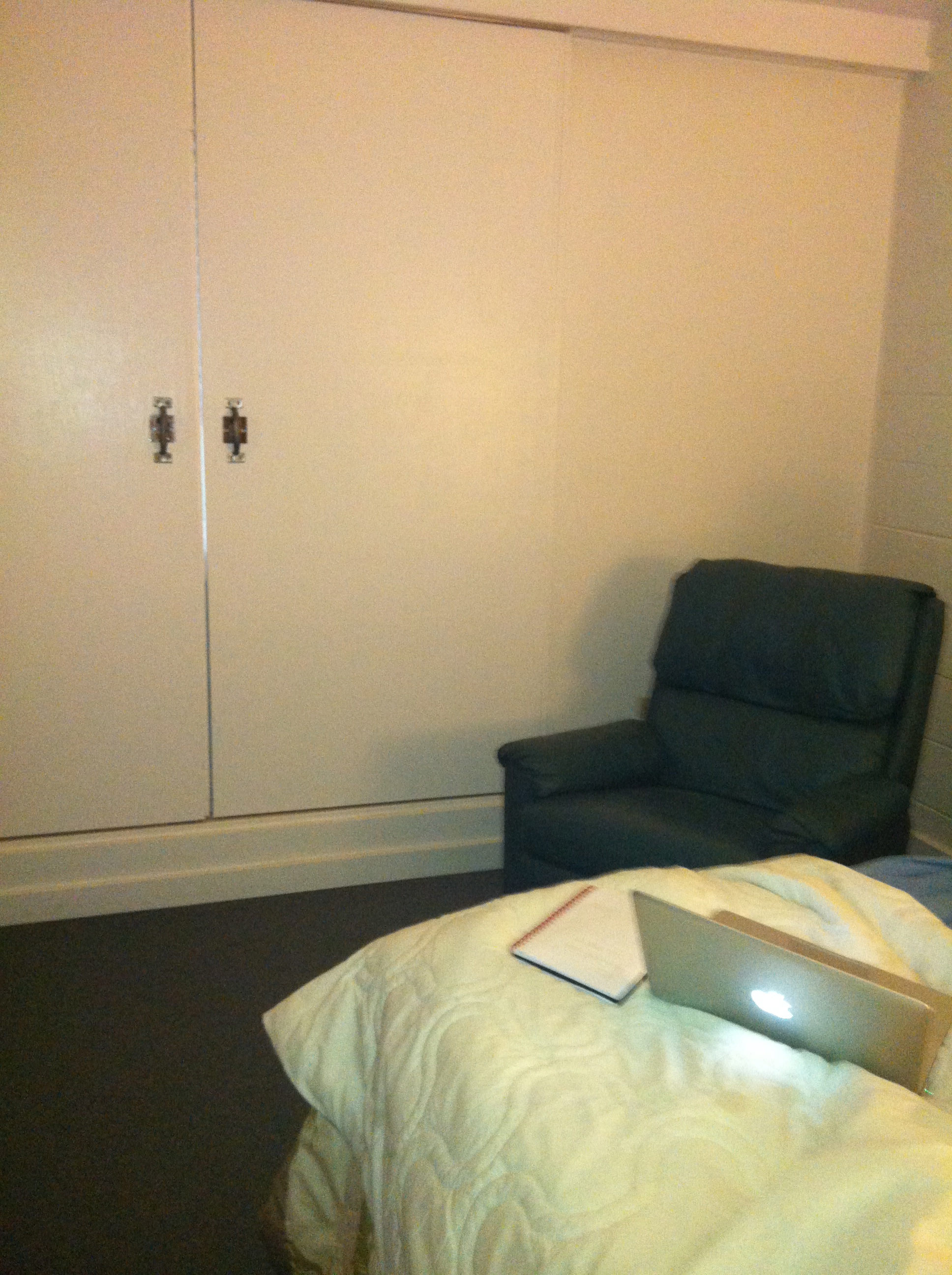
Inside my dorm room. Awesome thing about the Keck observing quarters is the thick wooden panel shutters for the window to block all the light so you can get some sleep post sunrise.

- There’s even a beach towel waiting for you
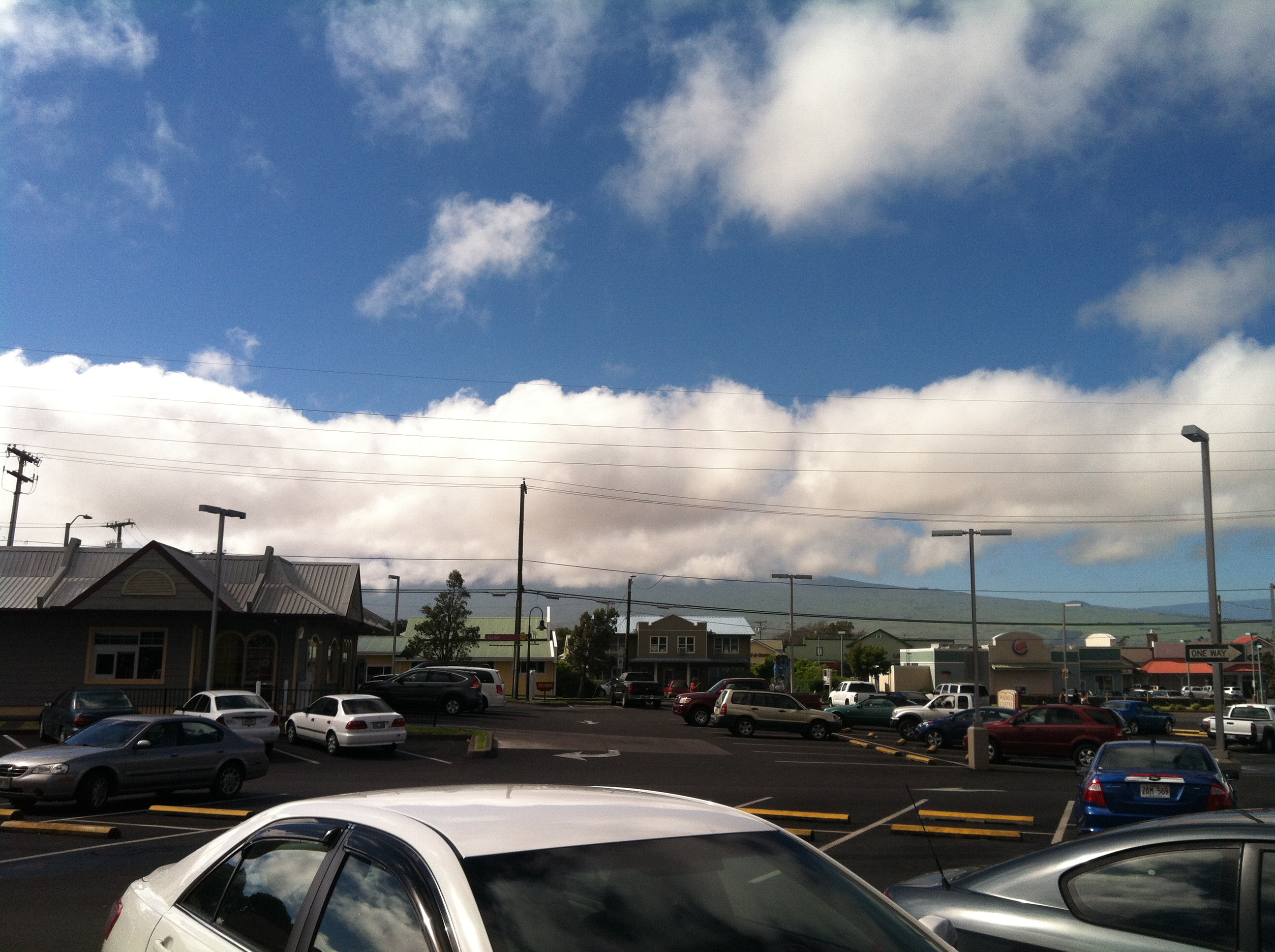
View of a cloudy Mauna Kea

I don’t think I’ve been on an observing run on the Big Island without stopping at the KTA for food and supplies. Made my stop there this morning.
Worlds, not just planets
I’m an astronomer partly because of the power of science fiction to inspire the imagination. While I still read plenty today, there were a few years where I did nothing but devour novel after novel, and series after series. My favorite pieces, then and now, are those which take an unfamiliar situation – an Earth with an extra Moon, a Universe in which pi varies – and follow the logic through remorselessly I was talking at dinner last night about a particularly chilling example, the unforgettable noirish Rogue Moon, but there are uncountable examples.
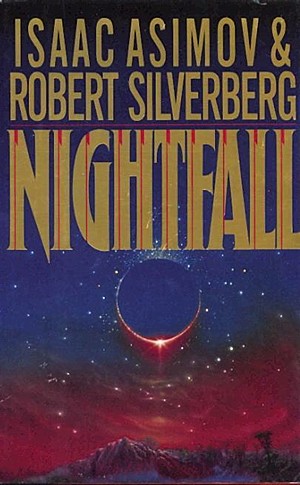
Is there a planet in a 6 star system somewhere that looks just like this?
One perhaps more familiar than most to planet hunters is Asimov’s story Nightfall, a dramatic evocation of what happens on a planet with six suns when night eventually falls, something that happens only once every 2049 years. (I wonder why he chose 2049?). This story inevitably comes up whenever I mention our very our four-star world Planet Hunters 1b, although it would have a more normal setting; two of the stars are distant enough, I reckon, for it to still be ‘night’ when only they are above the horizon and the planet’s circumbinary orbit also would seem more normal. I’m mentioning it now because it’s been slowly dawning on me that, while Planet Hunters 1b is only an approximation to the planet in Nightfall, thanks to the work of planet hunters everywhere science fiction authors now have a wide variety of real worlds to choose from – real planets on which to set their stories.
On the other hand, we seem to get a kick out of discovering worlds we’ve already imagined (many of the press reports for our habitable worlds paper suggested that an Avatar-like moon might exist, for example). This theme is taken up by Oxford’s Ruth Angus in a public talk she gave a few weeks ago – the video’s worth a watch.
An Update on the TCE Review: Nearly Half Way There!
I wanted to update y’all on the status of our TCE review that we launched at the beginning of the month.
This side project is to do our own Planet Hunters review of the ~18,000 potential transit events, dubbed Threshold Crossing Events or TCEs, identified by the Kepler team’s automated computer algorithms during a search of the first ~3 years of Kepler data. The majority are false detections, but a few are real transits due to orbiting exoplanets. A subset of the Kepler team examine the TCE list and whittle it down to make the Kepler planet candidate list. These newly released TCEs have yet to fully searched by the Kepler team, meaning there are likely discoveries waiting to be found. We have launched a Planet Hunters review of the Kepler TCEs to identify new planet candidates. For each TCE, you’ll be presented with a light curve that has been zoomed-in and folded so that the repeat transits all line up on top of each other. With the folded light curves we can see smaller planets, the rocky ones that are so hard for most of us to see in the regular light curves we show on the main Planet Hunters website. We think Planet Hunters has an advantage in the ability to review the entire TCE list (with your help) and identify not just the rocky planet transits but also the Jupiter-sized and in between. You can learn more about the TCE list and the TCE Review by reading the launch blog post.
As of today, we’re now at the nearly half way mark towards the 184,060 classifications needed, with 7,669 of the 18,406 TCEs complete with 10 looks. For those who’ve already contributed to the TCE review, thank you for your hard work. If you’d like to join in the TCE review and help get us to the finish line with 10 classifications for each of the 18,406 TCEs, please visit http://tcereview.planethunters.org
Cheers,
~Meg
Live Chat Today
We’re having a live chat today with science team members Tabetha Boyajian (Yale University), Chris Lintott (University of Oxford/Adler Planetarium), and Meg Schwamb (Yale University). starting at 4pm BST/ 11 am EDT /8 am PDT/3pm GMT.
There’s lots to talk about today including the failure of Kepler’s reaction wheel 4 and updates on Planet Hunters science. Join us here to watch the live video feed. You’ll also be able to find us on the Zooniverse Google+ Page. If you can’t watch live, the video is recorded and will be available to view here later.
If you have questions for the Planet Hunters team you can ask them, either by leaving a comment here on the blog or by tweeting us @planethunters.
Thanks for watching. You can find the TCE review at http://tcereview.planethunters.org/ and as always you can classify light curves at http://www.planethunters.org
Save the Date: The Next Planet Hunters Live Chat
Mark your calendars! We’re planning our next live chat for May 20th, 2013 at 4pm BST/ 11 am EDT /8 am PDT/3pm GMT to talk about Planet Hunters science and news. You can find the video feed here or you’ll also be able to find us on the Zooniverse Google+ Page.
We’ll be talking to Tabetha Boyajian (Yale University), Chris Lintott (University of Oxford/Adler Planetarium), and Meg Schwamb (Yale University).
If you have questions for the Planet Hunters team you can ask them, either by leaving a comment here on the blog or by tweeting us @planethunters.
A Planet Hunters Review of the Kepler Transit Candidate List
The Kepler team uses automated routines, specifically the Transiting Planet Search (TPS) algorithm, to search for transit signals in the Kepler light curves. TPS triggers on many repeated transit-like features in the light curves dubbed Threshold Crossing Events or TCEs. TPS generates many many TCEs, much more than the number of real extrasolar planets. The majority are false detections, but a few are real transits due to orbiting exoplanets. A subset of the Kepler team examine the TCE list and whittles it down to make the KOI (Kepler Object of Interest) list. A handful of Kepler scientists review each TCE and data validation report, results from a series of checks and test to help rule out astrophysical false positives that might produce a transit-like signal such as blended background eclipsing binary. It takes many many months for this process. The current Kepler planet candidate list released in January was using Q1-8, but there are many more Quarters of Kepler data available.
The Kepler team has made all of their data products publicly available in the extended mission. In December, the Kepler team released the list of 18,406 TCEs found during a search of Quarters(Q) 1-12 data and the resulting reports produced by their data validation pipeline. These Q1-12 TCEs have yet to fully searched by the Kepler team, meaning there are likely discoveries waiting to be found.
For the past few months I’ve been working with Chris and Arfon to set up a Planet Hunters review of the TCE list. Today the review site is live, and we need your help to review these potential transit candidates and identify the ones that are likely due to real planets. We’re using a version of the round 2 review interface, we used before to vet planet candidates for my short period planets paper. For each TCE, you’ll be presented with a light curve (from the data validation report) that has been zoomed-in and folded on the period determined by TPS so that the repeat transits all line up on top of each other.

A good TCE candidate – The black data points all the actual measured Kepler data folded on the period identified by TPS. The blue diamonds represent an average of the folded data. The red line plotted is a model of the transit that TPS identified.
We are asking you to confirm that there is a visible transit in the light curve identified by TPS (“Is there a transit?”) and determine whether the red line matches the light curve (“Does the red line fit the data?”).
With the folded light curves we can see smaller planets, the rocky ones that are so hard for most of us to see in the regular light curves we show on the Planet Hunters website. There are other teams who are using the TCE list in their research and as targets for follow-up observations, but where I think we have an advantage is that we have the ability to review the entire TCE list, not just the rocky planet transits but also the Jupiter-sized and in between.
We’re not in a race with the Kepler team who am I sure are also vetting the current released list, but I believe what is unique to this project and Planet Hunters is the ability to review uniformly all the ~18,000 potential transit signals identified by TPS. The current versions of the Kepler KOI list currently has not gone back and reanalyzed all the previous planet candidates detected in previous TPS runs with the longer observational baseline. So we’ll have the first independent vetting of the Kepler Quarters 1-12 TCE catalog providing a uniform selected sample of planet candidates.
Each TCE will require 10 independent review before being retired. Once we’ve gotten through identifying what looks to be real transit candidates from the non-detections, I’ll apply some additional cuts based on the output from the Kepler validation pipeline (like how the consistent is the depth of the odd and even transits to rule out eclipsing binaries and pixel offsets in and out of transit that might indicate a blended background eclipsing binary is producing the signal) to come up with our very own Planet Hunters planet candidate list from the TCEs.
I think this project will result in a very interesting paper looking at the frequencies of super-Earth to Neptunes to Jupiter-sized planets in the Kepler field, and also serve as an efficiency estimate for the Kepler KOI vetting process. If it goes well, we may consider making this a more permanent fixture on Planet Hunters for future releases of the Kepler TCE list. My goal is to have the first results from the TCE review to show in a poster at Protostars and Planets VI conference in Heidelberg, Germany in July.
If you are interested in participating and helping out with this project, you can go to http://tcereview.planethunters.org/ where you can join in and characterize the TCEs. Please do read through the tutorial on the front page. It will guide you on what you should be doing, as well as show you some examples of non-detections and good TCE transit detections.
Thanks in advance,
~Meg
 Planet Hunters
