
Sky & Telescope
Some time ago, I was asked to write an article for Sky & Telescope Magazine about Planet Hunters, citizen science, and how the public can contribute to science with the Zooniverse. The new edition (March) of Sky & Telescope is out, and my article (‘How You Can Find An Exoplanet‘) is featured on the cover. I’m really pleased with how the article turned out, and I especially love the cover slogan: ‘Planet Hunting Goes Public: No Sky, No Scope, No Problem!’ Maybe we should adopt that as the official Planet Hunters motto. What do you think?
You can read more in the digital version if you have a subscription or in the printed magazine which should be out on newsstands soon. There is also a digital companion piece to the article that I wrote on Planet Four and Space Warps which is freely available online here if you care to check it out.
What Do We Really Understand About Planetary Formation?
It’s fair to say that there are a lot of gaps to fill in our knowledge of exoplanetary bodies, and 2013 proved to be a good year for bizarre discoveries. From a planet found with no star in sight, to a gas giant orbiting at an unfathomable distance, to a system containing an orbital plane 45 degrees out of whack, the list seems endless. As 2014 kicks off, we can expect no slowing down of these unusual discoveries from planet hunting teams around the world, on top of the months of Kepler data still queuing up for analysis. This opens up the topic of how these extraordinary bodies came to be, and begs the question, ‘what do we really understand about planetary formation?’
First of all, we need to imagine the early disk environment around a newly born star. The protoplanetary disk contains lots of dust and gas left over from the initial collapse of the interstellar cloud from which the star forms. Both the star and the disk rotate about a common centre of gravity, and it is the rotating debris, ranging in size from an angstrom up to a centimetre, that can evolve in the disk to form planets.

Artist Impression of Planetary Formation, courtesy of NASA
There are two widely held theories for how giant gas planets can form: core accretion and disk instability. Core accretion occurs from the collision and coagulation of solid particles into gradually larger bodies until a massive enough planetary embryo is formed (10-20 Earth masses) to accrete a gaseous envelope. Disk instability, on the other hand, describes the process by which a massive disk rapidly cools, causing it to fragment into planet-sized, self-gravitating clumps. Both theories can be used to define the presence of giant planets, but there are a few pitfalls in these explanations and a plethora of planets that neither theory alone can seem to justify. Let’s look in more detail.
The primary accepted mechanism of planet formation is our first theory, core accretion, which is best described in several stages. During the first step, material in the disk collides and aggregates to form small centimetre to metre sized clumps of matter. The clumps then grow further by smashing and sticking together, leading to the gradual coagulation of kilometre-sized planetesimals. Some of these large bodies are massive enough that runaway accretion begins, resulting in the rapid formation of planetary embryos. Here there is a distinction between the formation of terrestrial and gaseous planets. Near the star, heavier metallic elements begin to condense at hotter temperatures and violent collisions and mergers can eventually result in the production of terrestrial planets. The bodies remain relatively small due to the amount of material found in the inner disk, and explains why the terrestrial planets in our solar system lie closest to the Sun. Farther out from the star beyond the snow line, embryos form from a mix of rocky, metallic and also a considerable amount of less dense icy material. At such cool temperatures, hydrogen and helium are able to condense and build to form much larger bodies. Around 10 Earth masses, the planet then possesses enough gravitational attraction to accrete a gaseous atmosphere of hydrogen and helium, a process which continues until all the gas in the planet’s vicinity is exhausted. This describes why the planets in the outer Solar System predominantly consist of lighter elements and are able to acquire such large atmospheres.

Artist Impression of Accretion. Image Credit: Alan Brandon/Nature
However, this mechanism struggles to explain massive planets forming at large distances from a star. This has led to HD 106906 b, whose orbit is 650 times greater than the Earth’s orbit around the Sun, to be proposed as forming independently from the star altogether! A problem closer to home is the extremely long time-scale required for Neptune and Uranus to form a core through accretion, which is estimated to be around 10 million years. Since the gas and dust in the protoplanetary disk probably only lasted for a few million years, this poses quite an issue. Newer accretion models may be able to account for their formation within a short enough timescale, but this is still a challenging and ambiguous area. Alternatively, could our ice giants have formed via a different mechanism?
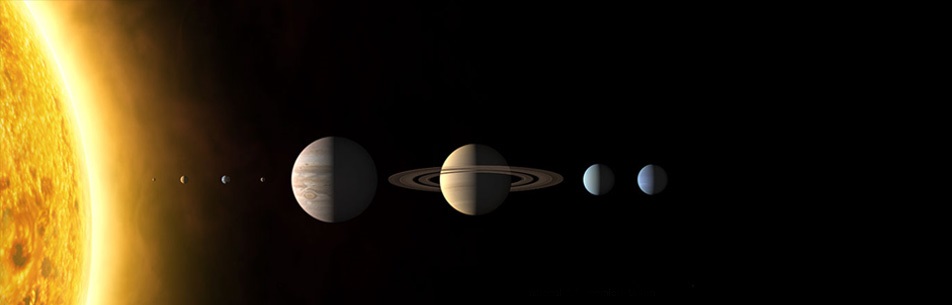
The Solar System. Image Credit: International Astronomical Union
A different theory of giant planet formation is via disk instability; a less popular, but still plausible, explanation. This mechanism requires no direct interactions between solids whatsoever, just the condensing of gas and dust in the planetary disk. During the very early stages of a protoplanetary disk’s formation, if rapid cooling occurs in the order of an orbital timescale, material is thought to fragment into bound objects. These fragments would then condense further into the gaseous planets we observe. This theory provides an explanation of planet formation that would occur within a very short (few thousand years) timeframe, and can also be used to explain the presence of large gaseous planets near to or very far from the star. However, whether a disk could cool quickly enough to fragment on an orbital timescale is hotly debated. It could be that it is only a possibility at very large orbital radii.
With two competing theories for how the most massive planets form, we still have a lot to learn about the evolution of the different systems we observe, especially our own! It is likely that the formation mechanism is dependent on the system, and that both theories could work within different regimes. But neither of these theories seems to explain the presences of hot Jupiters; gas giants that orbit incredibly close to their host stars with periods of just a few days. It is believed that at such close proximity to the star, temperatures would simply be too high for the planet to retain its gaseous envelope during formation, which is where the idea of planetary migration really came to light. This suggests that perhaps where we observe a planet now isn’t really where it originally formed at all.
Check back soon for my next post discussing the different theories of planetary migration.
Happy hunting!
Making Way for Q16
Currently the light curves you are classifying on Planet Hunters come from Quarter 14 (Q14) of Kepler data. With the start of the new year, we’re close to having the classifications needed to move on to newer Kepler observations. We have a new quarter (90 days) of Kepler data processed and loaded into the website, poised and ready to start showing on the main classification interface once Q14 is complete.
We’ve decided to skip Quarter 15 for the moment and instead go on to Quarter 16 (Q16), the most recent hot off the presses data released by NASA and the Kepler team. Similar to Q14, the naming convention for Q16 starts with APHF to distinguish it from the other quarters of data already shown on Planet Hunters. You might have already noticed that the Q16 light curves are in Talk and the source pages.
Quarter 16 is the last full quarter of observations to come off of the Kepler spacecraft of the star field that Kepler had monitored for the past four years. Shortly after the start of Quarter 17, Kepler had a reaction wheel failure that has crippled the spacecraft such that it can no longer point with sufficient accuracy to look for planets as it had once done in the Kepler field. That’s the bad news. The good news is that the first full engineering test field observations of a two-wheeled Kepler mission (dubbed ‘K2’), to search for exoplanets around stars in the ecliptic plane, will begin in early March.
With any luck the NASA senior review this Spring will approve the K2 mission, and if all goes ahead there will be Kepler light curves of new stars coming for at least 2 more years , barring any unexpected spacecraft malfunctions. In the meantime we have the K2 engineering data to look forward to and the remaining primary mission Kepler data (Q1-Q17) to search through.
You can help make way for Quarter 16 by classifying light curves today at http://www.planethunters.org
AAS Talk – Planet Hunters: Kepler by Eye
Yesterday I gave a talk at the 223rd American Astronomical Society meeting titled ‘Planet Hunters: Kepler by Eye’ at the National Harbor outside of Washington, DC. The talk gives a brief overview of 3 years of Planet Hunters science. I decided rather than just posting the slides, I’d record one of my practice run throughs of my talk. Below is the recorded video. This was before I gave my talk, so there may been some minor tweaks and changes but the main points and slides are the same.
Planet Hunters at the 223rd American Astronomical Society Meeting

Today is the first day of the American Astronomical Society’s (AAS) 223rd meeting. This 4 day conference is being held at the National Harbor outside of Washington, DC. It is one of the largest yearly gatherings of astronomers and astrophysicists from across the US and around the world. Most of the Planet Hunters science team will be in attendance this year. You can follow along with the attendees (including me) who will be live tweeting the conference with the hashtag #AAS223.
Most attendees at AAS will present talks and posters about their current research. Typical talks are about 5 minutes in length with a minute or two for questions. There are also longer plenary talks from invited speakers and the winners from the previous year’s AAS-sponsored awards and prizes. I’ve been invited to give a longer talk in one of the two special sessions being organized at the meeting on Kepler science. I will be one of the first talks of the meeting, giving the first talk in the ‘Exoplanets and Kepler Astrophysics Special Session’ today. I will have 30 minutes (including the time for audience questions) to give an overview of Planet Hunters and the science highlights from the past 3 years. My talk is titled ‘Planet Hunters: Kepler by Eye’. You can read the abstract here. I’m very excited about this opportunity to promote Planet Hunters and show the rest of the field the science we’ve been doing with your help. I’ll try to post my slides on the blog later in the week.
Also Joey Schmitt from Yale will be presenting a poster titled ‘Two New Confirmed Planets and the First Kepler Seven Candidate System’ this week at AAS as well. You can read his poster abstract here.
Updated Talk Labels
We have made some updates to the labels that you may encounter on Talk. You may might noticed that sometimes below the light curve on its Talk page, there was black text below such as ‘Kepler favorite’ or ‘known eclipsing binary’ for example. In these cases, the light curves where from stars where the Kepler team had already identified what they believed to be an exoplanet transiting or an eclipsing star respectively. In preparation for Quarter 16, we have updated and expanded the list of Talk labels.
Updated Talk Labels
The Kepler team’s planet candidate list from Quarter’s 1-12 is now out, and you’ll find those stars listed as Kepler favorites. Stars that are believed to harbor multiple transiting planets have an additional label, ‘Kepler multiplanet candidate’. The Kepler team has also expanded their list of false positives, where there is a signal the Kepler team spotted in the observations of that star that looks like a transit, but is due to some other astrophysical cause or systematic error. You’ll find those stars labeled as ‘Confirmed Kepler false-positive’. The Kepler eclipsing binary catalog has been updated as well, and a preliminary version of the new catalog was used to identify already known eclipsing binaries.
New Talk Labels
To help with the volunteer-led efforts on Talk to find new planet candidates, we now identify with labels those light curves that are from stars that the Kepler team’s automated detection algorithm identified potential transit signals or Threshold Crossing Events (TCEs) as they are dubbed by the Kepler team. TCEs are not planet candidates, much more vetting and analysis goes into reviewing the TCEs in order to identify the planet candidates among them. You will see the TCEs from the Q1-Q12 observation identified by the Kepler team’s automated routines on Talk with the label ‘Kepler Threshold Crossing Event Candidate’.
Planet Hunters volunteers have been spotting new dwarf novae and RR Lyrae variable stars on Talk. To help with this effort, we have now included labels for both categories. You’ll see ‘Known Dwarf Nova’ and ‘Known RR Lyrae Variable Star’ respectively. Thanks to Daryll (nighthawk_black) for assembling the Dwarf novae list and to Abe (cappella) and Robert Szabo for the RR Lyrae list.
Let’s not forget PH1 b and circumbinary planets, where the planet orbits both stars in a stellar binary. The 6 published circumbinary planets are now labeled in Talk as ‘Confirmed Circumbinary Planet’. So let’s go find another!
Happy hunting!
Happy Holidays

Happy Holidays and Merry Northern Winter (and Southern Summer) Solstice from everyone on the Planets Hunters team.
Three years ago, Planet Hunters was hiding behind one of the doors of the the Zooniverse Advent Calendar. In the spirit of the holiday season, there were several Planet Hunters themed gifts as part of this year’s calendar:
- Day 2 – The short film ‘A Close Distance’ documenting the lives of people looking for exoplanets including Planet Hunters volunteer Caroyln Bol.
- Day 16: An Anniversary Poster of the Planet Hunters Avatar composed of all of our volunteers names (can you find yours?) to celebrate Planet Hunters’ 3rd Brithday
- Day 22 – The PH1 b cocktail
And be sure to check out today’s very last door of the Advent Calendar.
Not part of the advent calendar but still a nice way to cap off the end of this year was the release of the NASA Astrophysics Roadmap on December 20th where Planet Hunters (along with Galaxy Zoo) is highlighted as having ‘led the way in astrophysics citizen science’. You can read more about that here.
Thank you for all the time and effort you put into Planet Hunters not just now but throughout the year. Wishing you a very Merry Solstice and Happy Holidays from us to you.
Planet Hunters Gets Highlighted in the NASA Astrophysics Roadmap

Image credit: NASA/NASA 2013 Astrophysics Roadmap
In March 2013, the Astrophysics Subcommittee of the NASA Advisory Council/Science Committee assembled a group of astronomers and astrophysicists tasked with the goal of coming together and developing a guide for the next 30 years of NASA’s Astrophysics Division. This document dubbed the ‘NASA Astrophysics Roadmap’ outlines what the scientific community believes the overarching goals and aims for NASA science and missions should be for the next 30 years. It builds upon the Decadal Survey which the US astronomical community assembles every 10 years (last one was 2010) prioritizing where they think funding should go and what big facilities and questions should be focused on in the next decade for all ground-based and space-based astronomy and astrophysics. The NASA Raodmap is similar, but sketches out the wishlist and plan astronomers want to see NASA take in terms of research areas to focus on, new technology to develop, and space missions to pursue in the next 3 decades.
The Roadmap team spent months getting community feedback and preparing this document.The 2013 Astrophysics Roadmap officially titled ‘Enduring Quests Daring Visions NASA Astrophysics in the Next Three Decades’ was released on December 20th. You can read the full NASA Astrophysics Roadmap here.
Planet Hunters and Galaxy Zoo were highlighted and praised in the Roadmap. In Chapter 5 – Public Engagement: Connecting Through Astronomy:
Similarly, accessibility to NASA data via online archives has given the public an opportunity to actively participate in data analysis alongside professional astronomers. This new field of citizen science exists in many disciplines, but astrophysics is uniquely poised to build on the public’s inherent fascination with astronomy and to engage people in authentic experiences with NASA-unique data. Projects like Galaxy Zoo and Planet Hunters (with over 855,000 registered users in Zooniverse as of this writing; see Chapters 2 and 3) have led the way in astrophysics citizen science, providing online user-friendly interfaces through which anyone can classify galaxies or look for signatures of planets in actual data. Similarly, programs such as the NASA/IPAC Teacher Archive Research Program have provided ways for educators to become involved in ongoing astronomy research using NASA data archives. Future programs should build on the community’s best-practices in order to make more NASA data accessible to the public and teachers in this highly participatory way
In addition to the mention in the Public Engagement Chapter, Panet Hunters got a cutout figure highlighting the project (shown below) in the exoplanets chapter (Chapter 2: Are We Alone?).

Image credit: NASA/NASA 2013 Astrophysics Roadmap
The fact that Planet Hunters is featured in the Astrophysics Roadmap is a testament to the impact the project has had in the past three years. Thank you for making Planet Hunters such a success!
Looking Back at 3 Years of Planet Hunters
It is hard to believe that Planet Hunters just recently turned three. It doesn’t seem that long ago that the project was just launching. Thank you to everyone who has contributed to the project since 2010. We couldn’t do the science without all of you and all the hard work and effort you put into Planet Hunters. In honor of 3 years of Planet Hunters, I put together some photos and images taken over the years that mark some of the highlights, discoveries, and milestones from the project.
I hope you enjoy the slide show, and if you can spare a moment let us celebrate 3 years of Planet Hunters and the future discoveries yet to come by classifying some light curves today at http://www.planethunters.org/
Onward to year 4!
(full screen resolution best if viewed on youtube)
3 Years of Hunting Planets
Congratulations everyone! Today is our third birthday. Three years ago we weren’t sure if would even find planets, today we have lots of candidates and even some confirmed planets of our very own. Here’s a poster to celebrate: the Planet Hunters avatar made up of the almost-200,000 names of our registered users. Happy Birthday everyone!
Download
 Planet Hunters
![Fullsize [46 MB]](http://zooniverse-resources.s3.amazonaws.com/bigblogfiles/ph-3-year-poster-7000.jpg)
![Half-size [11 MB]](http://zooniverse-resources.s3.amazonaws.com/bigblogfiles/ph-3-year-poster-3500.jpg)