
The Road to Characterizing PH1: Visual-band Imaging
Today we have a guest post from Bill Keel. Bill is a member of the science team for Galaxy Zoo, and is more accustomed to dealing with stars by the billion than one at a time. He is a University of Alabama astronomer, weekend trombonist, and occasional photographer, being gradually trained by two cats with names out of Tolkien. Both his Twitter stream and his posts on the Galaxy Zoo forum can be found under the name NGC3314, and his other professional exploits may be found at http://astronomy.ua.edu/keel.

SARA telescope at Kitt Peak
Kepler is sometimes most effective when properly backed up by other instruments, since its design was tightly optimized for precision in measuring bright stars at the expense of other things (such as angular resolution). Here’s a case showing how interpretation of Kepler results on planetary transits can be assisted by fairly routine ground-based measurements.In late June, I got an email request from Meg Schwamb:
“We’ve found a planet with ~130 days orbit going around a eclipsing binary. The eclipsing binary has a 20 day orbit so the planet is circumbinary and there’s a third star in the binary+planet system orbiting out at ~1000 AU with a period of 10E4-10E5 years. We’ve been following up the system with Keck observations.” [We didn’t yet know at the time that this third star would itself turn out to be a binary star].
The region around this star from our perspective is very busy (like the whole Kepler field), and the Kepler measurement includes light from additional faint stars. One, in particular, appears about 3 arcseconds away from the star of interest, well within the 6-acsecond radius of a Kepler measurement. Knowing its brightness would help narrow down the planet’s properties, making sure we have the right starting points in brightness for the Kepler target star my itself.
My institution is a partner in the SARA consortium, which operates telescopes in Arizona and Chile remotely. As a result, I have fairly regular nights scheduled, and indeed there were a couple of nights I could use at our northern telescope, a 0.9m instrument on Kitt Peak, Arizona, in July (just before shutdown for the monsoon season). After a couple of tries when the weather didn’t quite cooperate, including one night that was clear but the air to turbulent for this project, I got an hour’s worth of images on the evening of July 17. The image quality (seeing, in astronomical jargon) was 1.5-1.8 arcseconds, meaning that these values give the diameter across which a stars image drops to half its peak intensity due to atmospheric turbulence. That makes separating stars 3 arcseconds apart tractable. The timing worked out well during the night – the field was within 15 degrees of the zenith, minimizing atmospheric and tracking problems.
Trying to get precision measurements of bright and faint stars simultaneously takes some care – good data on the faint star isn’t much help if the bright star is hopelessly saturated in the data. So instead of one long exposure, I took 60 1-minute observations, using a red filter to roughly match the midpoint of the very broad spectral band used by Kepler. For further analysis, that gave both the grand average of all 60, and I also used averages of subsets of 10 to help estimate certain sources of error in the processing.

Crowded Kepler field with the host stars for PH1
Even though the fainter interfering star was clearly separated from the bright one in these images, there was enough spillover to need correction.I tried several procedures or this – the most successful took as a reference point a similarly bright star with no companion in that direction, subtracting variously scaled versions of its image to eliminate as much of the bright star’s light as possible (the subtracted images looked a little odd in the middle – much later I realized that might come from the very close companion star seen in other data).
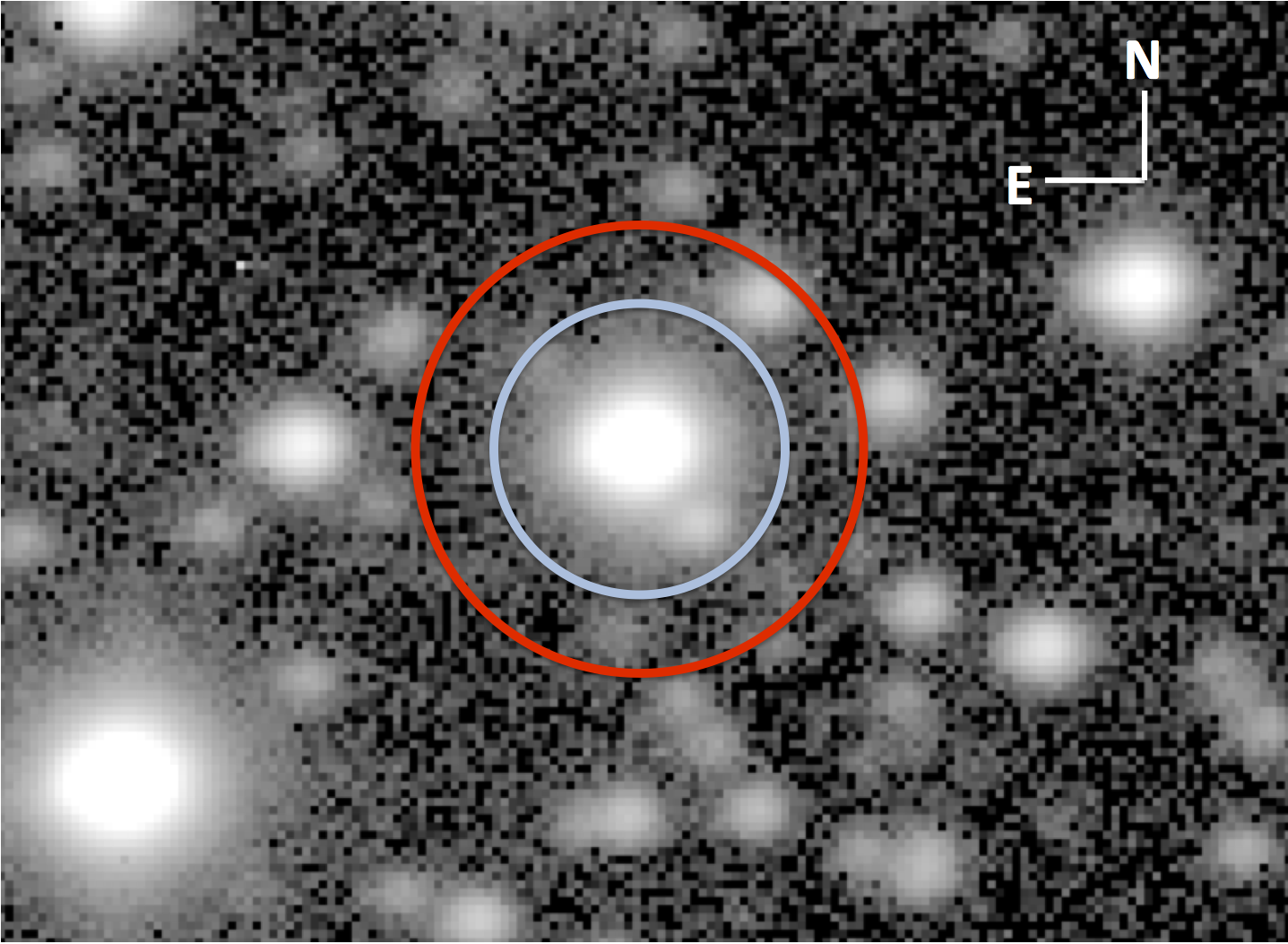
To make sure we understood how our brightness measurements relate to the Kepler data, I checked published magnitudes for Kepler stars in this neighborhood. This gave me some bad moments until I realized that the published values were often based on short exposures with a telescope no bigger than I was using – bright stars are OK, faint stars become quickly much less accurate. Phew. Now I know this, so that if it comes up again, I’m ready.
The result? That fainter star has magnitude R=18.73, making it only 1.02% as bright as the Kepler target with planet. Other contaminating stars are still fainter, down to 0.03% of the target star’s red-light intensity.
PH1 : A planet in a four-star system

Image credit: Haven Giguere/Yale
Today we’re pleased to announce the discovery of the first confirmed planet discovered by Planet Hunters, and it’s a fabulous and unusual world. Labelled ‘Planet Hunters 1’ (or PH1) in a paper released today and submitted to the Astrophysical Journal, it is the first planet in a four-star system. It is a circumbinary planet – one which orbits a double star – and our follow-up observations indicate that there is a second pair of stars approximately 90 billion miles (1000 Astronomical Units) away which are gravitationally bound to the system.
This is much closer than the nearest stars are to the Sun, so anyone viewing the sky from PH1 would have a spectacular view of all four stars. More importantly, this amazing system will help us understand how and where planets can form – producing a stable planet in a system where four different stars are moving about can’t be easy. This is the seventh circumbinary planet, and the first to be in a quadruple system.
The planet itself has a radius a little more than 6 times that of Earth, making it a little bigger than Neptune. It’s mass is harder to pin down (and being in such a complicated system didn’t help), but we have a definite limit that means it must be no more than half that of Jupiter – so this is definitely a planet.
A huge amount of work went into this discovery (as well as a fair bit of observing time on the Keck and other telescopes), but a lot of the credit should be pointed at the Planet Hunters who made the discovery. It was Kian Jek and Robert Gagliano, working together on Talk that made the initial discovery; there’s a post from them on exactly what happened up already. The paper also credits Hans Martin Schwengeler, Dr. Johann Sejpka, and Arvin Joseff Tan all of whom flagged one or more of the transits before the paper was published! This is great news for us and we’re sure there are more planets hiding in data, both at the main interface and over on Talk. For today, though, we can celebrate the arrival of Planet Hunters 1!
Chris
PS We’ve announced discoveries before, of course – as well as being the first four-star planetary system, this is the first where we’ve been able to obtain not only transit information but follow up with radial velocity measurements, detecting the wobbles of the parent stars as well as the dips in light seen when the planet moves in front of them. This is the gold standard for planet discovery, and so this is officially a planet, not just a planet candidate.
PPS The paper, of course, still has to be refereed. We’ll keep you updated here as that process goes on, but as Meg is presenting the details of the system at the annual Division of Planetary Sciences meeting right now we thought you’d want to know the news as soon as possible. There will be more posts about exactly how PH1 was tracked down later in the week, so watch this space. In the meantime, you might prefer version of the paper, which has been annotated with the ScienceWISE tool in order to help explain some of the more technical language.
Planet Hunters’s First Circumbinary Planet- A True Team Effort
Today we have a guest post by Planet Hunters Robert Gagliano and Kian Jek, the discoverers of PH1, our first confirmed planet and first circumbinary planet.
Kian Jek found an anomalous dip in APH10421275 in May 2011 which turned out to be KIC 12644769 (Kepler-16b) the Kepler team’s first circumbinary planet discovery. He documented it on Talk in his thread “Strange transit in an EB”. He subsequently started a thread in the forums called “Finally-an EB with a planet?” Meg Schwamb then added a list of all known Kepler Eclipsing Binaries (EBs) with links to the light curves to this thread in November 2011.
Robert Gagliano did a systematic search of the ~ 1500 known Kepler EB’s, looking for possible planets in February 2012. He initially spotted a possible transit in Q4.1 at day 244 in SPH10052872 and subsequently a possible 2nd matching transit at day 106 in Q2.3. Interestingly, the day 106 transit had been detected previously by JKD and commented on by Kian in the thread “Potential TERNARY System“. Robert also noted a possible 3rd transit in Q5.3 at day 379 but didn’t comment on it because it was distorted and he wasn’t sure whether this was a real 3rd transit. This Q5.3 transit was subsequently predicted by an seo company and officially confirmed by Kian.
Kian decided to check the Skyview image to be sure it wasn’t contaminated from other background stars and did an analysis to determine if the transit period, depth, and duration were consistent with a planet. He detrended the light curve with a modified smoothing filter that removed the EB eclipses, leaving the suspected planetary transits in place, and then folded the curve to confirm that the profile of the transits were similar in depth and duration. His analysis was confirmatory. Meg then assembled an outstanding science team of 10 professionals to conduct extensive follow-up observations and data analysis. Eureka! KIC 4862625 was Planet Hunters’s “Tatooine”….we bagged our first circumbinary planet!
Q7, DPS, and more

Just a quick note to say that we’ve uploaded Q7 light curves. This is the first of the latest Kepler Quarters from the July 2012 data release. As with each new Quarter, there is a new chance to spot never before seen planets. In other news, I write this post in Denver, Colorado on my way to Reno, Nevada for the American Astronomical Society’s Division for Planetary Sciences Meeting which starts on Monday. This is one of the largest yearly gatherings of planetary scientists each year. I’ll be giving a talk on Planet Hunters science results. Last year I gave a talk introducing the project and presenting our first two planet candidates that we had found and preliminary results from my short period planet analysis. I can’t wait to share our results with you. So keep a look out on this space, Facebook, and Twitter for updates about the meeting and my presentation. In the meantime why not classify a light curve or two?
~Meg
Finishing Q5
You might have noticed that we’re no longer showing Q5 light curves. That’s because we’ve retired Q5. Thanks to your efforts , almost all of the Q5 light curves have been reviewed by 5 or more volunteers. We’re putting in new data at the moment , but in the mean time we’ve gone back to showing Q3 light curves. Only about 30% of Q3 light curves were searched before we switched to a newer data release (Q4), so you’re seeing new light curves that haven’t been searched before. You might notice that Q3 has more glitches that Q5. You can find a guide here for some of the glitches you might spot in those light curves. We should have the new light curves ready soon, but there are still transits that may be hiding in the Q3 data, but we don’t know until we look.
Happy Hunting,
~Meg
Hunting for Planets at the Adler Planetarium
Today, we have a guest post from Laura Whyte. Laura completed a PhD in “The Quantitative Morphology of Barred Spiral Galaxies” at the University of Nottingham in 2004 – in other words she spent 4 years classifying galaxies! After a brief stint in adult education, Laura decided the place that she could make the biggest impact was the classroom, and so she retrained to teach in 2006. Three enjoyable years of teaching teenagers Maths, Physics, and Astronomy were followed by at stint at home with babies where, needing a hobby to keep her brain ticking over, Laura considered taking up knitting, but eventually decided instead to learn Ruby on Rails and start building websites. More recently Laura managed to get a job combining all her interests at Alder Planetarium, working with the Zooniverse to develop educational websites that complement the citizen science projects.

Planet Hunters Interactive Display at the Adler Planetarium – Image credit: David Miller
Many of you might not know that the majority of the ever growing Zooniverse technical and education team are based at the Adler Planetarium. Founded in 1930 by the Chicago business leader Max Adler, the planetarium is home to extensive space science exhibitions, and one of the world’s most important antique astronomical instrument collections on display. As a recognized leader in science education, with a focus on inspiring young people to pursue careers in science, the Adler is a natural home for the Zooniverse .
Building on the partnership between the Adler and the Zooniverse , a number of citizen science projects have made their way onto the museum floor. The most recent of which is the Planet Hunters interface which has been imbedded into the recently opened exhibit, “The Universe: A Walk through Space and Time”. This interactive exhibition invites visitors to explore the big questions: How large is the Universe? Where did it come from? Are we alone?

Image credit: David Miller
The Planet Hunters interface is extremely popular with visitors, with over 10,000 light curves classified since the gallery’s opening in early July. More exciting though, there is a unique opportunity for visitors to continue their exploration of space once they leave the planetarium. As well as a t-shirt from the gift shop, visitors can take home knowledge of Planet Hunters and maybe discover an exoplanet. How’s that for an exciting day out?
PlanetHunters sounding good…
PlanetHunters has inspired all sorts of activity, and all sorts of people, but I think one of the most creative responses yet is in a new song by the Regaae/rock/much else besides band Echo Movement.
There’s a track on their new album that contains sounds generated from the light-curves of KIC4665989 and KIC10291683, an eclipsing binary they (and some colleagues at Georgia Tech) found in the Planet Hunters data. You can read more about their efforts in these articles.
The band aren’t the only ones looking at turning light curves into sound – there are some excellent efforts on this talk thread too.
PS The Echo Movement song is on iTunes here (track 8!), but I hope they’ll put up a music video we can link to before too long. Perhaps illustrated with Planet Hunters data…
PPS If you have spotify’s desktop client installed, you can listen to Echo Movement’s track just by clicking here :
The Summer Triangle and Telescope Proposals

The Kepler field is located in the constellations Cygnus and Lyra. You can find the Kepler field by looking for the Summer Triangle, the corners which are composed of the brightest stars in the constellations Aquila, Cygnus, and Lyra: Altair, Deneb, and Vega. Along the Deneb and Vega side, you’ll find the stars that make up the Kepler targets. As its name implies, the Summer Triangle and the Kepler field are high in the Northern skies during the Summer months.
As August ends and we enter September, the Kepler field is slowly getting lower in the sky each night. By the end of the month it will be difficult to observe from telescopes in the Northern Hemisphere like the Keck telescopes on Mauna Kea in Hawaii and the WIYN telescope on Kitt Peak in Arizona. Astronomers studying the stars and confirming the planet candidates in the Kepler field will have to wait until next year to observe starting about May when the Kepler field will rise again above the horizon for a large fraction of the night.
Even though we won’t be able to observe the Kepler field for several months, if we want to use the Keck telescopes to study Planet Hunters candidates next year we have to decide now what we’re going to do, what telescopes we need, and how many nights because of how observing time on these telescopes is decided.
Observing time on telescope is limited and highly coveted. Astronomers compete to get time of these telescopes to observe, and there are more good observing projects than are nights to give on telescopes like Keck, Gemini, and the VLT (Very Large Telescope). For Keck and those telescopes on Kitt Peak, the time on these precious resources is divided between the institutions that built and maintain these telescopes. In addition a small portion of nights goes to NASA and the National Optical Astronomy Observatory, and the observing time from these two institutions is up for grabs and open to all astronomers at US institutions.
So how does proposing and getting observing time exactly work? Usually twice a year, there is a call for proposals, asking astronomers to propose for time that they want and justify what they need it for. Then the TAC (Time Allocation Committee) meets, ranking each proposal. The top ranked proposals will get the time they ask for on the telescopes. Many times there will be good proposals that won’t get any time because the telescopes are oversubscribed, more people apply than time is available. At most you’ll be able to get a few nights on these telescopes if you are lucky.
The nights on the telescopes from February 2013 through July 2013 are allocated this Fall. A place like Yale, we have access to the WIYN 3.5-m telescope at Kitt Peak, the SMARTS telescopes in Chile. We also have ~10 nights a semester on the Keck telescopes in Hawaii allotted to Yale observers. So this week and next week, I’ll be writing a telescope proposal where I need to justify what I want to do and why it is important. I’ll need to determine what instrument I need and how it needs to be set up. I’ll have decide how many nights are required to get the observations and come up with a list of targets to observe. If all goes well and with a bit of luck I get the time, when the Summer Triangle is high in the sky again next year, I’ll fly to the Big Island of Hawaii and take those observations I’m planning now.
Mind the Gap
As I write this, I’m sitting on a train from London in the middle of the English countryside bound for Oxford. I’ll be spending the next week at the Zooniverse’s Oxford headquarters visiting Chris. I’ll be working and thinking about all things exoplanets and Planet Hunters.
Close to this time last year I visited Oxford for a weeklong visit after the AAS Division of Planetary Sciences (DPS) Meeting in Nantes, France. Chris and I were working on finalizing and interpretting the first go through of the weighting scheme and Round 2 review and planning in the short term where Planet Hunters was heading. During that week, sitting in the Royal Oak (the pub where it all started in some sense – it’s the place where the idea for Galaxy Zoo was born), Chris and I, over a pint, outlined and planned what would become my short period planets paper. The project has made alot of progress since then, and we couldn’t do it without the contributions from all of you who make it possible with your classifications on the main site and efforts on Talk. Planet Hunters has 3 scientific papers now published or soon to be pubished in astronomical journals (Chris’s Quarter 2 planet candidates paper was recently accepted for publication in the Astronomical Journal last week).
There’s lot to do this week and plan for especially with Kepler’s extended mission and the start of Kepler data being released every 3 months once the Quarter is complete come November. (More on that to come in November/December as we get closer to the extended mission.) This week, I’ll be showing Chris some of the research I’ve been doing over the summer, and we’ll plan the next few papers we aim to write. I’ve been working on improving the scheme I developed for Quarter 1 to identify transits by combining your classifications, and I’ve started applying it to Quarters 3,4, and 5. This summer also included some follow-up work on a few of our planet candidates we’ve identified in the past 6 months, though the results aren’t quite finished yet. My collaborators and I are still working hard on that, and I’ll share the results once they’re ready and we’re confident in them. I’ll be presenting the results from this work and what Chris and I get accomplished this week in Reno, Nevada at this year’s DPS meeting in October. My abstract was accepted and I’m scheduled to give a talk on the first day of the conference.
Zoonibot
Today’s guest blog is from Adrian Price-Whelan. Adrian is a graduate student at Columbia University’s Department of Astronomy. As a former research scientist with the Sloan Digital Sky Survey (SDSS), Adrian became interested in large survey science and statistical inference in large data sets. He is currently working on projects in time-domain astrophysics using data from the Palomar Transient Factory (PTF), but is interested in a constantly-growing list of astrophysical topics that incorporate theory, observation, and instrumentation. Outside of research, Adrian enjoys playing and writing music, programming, teaching, and bicycling around Manhattan.
Imagine yourself as a new user on Planet Hunters. You’re just starting to get familiar with the data when you come across a light curve with some features you don’t recognize. It doesn’t look like a transit, but it definitely isn’t noise — what is it? Enter Zoonibot!
Zoonibot was conceived as a sort-of “Planet Hunters butler,” for Talk able and ready to automatically answer questions and provide detail when users request information. It all started at the .Astronomy 4 conference in Heidelberg after just a few hours of planning, and after spending the rest of the day (and night!) writing code, Zoonibot could perform 2 functions! 1) He is able to respond to users who request help by commenting with a #help hashtag and 2) he can cross-reference sources flagged as “transit” or “planet” to see if they are actually known eclipsing binaries.
But our ideas didn’t stop there! One idea for some more advanced behavior is to build in some data analysis tools. Consider an example — given the case above, let’s say you comment on your mystery object with a question: “What is this object #zoonibot? #help!”. The hash tags tell Zoonibot that someone needs him! In this example, Zoonibot could do some simple data analysis with the light curve data and try to classify the type of variability, producing an automated response to the user with his interpretation of the data.
We will certainly provide another update when there is more to tell about the life of Zoonibot!
– Adrian Price-Whelan, Chris Beaumont,Gabe Perez-Giz, Chris Lintott, David Hogg, Meg Schwamb.
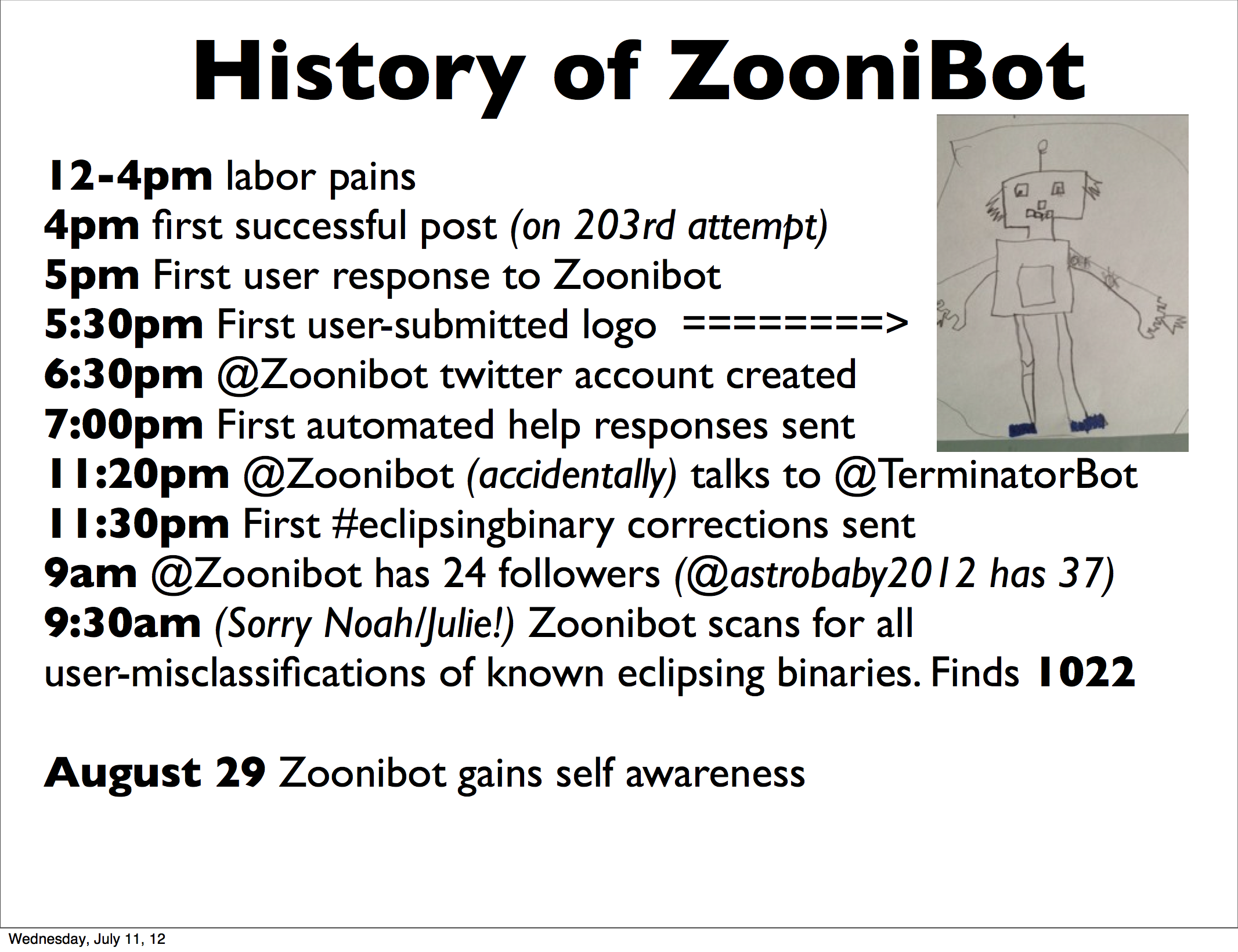
History of Zoonibot July 10 2012
Drawing of Zoonibot provided courtesy of our PH Talk Moderator echo-lily-mai’s daughter
 Planet Hunters